
Property owners
Talise de Culebra Landscaping
Enjoy more time outside in Talise de Culebra. Texas Allied Landscape can design your yard, prepare the review package and build the approved plan.
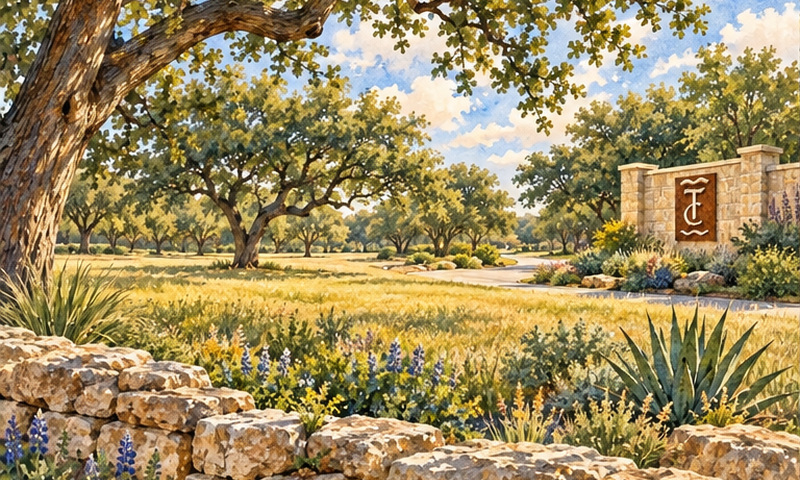
Get a quoteIllustration based on reference photos of Talise de Culebra. Not a single literal view.
On this page
Make your Talise de Culebra yard a place to relax. Gather and spend time outside. Texas Allied Landscape can bring plants and lawn into one plan. Irrigation and outdoor spaces fit too. We prepare the review package. We build the approved design. Start with your address, survey and ideas. The plan should fit your lot and your neighborhood's rules. It should fit the way you want to use your yard.
Know your neighborhood and your lot
Your deed, survey and plat help show which rules apply. Check them for your Talise de Culebra home. This guide covers the association in the recorded declaration and annexations. It also covers the October 2024 notice. Confirm coverage for your address before design.[1] [2] [3] [4] [5]
The October 2024 notice names several units. They are Units 1, 2, 3A, 3B and 3C, 5B and 6A. It also names two described acreage tracts. Those tracts may include land later platted under other unit names. This review has not mapped every later unit and lot into them. Check your recorded documents, especially if your unit is not named.[4]
The 2014 standards replace the original 2012 standards. The October 2024 notice lists the 2014 standards. It also lists the corrected 2018 enforcement policy. Ask management for the current application and standards. Check lot-specific requirements before buying materials. The public HOA pages reviewed had no newer separate ACC form. No newer separate plant list was found there either.[6] [4] [7] [8]
Prepare your plan and get approval
Get written Architectural Control Committee (ACC) approval first. This applies before putting in an improvement. It also applies before removing or changing its outside. This includes landscaping, clearing, grading, grubbing, planting and removal. The primary contractor, including a landscape contractor, also needs written ACC approval.[1]
Prepare the plan and confirm the submission route.
Get the current application through management or the homeowner portal. The plans must show exterior design, height, materials, color and location. Include a general landscape plan. Give the detail the ACC needs. Include your contractor information.[1] [8]
Track the two review steps.
The ACC has 30 days after receiving plans to ask for missing information. Otherwise the submission is treated as complete. It then has 30 days after a complete submission to disapprove the plans. If that second period passes without disapproval, the plans are deemed approved. Keep proof of delivery. Before work, ask for written confirmation of completeness and the decision.[1]
Build the approved design on time.
Complete the approved work within 180 days after approval. An exception applies if a written extension is approved before that period ends. Keep the approved plan and conditions with your contractor. Resolve the separate initial-landscape deadline below for a newly occupied home.[1] [6]
Start with your survey. Mark the house, property lines, work area, easements, drainage and street corners. Show what will be planted, removed, built or moved. Include plants, turf, mulch, rock, irrigation, lighting and yard features that apply to your project.
Some work needs an engineer-prepared plan and ACC approval. That covers grading and drainage changes. It also covers work that removes material from the property. Keep water routes and easements clear when placing beds, walls or paving.[6]
The public homeowner page points residents to the portal for documents and service tools. A current downloadable ACC form was not recovered in the earlier review. Confirm the submission route. An old email address may not count as a submission. An informal talk may not count either.[8]
Keep delivery records and requests for missing details. Save your responses and the final decision too. The review clock has two steps. Do not plan around a single 30-day period from your first contact. Ask the ACC to confirm the complete-submission date. Ask for the decision for your application too.[1]
You may appeal an ACC decision to the board. Ask for the current procedure if your request is denied. A variance must be in writing. An exception for another owner does not give your lot the same exception.[1] [6]
Confirm the first-landscape deadline
For a newly occupied home, the recorded deadlines conflict. The declaration says 60 days after occupancy. The restated standards say 90 days. The declaration gives itself priority when governing documents conflict. Get written HOA confirmation before relying on the longer period.[1] [6]
HOA review does not replace other lot checks. Check plat notes, permits and easement conditions.[1] [6] [2] [3] [5]
Fit the layout to your lot
Use the survey to plan planting, lawn, irrigation and outdoor spaces together. At street corners, check the specified 25-foot corner triangle. Keep landscaping over 3.5 feet tall out of it. Trees there need a foliage line high enough to preserve visibility. Show that area on the plan before placing tall shrubs or yard features.[6]
Keep traffic sight lines clear. Planting or materials that interfere with an easement need ACC approval. So do drainage-pattern changes. Landscape improvements in easements may be damaged during work. The declaration limits liability for that damage.[1]
Maintain and water the lot, including landscape and pedestrian easements. Aim downspouts to limit drainage onto adjoining property. Keep beds, trees, walls, edges and stored material clear of swales. Leave access routes and drainage facilities clear too.[6]
Plan fences, screens and yard features
Confirm the full fence specification and approved location for your lot. Do this before ordering. The 2014 standards cover six-foot cedar side and rear fencing. They cover masonry along collector and arterial streets too. They also cover which way wood pickets face. That applies toward streets, open space, recreation areas and parks. Street-facing wood fencing uses Sherwin-Williams Cedar Bark SW3511. The ACC may approve otherwise.[6]
The standards also cover masonry along streets that intersect a collector or arterial street. They address its minimum run and the front-setback limit. Use the 2014 restated standards for this check. The replaced 2012 standards had broader street-adjacency wording.[6]
Walls and hedges must meet the design standards. Specified planting or mass hedges in the street-front setback need ACC approval. Include living screens in your review request.[1]
Screen equipment with landscaping or fencing. Visible yard lighting needs ACC approval. It must not create an offensive or nuisance light source. Statues, fountains, multilevel planters and concrete features need prior approval in front or side yards. So do similar items there. Asphalt and loose-gravel driveways or sidewalks are prohibited.[6]
Choose plants, lawn and irrigation
Choose low-water plants and grasses. Use water-efficient irrigation, as the standards encourage. Submit a labeled plan for written approval. The text reviewed names no approved species or cultivar palette. The ACC decides how certain terms apply to a design. Those include native, drought resistant and wildscape. Those labels alone do not make a design approved.[6]
The front yard and street-facing side yard of a corner lot must be fully landscaped. Make every effort to preserve existing vegetation. Replace vegetation that dies, is destroyed or is removed. A low-water design still needs to meet the rules. That covers coverage, trees, sight lines, drainage and yard features.[6]
Get a written rock-coverage limit
The front-yard rock rule contains a recorded conflict: "No more than ten percent (25%)." The words and number disagree. Get a written percentage and decision for the area on your plan. Do this before choosing either number.[6]
This rule covers the front yard other than driveways, sidewalks and patios. It limits rock or other material besides dirt and vegetation. The ACC may approve otherwise. The front yard starts at the front property line. It ends at a line from the front of the home. That line extends to the side property lines. It is not a percentage of the whole lot.[6]
Check artificial vegetation and tree work
Artificial vegetation is prohibited in front and side yards. That restriction does not establish blanket backyard permission. Ask the ACC about the exact location and product. Do this before proposing artificial turf or plants elsewhere.[6]
Native mulch at least two inches deep is recommended. The recorded wording is "should." This is not a mandatory two-inch rule. Removing a tree more than six inches in diameter needs ACC approval. The rule leaves the measurement height unstated. Confirm how to measure your tree.[6]
For generic oak trees, the recorded care instructions call for minimal pruning in dormant months. Those are normally January and February. They also call for painting fresh cuts. They call for steps to prevent oak wilt and oak decline too. Get current advice from a qualified tree professional too. These care instructions do not approve a particular oak species.[6]
Traditional commercially produced pesticides, herbicides and fertilizers are allowed. The ACC prefers alternative, naturally occurring fertilizers and pesticides. Follow the other safety and legal requirements that apply.[6]
No plant cards are presented as approved choices. The recovered rules do not establish named species permissions. Texas Allied can develop a plant and irrigation plan for review.
Plan care, fees and enforcement
Mow, prune, water and control weeds. Care for curbs and gutters. Replace lost vegetation. Keep the yard maintained after installation. For a large repair or design change, ask whether you need a new application. Keep photos, plant labels, approved plans and written exceptions together.[1] [6]
Texas Allied can care for the finished yard with maintenance and plant care. We offer irrigation checks and repairs. Refreshes and later planting work are available too.
Confirm review costs
A fixed current landscape-application fee was not verified. A complex project may call for architect or engineer review. Reasonable review costs may be charged to the owner. Confirm the cost for your project before submitting. Routine review has not been verified as free.[1]
Watch notice and hearing deadlines
Under the corrected 2018 policy, courtesy letters are optional. Violation letters are optional too. Some violations can be cured and do not threaten public health or safety. For those, expect a mailed demand with a reasonable cure deadline. It must give notice of the right to ask for a hearing. The hearing request must be in writing. Send it within 30 days after the demand is mailed.[7]
Different procedures apply to some violations. They cover those classed as uncurable or public health or safety threats. They also cover repeat violations within six months. An informal warning is not assured for each violation. Neither is the same cure period or a fresh series of letters.[7]
Understand the recorded fine schedule
For curable violations, the 2018 schedule starts at $25 plus administrative costs. Each further same or substantially similar violation adds $25. For uncurable or health-and-safety violations, it lists $50, then $100. Later violations are $200. Administrative costs and possible loss of amenity access come on top.[7]
The board may impose a different fine or no fine and may change the schedule. These are the recorded 2018 amounts, not a guaranteed current quote. Current legal enforceability was not separately determined.[7]
Other remedies include legal costs and self-help. Suspension of common-area use and court action are also listed. Check the current policy and law as well as the older maintenance-notice clause. If you receive a notice, read its deadline. Request the current policy. Get qualified legal advice when needed. This guide does not decide a live violation or your legal rights.[1] [7]
Landscaping questions at Talise de Culebra
Can I design around a 25% rock allowance?
Get written clarification first. The recorded rule says "ten percent (25%)," so neither number is a clear allowance. Show the front-yard area on your plan and ask for the percentage and decision in writing.[6]
Does the review take just 30 days?
There are two steps. The ACC has 30 days after receiving plans to request missing details. Otherwise they are treated as complete. It then has 30 days after a complete submission to disapprove the plans. Plans are deemed approved if that second period passes without disapproval. Keep dated records and confirm your decision in writing before work.[1]
Does a native or low-water garden need approval?
Plan your Talise de Culebra landscape
Bring your address, survey and ideas. Texas Allied Landscape can check the requirements. We bring plants, lawn, irrigation and outdoor spaces into one design. We prepare and submit the review package. We build the approved plan and care for the finished yard.
Documents and limits of this guide
This rewrite preserves the earlier review, with sources read November 10, 2026. It is not a new records audit or a title search. It is not a promise that no newer rule exists. The full primary reading covered the 2012 declaration and three annexations. It covered the 2012 formation, bylaws and original standards filing. The 2014 restated standards and 2019 bylaw amendment were read too. Both 2018 enforcement filings were read. So were the October 2024 notice and attached bylaw amendment. The notice cross-references the declaration and all three annexations. It also names the 2014 standards and corrected enforcement policy.[1] [6] [2] [3] [4] [7] [9] [10] [5] [11]
Management certificates were read for identity, scope and management details. They were not read for plant rules. The newer October 2024 certificate was checked alongside the public HOA website. County searches were bounded. Not every result, lot plat and possible later instrument was reviewed. A few policy-adjacent index categories were not fully checked. The complete current ACC package and any newer unlocated rules remain gaps.[8] [12] [13] [14] [15]
The rock-percentage and installation-deadline conflicts remain open. Confirm current documents, fees and address-specific requirements before work. No named plant permission, guaranteed fee or numeric score has been added to fill a gap.
Community score card
Community profile
Talise de Culebra
Recorded rules require broad landscape review by one ACC. The rock-percentage typo, conflicting installation deadlines and missing current application need written clarification.
1 permissive5 protective
| Design latitude | — |
|---|---|
| Approval scope | 5/5 |
| Approval layers | 1/5 |
| Approval cost | — |
| Plan preparation | — |
| Enforcement capability | — |
Higher means more documented control or burden, not a better community.
Declaration, annexations, 2014 restated standards, corrected 2018 enforcement policy and October 2024 notice read November 10, 2026. Bounded county check; not a title search.
Design latitude
—
- 1
- 2
- 3
- 4
- 5
How much of the plant and design palette is prescribed. A higher score means less design freedom.
Why this score
The standards set yard, tree and artificial-vegetation limits but no named species palette. The rock cap has conflicting words and numerals, and a current separate ACC package remains unlocated. A complete palette rating is withheld.
Approval scope
5/5
Broad landscape review
- 1
- 2
- 3
- 4
- 5 (this score)
How much exterior work needs written sign-off.
Why this score
The declaration requires written ACC approval before an improvement is erected, removed or externally altered. Its definition includes landscaping, clearing, grading, planting and removal, and the primary landscape contractor also needs written approval.
Approval layers
1/5
One required reviewer
- 1 (this score)
- 2
- 3
- 4
- 5
Counts distinct required community reviewers only. City, county and state permits, optional steps and repeat submissions are not counted.
Why this score
The reviewed governing chain names the ACC as the required community reviewer. A Board appeal is optional and is not counted as a second required layer. City, county and state approvals are outside this count.
Approval cost
—
- 1
- 2
- 3
- 4
- 5
What the community's own approval process costs to apply.
Why this score
The declaration permits reasonable architect or engineer review costs when complexity warrants. A fixed current landscape-application fee or deposit was not verified, so unknown is not rated as free.
Plan preparation
—
- 1
- 2
- 3
- 4
- 5
How much drawing and documentation an application needs.
Why this score
The declaration requires written plans showing exterior design, materials, location and a general landscape plan in ACC-required detail. Drainage work adds an engineer requirement. The complete current application package remains unlocated, so no universal preparation rating is assigned.
Enforcement capability
—
- 1
- 2
- 3
- 4
- 5
Which remedies the verified governing documents and adopted policies provide. The score reflects verified documented provisions, not observed enforcement practice or legal conclusions. Not finding an express clause is not a conclusion that no authority exists.
The scores keep the earlier review's findings. High scores mean more documented control or burden, not a better community. Unverified axes remain unscored. One required ACC reviewer is counted. An optional board appeal is not an extra required community layer. Outside permits are not extra required community layers either.[1]
Sources
- Declaration of Covenants, Conditions and Restrictions, 20120189022 , September 27, 2012. All 19 county pages read. See B.3; C.2(o), (s); D.1, D.2; F.1-F.2; G.9; J.5. Read November 10, 2026.https://bexar.tx.publicsearch.us/doc/12282984abcdefghijklmnopqr
- Annexation, 20130154109 , all seven pages. Applies the declaration to the described 79.840 acres. Read November 10, 2026.https://bexar.tx.publicsearch.us/doc/12657529abc
- Annexation, 20140155612 , all eight pages. Covers the described 60.118 acres and applies the governing documents. Read November 10, 2026.https://bexar.tx.publicsearch.us/doc/12857301abc
- Notice of Dedicatory Instruments and bylaw amendment, 20240195549 , October 23, 2024. All six pages read. Lists the core governing documents; attached amendment changes member quorum and reconvening procedure, not the landscape standards. Read November 10, 2026.https://bexar.tx.publicsearch.us/doc/224302049abcd
- Unit 2 annexation, 20140074997 , all four pages. Applies the declaration to the described Unit 2 land, plat Volume 9667, pages 68-70. Read November 10, 2026.https://bexar.tx.publicsearch.us/doc/12817188abc
- Restated Design Standards, 20140163017 , September 22, 2014. All 15 county pages read. Replaces 2012 Exhibit C; see standards 1, 4, 5, 11-14, 17 and 18. Original pages checked for the rock-percentage typo and landscape provisions. Read November 10, 2026.https://bexar.tx.publicsearch.us/doc/12865956abcdefghijklmnopqrstuvw
- Corrected Governing Documents Enforcement and Fine Policy, 20180225766 , November 16, 2018. All ten pages read, including Exhibit A. Rerecords instrument 20180216539 with the omitted fine exhibit attached. See sections 2-6 and Exhibit A. Read November 10, 2026. Current statutory enforceability was not separately determined.https://bexar.tx.publicsearch.us/doc/16741833abcdefg
- Official homeowner resources , checked November 10, 2026. Public pages offer portal and management resources; a separate current downloadable ACC package was not recovered. This is not a claim that no such package exists.https://www.talisedeculebra.com/homeownerabcd
- Certificate of Secretary, formation, bylaws and original Design Standards, 20120208006 , all 34 pages read. The original standards are superseded by the 2014 restatement. Read November 10, 2026.https://bexar.tx.publicsearch.us/doc/12281355↑
- First Amendment to Bylaws, 20190114642 , all four pages read. Changes quorum and bylaw-amendment provisions, not the landscape palette. Read November 10, 2026.https://bexar.tx.publicsearch.us/doc/20565492↑
- Original enforcement policy filing, 20180216539 , all seven pages read. The later corrected filing supplies the omitted fine schedule. Read November 10, 2026.https://bexar.tx.publicsearch.us/doc/16730926↑
- October 2024 management certificate, 20240179843 , all five pages read. Administrative identity and scope evidence, not a source of plant permission. Read November 10, 2026.https://bexar.tx.publicsearch.us/doc/223444804↑
- Official Talise de Culebra HOA website , checked November 10, 2026. Public-site identity and resource check, not proof of a complete current rule package.https://www.talisedeculebra.com/↑
- 2012 management certificate, 20120208016 , all three pages read. Historical administrative evidence, not plant permission. Read November 10, 2026.https://bexar.tx.publicsearch.us/doc/12276159↑
- 2013 management certificate amendment, 20130058277 , both pages read. Historical administrative evidence, not plant permission. Read November 10, 2026.https://bexar.tx.publicsearch.us/doc/12598179↑