
Property owners
The Arbor at Sonoma Ranch Landscaping
Enjoy a Helotes setting, community pool days and a yard made for time outside. Texas Allied Landscape helps plan planting, shade and irrigation around your Arbor home.
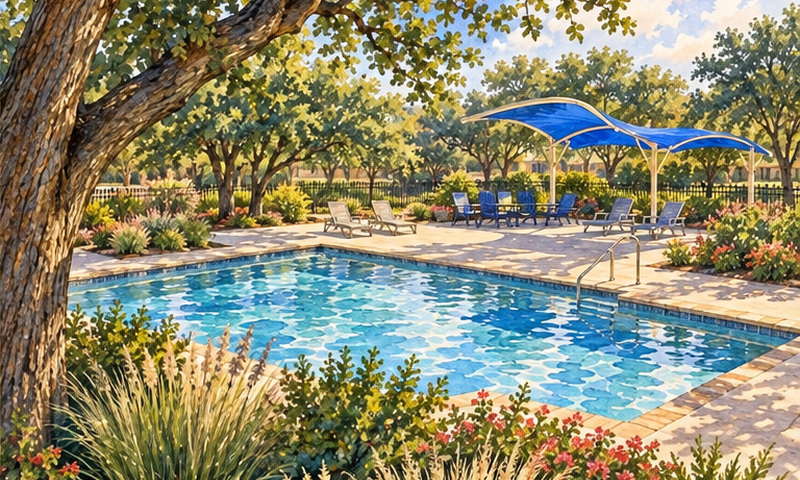
Get a quoteIllustration based on reference photos of The Arbor at Sonoma Ranch. Not a single literal view.
On this page
The Arbor at Sonoma Ranch brings a community pool to everyday life.[1][2] It adds a Helotes setting. Your yard can add a place to unwind. Gather with friends and enjoy planting close to home. Texas Allied Landscape helps plan the shade, planting and irrigation around your lot. We guide the review steps and design details. Your ideas can grow into an outdoor space you enjoy caring for and using.
Plan, submit, review, then install
Landscaping readily visible from the street needs written Architectural Control Committee (ACC) approval. That applies before placement or a change. Replacing or treating an item can also fall under review. That happens when the work materially changes its outside appearance.[3]
Prepare a complete plan.
Show the work area, plants, materials, colors and changes to ground level. Send the whole package together. The recorded rules call for duplicate plans. The ACC may ask for a preliminary landscape plan. It may also want a cross-section of existing and proposed grades. Ask which digital files the current application needs.[3][4]
Track the right review clock.
For ordinary plans, the ACC has 30 days to act. It can approve, deny or reject inadequate plans. If it does none of those, the recorded clause presumes approval. A variance request is denied after 30 days of silence. Keep proof of the complete submission. Confirm how the rule applies before relying on silence.[3]
Install and care for the approved work.
Follow the reviewed design. Confirm project-specific start and finish dates in the approval. Keep vegetation mowed. Remove dead trees, shrubs, vines and plants promptly. Then replace them with plants of equal quality or value.[3]
The manager's public instructions allow three business days to process a request. That step loads it into the homeowner account. An email then confirms that the request has gone to committee review. It also gives a decision timeline. Track that loading step separately from the recorded 30-day rule.[4]
Fit lawn and rock to the yard
Plan the initial sod
Front, rear and side yards must be sodded quickly. The deadline is three months after the house is occupied. After that, keep grass or landscaping neat and well mowed. Keep it free of unsightly weeds or overgrowth. A permanent lawn percentage is not stated in this initial sod clause.[3][5][6][7][8][9][10][11][12]
Measure rock across the front and sides together
Decorative ground-cover rock may replace grass in the front and side yards. The limit is 10% of their combined area. Add the front and side areas together when working out that limit. The clause's stated area covers those yards. It sets no backyard rock limit.[3][5][6][7][8][9][10][11][12]
Current Arbor rules for a xeriscape palette remain unverified in the sources reviewed. So do rules for synthetic turf, rainwater storage and drought-stage protections. Have the current conversion requirements checked before ordering materials. State and local requirements also need their own check.
Keep street views and drainage clear
- Street corners: keep fences, walls, hedges and shrubs from blocking sight lines. The triangle measures 25 feet along intersecting street property lines. Use the extended street lines at rounded corners.[3]
- Driveways and alleys: the same sight-line limits apply within 10 feet of a key point. That point is where a street property line meets the edge of driveway or alley pavement. Keep tree foliage high enough to leave views clear.[3]
- Easements: keep plants, structures and materials from damaging or blocking utilities. Protect water flow in drainage easements. Check the plat and survey before planting or changing grades.[3]
Choose plants and care for protected trees
Get written ACC approval before removing an oak, elm or pecan larger than 18 inches in diameter. Have the measurement method confirmed. The clause leaves the trunk-measurement height unstated. Check other applicable review rules before removing smaller trees too.[3][5][6][7][8][9][10][11][12]
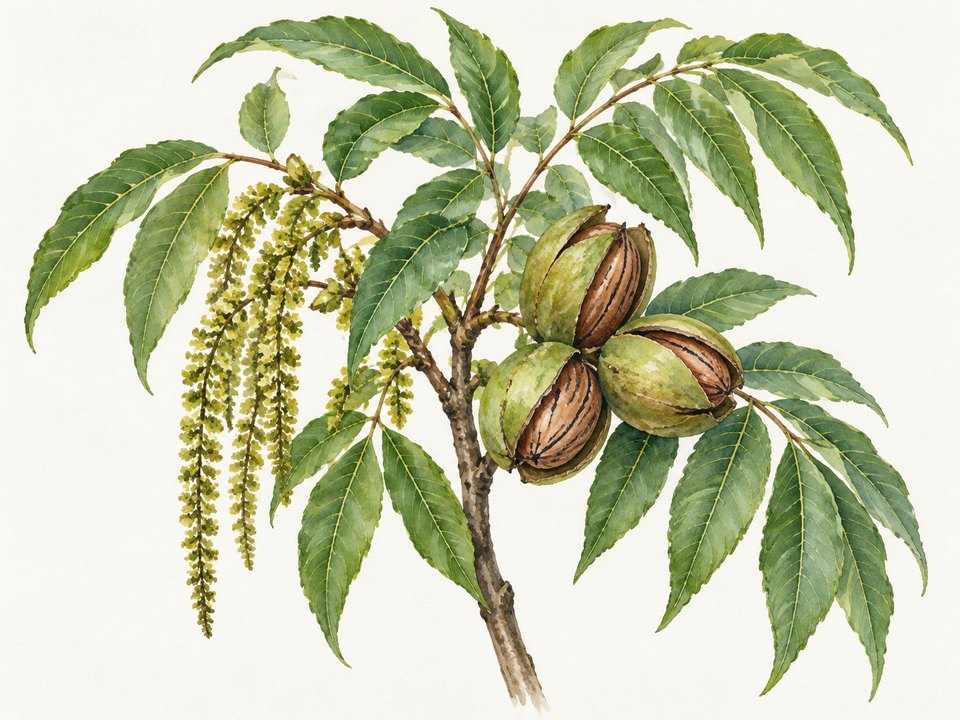
Oak, elm and pecan are broad tree names in the removal rule. An approved species or cultivar list was not found. The yard rules reviewed do not include one. Choose exact plants for the application. Have the proposed plan reviewed. The broad oak and elm groups stay in the written rule. They are not narrowed to an invented species list.
 Illustration
PecanCarya illinoinensisIllustration
Keep all trees when installing a flagpole. That separate condition applies alongside the tree-removal rule.[13]
Plan fence stain before buying it
Apply to the ACC before staining. Use a permitted finish, applied evenly without blotching. Red, maroon, red-tinted and opaque stains are prohibited. Paint is prohibited too. Approvals granted before the 2005 stain resolution are grandfathered.[14]
That resolution names Sherwin Williams Cuprinol natural cedar stain. It also names Behr semi-transparent natural cedar stain. Both still need an application. A sample is waived for those two choices. Other stains need a sample with the application. Have today's product label and finish confirmed. Do this before buying a historic named product.[14]
Check costs and yard-care responsibilities
An Arbor landscape-review fee remains unverified. Some associations require fees, deposits or extra forms. Confirm the charge for this project before submitting.[4]
The association or an owner may seek enforcement through legal proceedings. Legal action can also be used to prevent violations or recover damages.[3][15]
For a lot without a home, the maintenance clause allows the developer or association to act. They can cut vegetation, remove dead plants or remove prohibited construction refuse. They recover the costs from the owner. That entry provision has the stated vacant-lot scope.[3][15]
A current landscape-fine schedule remains unverified. So do repeat-fine amounts, daily charges, caps and the inspection schedule. Fences, outbuildings, parking and storage have shared rules outside this landscape profile. So do signs, solar equipment, flagpoles and pool use.[3][13][1][16]
Arbor landscape questions
Planning your yard
How much decorative rock can go in the front and side yards?
Up to 10% of the combined front-and-side-yard area. Add those areas together. Show the proposed rock on the plan. Check the review requirement before work starts.[3]
Does silence mean my plan is approved?
Ordinary plans and variances have different 30-day rules. Ordinary plans may be presumed approved only under the recorded clause's conditions. A variance is denied after 30 days of silence. Keep a complete dated submission. Confirm how the rule applies to your request.[3]
Plan your Arbor yard
Bring your unit, survey and ideas for time outside. Texas Allied Landscape helps turn them into a planting, materials and irrigation plan. We prepare the review details. Then we build around the approved work. We check the lot conditions early. That way you can enjoy the design process and the finished yard.
Sources and lot coverage
The base declaration and operative use restrictions were read. So were the annexations for all 13 units. For Units 8 and 9, this guide uses the corrected declaration. That version replaces the original. The bylaws/fence-stain packet and the 2011 rules were also read. So were the 2014 bylaw amendment, the later pool rules and the August 2026 management certificate. County index results were checked on November 10, 2026. The search is certified through November 5. This is not an exhaustive title search. Current community-only application fields remain checks for the proposed project. So do later unlocated guidelines, exact fees and lot-specific easements.[3][17][18][19][5][6][7][8][9][10][11][12][13][14][1][16][20]
A 2021 amendment involving the Arbor association applies elsewhere. It covers a separate 34.263-acre multifamily development tract. Its 30-foot buffer and tree provisions are not applied here. They are not rules for residents' yards. A neighboring Steubing Ranch declaration also appeared in the name search. Its title confirms it is not an Arbor yard rule.[21][22]
Your community profile
Community profile
The Arbor at Sonoma Ranch
1 permissive5 protective
| Design latitude | — |
|---|---|
| Approval scope | 3/5 |
| Approval layers | — |
| Approval cost | — |
| Plan preparation | 3/5 |
| Enforcement capability | 3/5 |
Higher means more documented control or burden, not a better community.
Operative use restrictions and annexations for Units 1-13 read. County index sweep November 10, 2026, certified through November 5. Current community-only application fields, fees and later unlocated guidelines remain unverified; affected axes stay unscored.
Design latitude
—
- 1
- 2
- 3
- 4
- 5
How much of the plant and design palette is prescribed. A higher score means less design freedom.
Why this score
The reviewed rules limit front-and-side decorative rock, initial sod, tree removal and street-visible changes. A separate current community design guide or planting palette has not been recovered, so the full option space is not scored.
Approval scope
3/5
- 1
- 2
- 3 (this score)
- 4
- 5
How much exterior work needs written sign-off.
Why this score
Prior written ACC approval covers landscaping readily visible from the street and changes that materially alter an item's exterior appearance. The rules also require written approval to remove oak, elm or pecan trees larger than 18 inches in diameter. This is broader than structures alone, but it is not treated as an explicit requirement for every hidden-yard planting or irrigation task.
Approval layers
—
- 1
- 2
- 3
- 4
- 5
Counts distinct required community reviewers only. City, county and state permits, optional steps and repeat submissions are not counted.
Why this score
The operative unit texts identify an ACC, and Spectrum administers submissions. A current community-specific process confirming every required reviewer has not been recovered. Manager processing is not invented as a separate approval layer.
Approval cost
—
- 1
- 2
- 3
- 4
- 5
What the community's own approval process costs to apply.
Why this score
Spectrum says some associations require review fees, deposits or extra forms. An Arbor landscape-review charge has not been verified. Transfer and resale-package fees in the management certificate are not landscape-review fees.
Plan preparation
3/5
- 1
- 2
- 3 (this score)
- 4
- 5
How much drawing and documentation an application needs.
Why this score
The recorded rules require complete plans and specifications in duplicate, not piecemeal submissions. The ACC may request a preliminary landscape plan and a cross-section showing existing and proposed grades. This is a documented plan package; no professional-designer requirement is inferred.
Enforcement capability
3/5
- 1
- 2
- 3 (this score)
- 4
- 5
Which remedies the verified governing documents and adopted policies provide. The score reflects verified documented provisions, not observed enforcement practice or legal conclusions. Not finding an express clause is not a conclusion that no authority exists.
Why this score
The recorded policy sets a 10-day courtesy notice, then an intent to fine $50, then $50 fines that may recur every 15 days while unresolved; uncurable violations draw an applied $50 plus $50 per 15-day cycle, with attorney escalation and a lien if unpaid.
This guide covers The Arbor at Sonoma Ranch Homeowners Association, Inc. and Sonoma Ranch II Units 1-13. Unit 10 was marketed as The Retreat at Sonoma Ranch. Its recorded annexation places it under the Arbor association. Match the address and unit before using these rules for a project.[3][15][17][18][19]
Sources
- 2024 pool-rules filing .https://bexar.tx.publicsearch.us/doc/195506505abc
- The Arbor at Sonoma Ranch pool shade project . Contractor describes the community pool project in Helotes, completed spring 2019. Used for setting and community-pool context alongside the 2024 pool filing, not current hours or access promises. Read November 11, 2026.https://shadepro.com/the-arbor-at-sonoma-ranch/↑
- Units 1-2 use restrictions, Articles II, VI, IX, XI and XXIV, PDF pp. 2-8 and 11 .https://bexar.tx.publicsearch.us/doc/6304986abcdefghijklmnopqrs
- Spectrum's current property-improvement instructions and application route , read November 10, 2026. These are manager-wide instructions, not a separate Arbor design guide.https://spectrumam.com/homeowners/property-improvement/abcd
- Unit 3 . All pages read; landscape maintenance is in Article XI.https://bexar.tx.publicsearch.us/doc/6505519abcd
- Unit 4 . All pages read; landscape maintenance is in Article XI.https://bexar.tx.publicsearch.us/doc/6935619abcd
- Units 5-7 . All pages read; landscape maintenance is in Article XI.https://bexar.tx.publicsearch.us/doc/6565209abcd
- corrected Units 8-9 . All pages read; landscape maintenance is in Article XI.https://bexar.tx.publicsearch.us/doc/10006072abcd
- Unit 10 . All pages read; landscape maintenance is in Article XI.https://bexar.tx.publicsearch.us/doc/8120872abcd
- Unit 11 . All pages read; landscape maintenance is in Article XI.https://bexar.tx.publicsearch.us/doc/8213855abcd
- Unit 12 . All pages read; landscape maintenance is in Article XI.https://bexar.tx.publicsearch.us/doc/8281333abcd
- Unit 13 . All pages read; landscape maintenance is in Article XI.https://bexar.tx.publicsearch.us/doc/8281214abcd
- 2011 adopted rules, flags and solar equipment, PDF pp. 2-4 .https://bexar.tx.publicsearch.us/doc/12452790abcd
- Recorded bylaws and fence-stain resolution, resolution at PDF p. 26 .https://bexar.tx.publicsearch.us/doc/8434308abc
- Base declaration, including enforcement, PDF p. 6 .https://bexar.tx.publicsearch.us/doc/6800832abc
- earlier 2021 pool-rules filing .https://bexar.tx.publicsearch.us/doc/96421840ab
- Unit 10 annexation to the Arbor association .https://bexar.tx.publicsearch.us/doc/8097270ab
- Unit 10 use restrictions, recorded as The Retreat at Sonoma Ranch .https://bexar.tx.publicsearch.us/doc/8120872ab
- August 2026 management certificate identifying the association and unit chain .https://bexar.tx.publicsearch.us/doc/330514254ab
- 2014 bylaw amendment, meeting quorum .https://bexar.tx.publicsearch.us/doc/12760361↑
- 2021 amendment for the separate multifamily development tract, especially PDF pp. 1-2 and 13-16 .https://bexar.tx.publicsearch.us/doc/104273353↑
- Steubing Ranch Unit 11 use restrictions, title and property scope at PDF p. 1 .https://bexar.tx.publicsearch.us/doc/8282093↑