
Property owners
Bicolor Iris
- Plant
- Bicolor Iris
- Botanical name
- Dietes bicolor
- Group
- Medium shrubs and perennials
Bicolor Iris (Dietes bicolor): light, water, soil, size and care for San Antonio area landscapes.
On this page
Botanical name: Dietes bicolor.
Light
Soil and drainage
Adaptable with reasonable drainage; tolerates intermittent moisture.
Height
4 ft.
Spread
2-3 ft.
Foliage
Evergreen in mild winters; rated to zone 8b (15-20F) and freezes to the ground in harder Austin winters, resprouting in spring.[3]
Water
Low water. If watering ever feels like a guessing game, our horticulturists can care for your Bicolor Iris on a schedule that fits your yard.
Pruning
Occasional grooming to remove spent foliage; clumps can be divided with a shovel.
Seasonal behavior
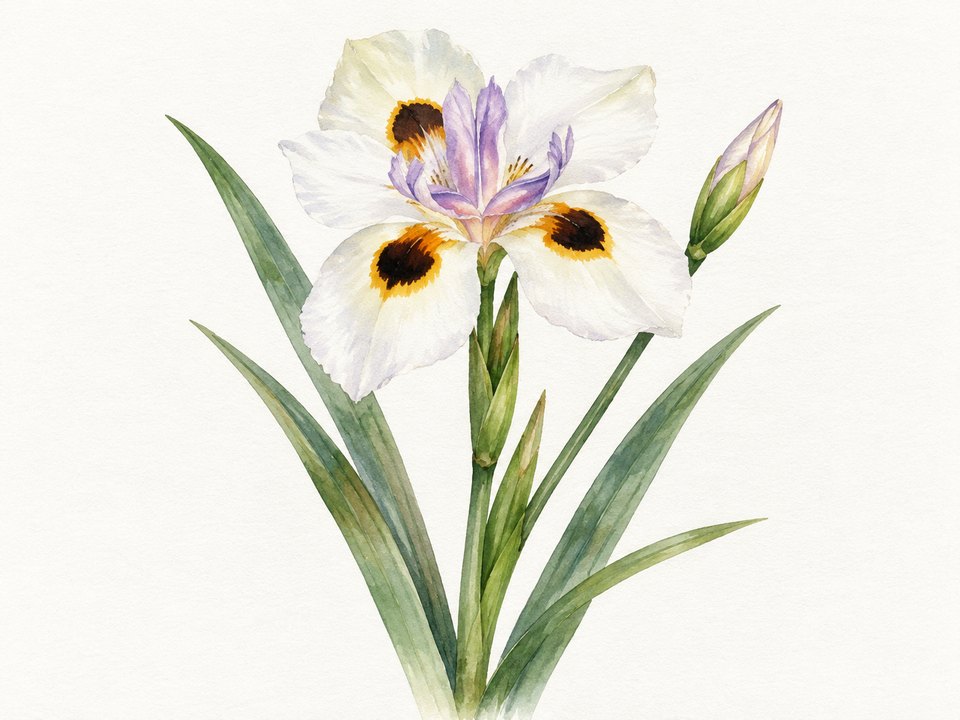
Yellowish one-day blooms in recurring flushes; self-sowing; butterfly iris is similar with wider leaves.
Why did my bicolor iris freeze to the ground?
Dietes bicolor is rated to zone 8b (15-20F) and froze to the ground across Austin in a hard winter, with plants resprouting new greenery. Freeze-back alone is expected behavior, not necessarily death.
When to Plant Bicolor Iris
Plant Bicolor Iris in fall or early spring in Central Texas. A fall planting establishes roots through the cool season and is ready to grow and bloom the following year; spring planting works too if you water through the first summer.[4]
If you would like a hand, the Texas Allied Landscape team can plant your Bicolor Iris and keep it thriving.
Planting
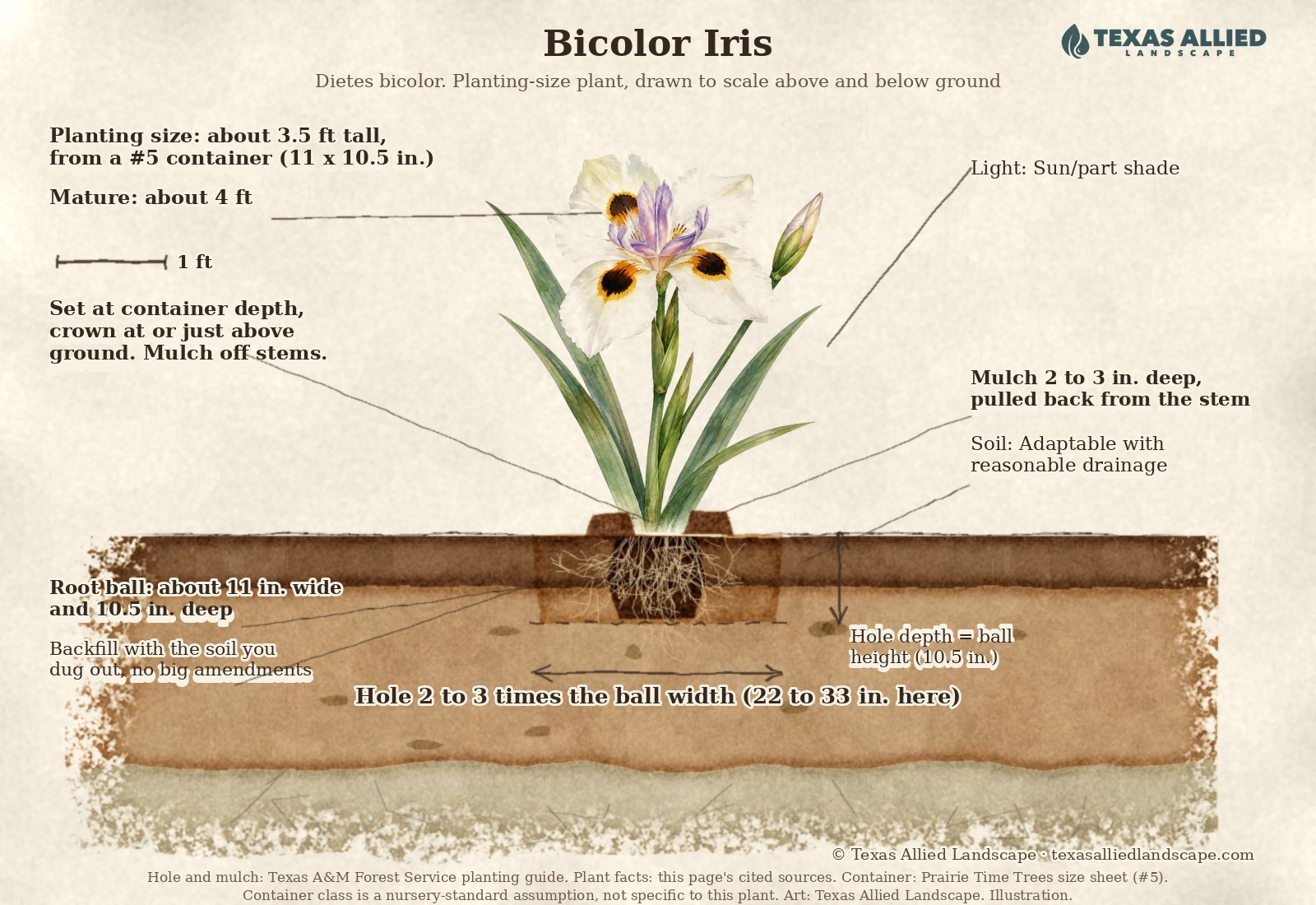
- Dig a hole twice as wide as the pot and no deeper, with sloping sides, and set the plant at the same depth it grew in its pot. Loosen any circling roots before backfilling.[5]
- For a new bed, clear grass and weeds first, roots and all.[5]
- Site: Sun/part shade.[1][2]
- Timing: A fall planting establishes roots through the cool season and is ready to grow and bloom the following year; spring planting works too if you water through the first summer.[4]
- Soak it well at planting and keep watering while the roots establish.[5]
- Mulch 2 to 4 inches, kept a few inches away from the stems to prevent crown rot. It needs no staking or other support.[5]
Care Instructions for Your Bicolor Iris
How to Water a Bicolor Iris
Low water.
Sunlight
Soil and drainage
Adaptable with reasonable drainage; tolerates intermittent moisture.
Mature height and spread
4 ft. 2-3 ft.
Pruning
Occasional grooming to remove spent foliage; clumps can be divided with a shovel.
Normal seasonal behavior
Yellowish one-day blooms in recurring flushes; self-sowing; butterfly iris is similar with wider leaves.
Bicolor iris questions
Will bicolor iris survive a Texas freeze?
It is borderline-hardy here: mild winters leave it evergreen, but a hard freeze burns the foliage and can kill plants in exposed spots. Trim off burned leaves in spring; established clumps usually recover.[6]
Why won't my bicolor iris bloom?
Not enough sun or too much kindness: it blooms best with at least half a day of sun and lean soil. Heavy feeding grows leaves, not the white-and-yellow flowers.[7]
How do I divide bicolor iris?
Every few years in fall or early spring, lift the clump, pull apart the rhizomes, and replant fans a few inches apart. Division recharges blooming.[8]
Next step: Our horticulturalists can divide an overgrown clump and spread it through the bed in one visit.
Is bicolor iris drought tolerant?
Moderately - it takes dry spells once established but looks and blooms best with weekly deep watering in summer. It is tougher than it looks.[9]
Let Texas Allied Landscape care for your Bicolor Iris
Bicolor Iris does best with steady, knowledgeable care: the right water, pruning at the right time, and a trained eye for stress. The horticulturists at Texas Allied Landscape care for plants like yours across the San Antonio area, backed by over 40 years of landscape experience.
In these community guides
- Art in progress
Homestead Landscaping
Share your Homestead address, survey and yard ideas with Texas Allied Landscape. We help prepare a clear plan for…
Sources
- Iris, Bicolor, City of Austin Watershed Protection - Grow Green.https://www.austintexas.gov/watershed-protection/plant-guide/iris-bicolorabc
- Bicolor Iris, San Antonio Water System - Garden Style San Antonio.https://www.gardenstylesanantonio.com/plants/bicolor-iris/abc
- Dietes bicolor (Bicolor Iris) winter-hardiness in Austin, Lady Bird Johnson Wildflower Center.https://www.wildflower.org/expert/show.php?id=5111↑
- October Gardening Checklist, Travis County AgriLife Extension.https://travis-tx.tamu.edu/about-2/horticulture/monthly-gardening-calendar-for-austin-area/october-gardening-checklist-for-austin-and-central-texas/ab
- Back to basics: Planting perennials, SAWS Garden Style San Antonio.https://www.gardenstylesanantonio.com/garden-articles/back-to-basics-planting-perennials/abcd
- Central Texas Gardener, "Butterfly Iris."https://centraltexasgardener.org/resource/butterfly-iris/↑
- Lady Bird Johnson Wildflower Center, Ask Mr. Smarty Plants on Dietes.https://www.wildflower.org/expert/show.php?id=5111↑
- University of Florida IFAS, "Dietes bicolor: Evergreen Iris."https://ask.ifas.ufl.edu/publication/FP178/pdf↑
- Mortellaros Nursery, "Dietes bicolor."https://www.mortellaros.com/plant-name/Moraea-bicolor↑