
Property owners
Coralbean
- Plant
- Coralbean
- Botanical name
- Erythrina herbacea
- Group
- Large shrubs
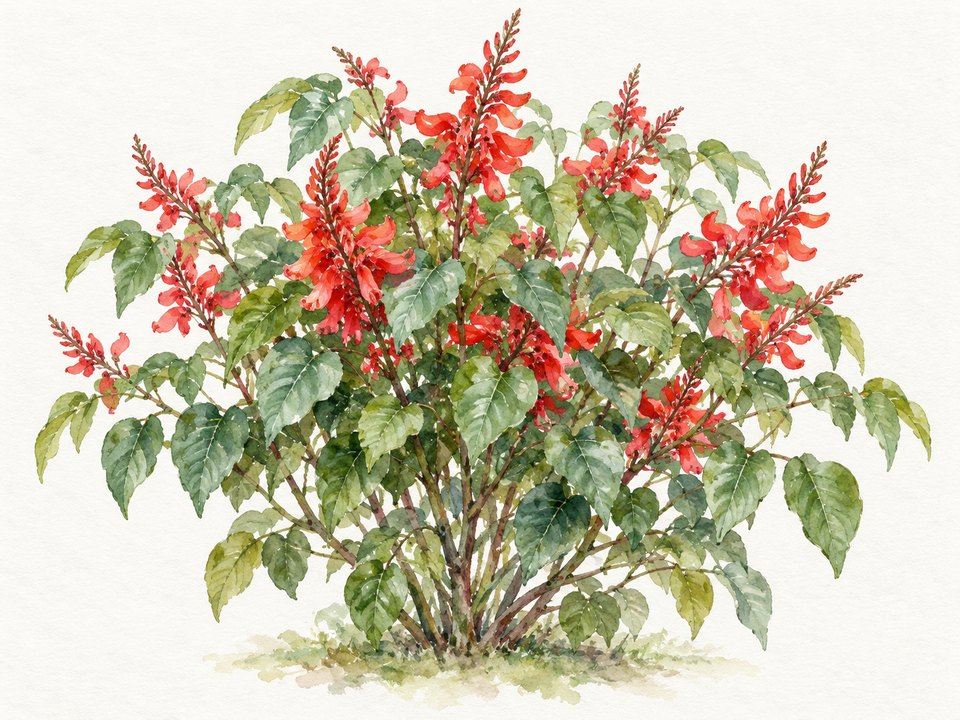
Coralbean (Erythrina herbacea): light, water, soil, size and care for San Antonio area landscapes.
On this page
Botanical name: Erythrina herbacea.
Light
Sun or partial shade.[1]
Soil and drainage
Sand, loam and clay textures and dry soil moisture.
Height
About 6 feet where it dies back annually and up to about 25 feet in climates without annual dieback. Do not apply tropical tree size as a local guarantee.
Foliage
Deciduous; another source says leaves fall in winter.
Water
Medium Water, not the supplied Low category. If watering ever feels like a guessing game, our horticulturists can care for your Coralbean on a schedule that fits your yard.
Pruning
Trim dead tips after new growth emerges in spring, when frost damage is evident.
Seasonal behavior
Deciduous; top often freezes back in winter. Scarlet flowers and red seeds follow; seeds are highly toxic if ingested. Removing pods does not establish that all risk is eliminated.
Does removing coralbean seed pods make the plant risk-free?
No. Another source warns that its red seeds are highly toxic if eaten, with children especially vulnerable. Do not treat pod removal as proof that all exposure risk is eliminated.
When can I tell which coralbean stems were damaged by winter?
Trimming dead stem tips after new growth emerges in spring, when frost damage is evident. It notes that top growth often freezes back. This does not support an automatic February ground cut or guaranteed recovery of a particular plant.
When to Plant Coralbean
Coralbean is frost-tender, so plant it in spring after the last frost, around mid-March in San Antonio. It needs warm months ahead to establish, and it often dies back to the roots in winter.
If you would like a hand, the Texas Allied Landscape team can plant your Coralbean and keep it thriving.
Planting
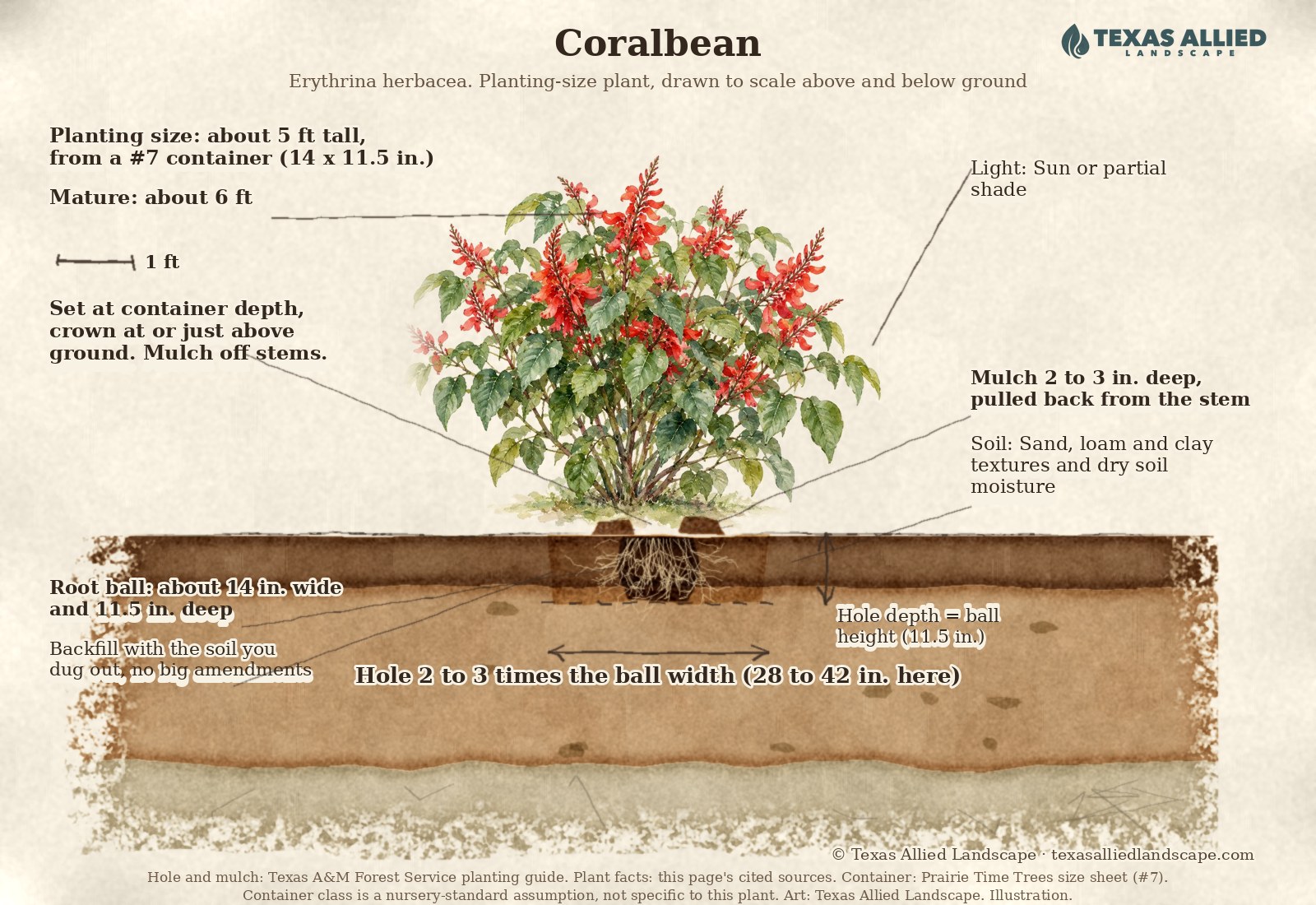
- Dig a hole at least twice as wide as the root ball and no deeper, so the roots can grow out into the surrounding soil.[2]
- Fill the empty hole with water and check the drainage. If it takes longer than 24 hours to drain, choose another spot: roots sitting under water will kill the plant.[2]
- Set it with the root collar (where the stems meet the roots) level with the ground, and take off the container and any twine or bags before backfilling.[2]
- Backfill with the same soil that came out of the hole, without amendments, and settle it with water rather than packing it down.[2]
- Site: Sun or partial shade.[1]
- Timing: Coralbean is frost-tender, so plant it in spring after the last frost, around mid-March in San Antonio.
- Water regularly through the first growing season while roots establish, without overwatering: a thorough soaking beats light, frequent watering.[2]
- Mulch 2 to 3 inches deep, up to but not touching the stems. It needs no staking or other support. Do not fertilize during the first growing season.[2]
Care Instructions for Your Coralbean
How to Water a Coralbean
Medium Water, not the supplied Low category.
Sunlight
Sun or partial shade.[1]
Soil and drainage
Sand, loam and clay textures and dry soil moisture.
Mature height and spread
About 6 feet where it dies back annually and up to about 25 feet in climates without annual dieback. Do not apply tropical tree size as a local guarantee.
Pruning
Trim dead tips after new growth emerges in spring, when frost damage is evident.
Normal seasonal behavior
Deciduous; top often freezes back in winter. Scarlet flowers and red seeds follow; seeds are highly toxic if ingested. Removing pods does not establish that all risk is eliminated.
Coralbean questions
Is coralbean a Texas native?
Yes - Erythrina herbacea is a native of East and South Texas, with spikes of red flowers that hummingbirds find the moment they open.[3]
Why is my coralbean just a stalk?
That is normal - it dies back to a stub each winter and the flowers open on bare stems before the leaves. Give it time; it is slow to wake in spring.[4]
Are coralbean seeds poisonous?
Yes - the bright red beans are toxic if eaten, so keep them away from kids and pets.[5]
Next step: Our horticulturalists can site it where the seeds stay out of reach.
Sun or shade for coralbean?
Part shade to sun - it is an understory plant by nature and handles dappled light well.[6]
Let Texas Allied Landscape care for your Coralbean
Coralbean does best with steady, knowledgeable care: the right water, pruning at the right time, and a trained eye for stress. The horticulturists at Texas Allied Landscape care for plants like yours across the San Antonio area, backed by over 40 years of landscape experience.
In these community guides
- Art in progress
Esperanza Landscaping
Plan your Esperanza landscape with help on plants, irrigation and the approval package. We check your neighborhood, lot…
Sources
- Erythrina herbacea (Coralbean), Lady Bird Johnson Wildflower Center.https://www.wildflower.org/plants/result.php?id_plant=erhe4abc
- Planting, Texas A&M Forest Service.https://tfsweb.tamu.edu/trees/tree-care/planting/abcdef
- Native Plant Society of Texas, "Erythrina herbacea."https://www.npsot.org/posts/native-plant/erythrina-herbacea/↑
- City of Austin Grow Green plant guide, "Coralbean."https://www.austintexas.gov/department/grow-green/plant-guide/coralbean↑
- Lady Bird Johnson Wildflower Center, "Erythrina herbacea."https://www.wildflower.org/plants/result.php?id_plant=erhe4↑
- Native Plant Society of Texas, "Plant of the Month: Coralbean."https://www.npsot.org/posts/plant-of-the-month-coralbean/↑