
Property owners
Gregg's Blue Mistflower
- Plant
- Gregg's Blue Mistflower
- Botanical name
- Conoclinium greggii
- Group
- Medium shrubs and perennials
Gregg's Blue Mistflower (Conoclinium greggii): light, water, soil, size and care for San Antonio area landscapes.
On this page
Its botanical name is Conoclinium greggii.
Light
It grows in sun to part shade. It spreads easily in partial shade.[1][2][3]
Soil and drainage
It likes gravelly, calcareous soils. It also grows in sand, loam, clay or limestone along stream beds and overflow areas.
Height
It grows up to about 2 ft. Another source lists 1-2 ft.
Spread
It spreads 2-4+ ft. It forms colonies by roots and rhizomes.
Foliage
It is an herbaceous perennial. Another source lists it as deciduous and freeze hardy.
Water
It has medium water use. It appreciates supplemental summer water in exposed locations. It spreads aggressively in an irrigated setting. If watering ever feels like a guessing game, our horticulturists can care for your Gregg's Blue Mistflower on a schedule that fits your yard.
Pruning
It can be cut back freely.
Seasonal behavior
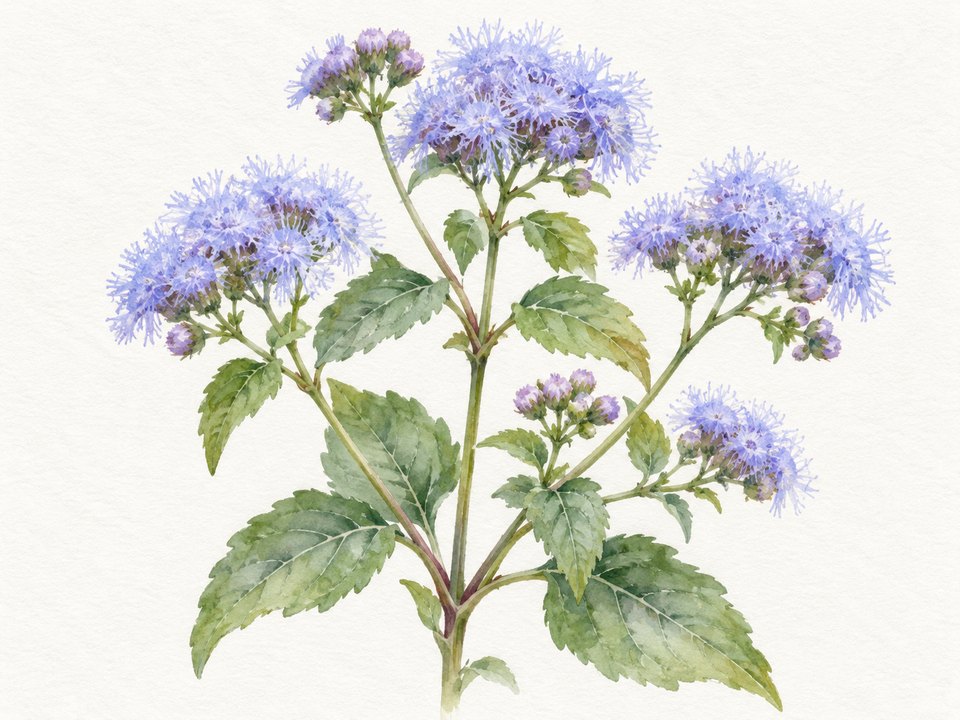
It shows soft blue-purple floss flowers summer through fall (March-November per). It is famous for drawing Queen butterflies.[4]
When to Plant Gregg's Blue Mistflower
Plant Gregg's Blue Mistflower in fall or early spring in Central Texas. A fall planting establishes roots through the cool season. It is then ready to grow and bloom the following year. Spring planting works too if you water through the first summer.[5]
If you would like a hand, the Texas Allied Landscape team can plant your Gregg's Blue Mistflower and keep it thriving.
Planting
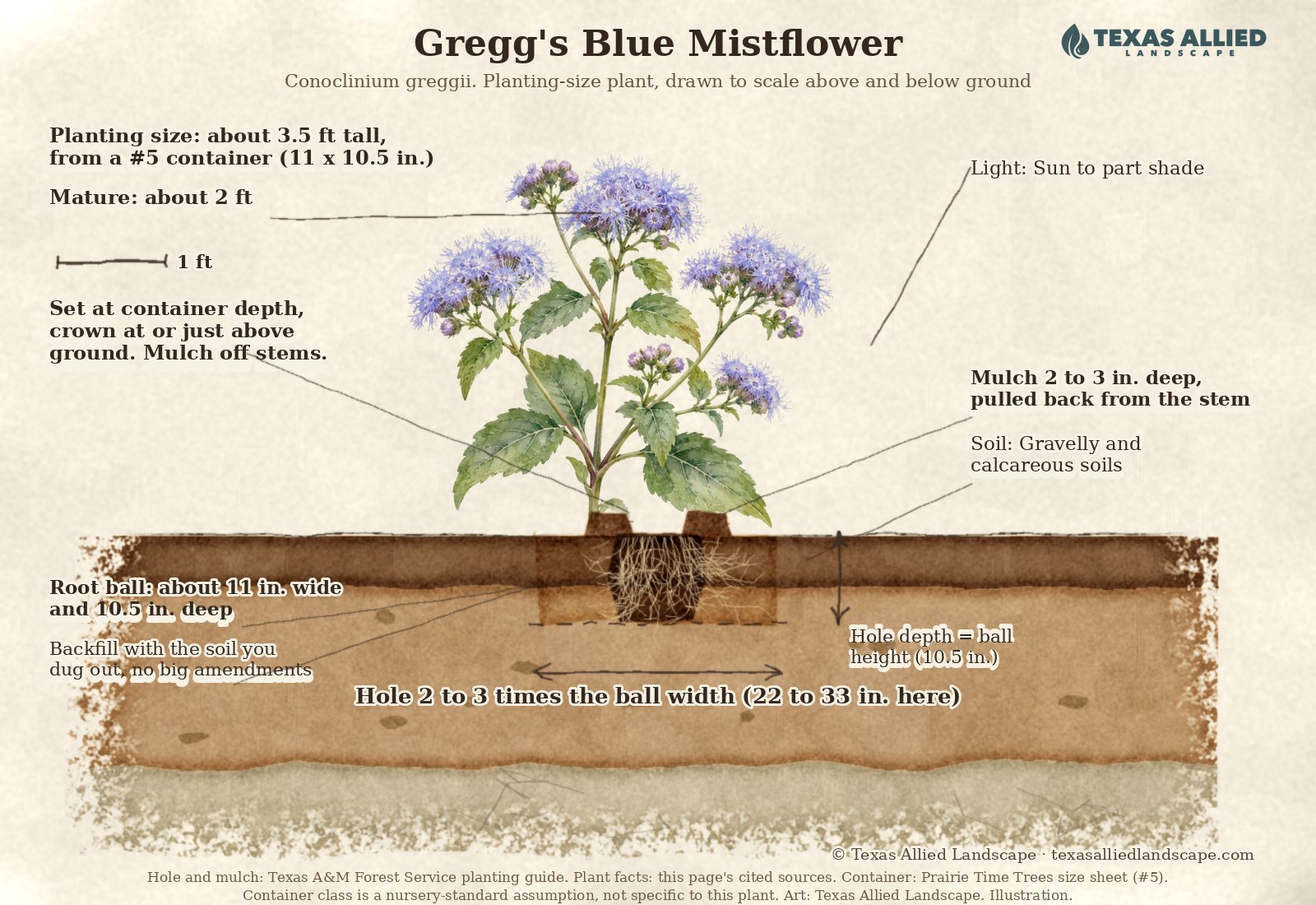
- Dig a hole twice as wide as the pot and no deeper, with sloping sides. Set the plant at the same depth it grew in its pot. Loosen any circling roots before backfilling.[6]
- For a new bed, clear grass and weeds first, roots and all.[6]
- Site: It grows in sun to part shade. It spreads easily in partial shade.[1][2][3]
- Timing: A fall planting establishes roots through the cool season and is ready to grow and bloom the following year. Spring planting works too if you water through the first summer.[5]
- Soak it well at planting and keep watering while the roots establish.[6] Once established: A fall planting establishes roots through the cool season and is ready to grow and bloom the following year. Spring planting works too if you water through the first summer.[5]
- Mulch 2 to 4 inches, kept a few inches away from the stems to prevent crown rot. It needs no staking or other support.[6]
Will Gregg's mistflower take over?
It spreads easily by roots and spreads aggressively in irrigated beds. Plan a spot where a seasonal groundcover is welcome, or keep it dry to check it.
Care Instructions for Your Gregg's Blue Mistflower
How to Water a Gregg's Blue Mistflower
It has medium water use. It appreciates supplemental summer water in exposed locations. It spreads aggressively in an irrigated setting.
Sunlight
It grows in sun to part shade. It spreads easily in partial shade.[1][2][3]
Soil and drainage
It likes gravelly, calcareous soils. It also grows in sand, loam, clay or limestone along stream beds and overflow areas.
Mature height and spread
It grows up to about 2 ft. Another source lists 1-2 ft. It spreads 2-4+ ft. It forms colonies by roots and rhizomes.
Pruning
It can be cut back freely.
Normal seasonal behavior
It shows soft blue-purple floss flowers summer through fall (March-November per). It is famous for drawing Queen butterflies.[4]
Gregg's mistflower questions
Is Gregg's mistflower a Texas native?
Yes. Conoclinium greggii is a native of Texas and the Southwest. Its fuzzy blue flowers are a queen- and monarch-butterfly magnet in fall.[7]
Does Gregg's mistflower spread?
Yes. It runs on rhizomes into a patch. It is wonderful as a groundcover but pushy in a formal bed.[8]
Next step: Our horticulturalists can let it fill a contained bed and edge it yearly.
When does it bloom?
It blooms from summer into fall. The big blue haze comes in fall, right when migrating butterflies need it.[9]
Sun or shade for mistflower?
It wants sun to part shade. It handles more shade than most native bloomers and likes a little summer water.[10]
Let Texas Allied Landscape care for your Gregg's Blue Mistflower
Gregg's Blue Mistflower does best with steady, knowledgeable care. That means the right water, pruning at the right time, and a trained eye for stress. The horticulturists at Texas Allied Landscape care for plants like yours across the San Antonio area. They are backed by over 40 years of landscape experience.
In these community guides
- Art in progress
Esperanza Landscaping
Plan your Esperanza landscape with help on plants, irrigation and the approval package. We check your neighborhood, lot…
Sources
- Conoclinium dissectum (Gregg's mistflower), Lady Bird Johnson Wildflower Center.https://www.wildflower.org/plants/result.php?id_plant=CODI21abc
- Mistflower, Gregg, City of Austin Watershed Protection Grow Green.https://www.austintexas.gov/watershed-protection/plant-guide/mistflower-greggabc
- Gregg Mistflower, San Antonio Water System - Garden Style San Antonio.https://www.gardenstylesanantonio.com/plants/gregg-mistflower/abc
- Gregg's Mistflower: Butterfly Magnet, San Antonio Water System - Garden Style San Antonio.https://www.gardenstylesanantonio.com/garden-articles/greggs-mistflower-butterfly-magnet/ab
- October Gardening Checklist, Travis County AgriLife Extension.https://travis-tx.tamu.edu/about-2/horticulture/monthly-gardening-calendar-for-austin-area/october-gardening-checklist-for-austin-and-central-texas/abc
- Back to basics: Planting perennials, SAWS Garden Style San Antonio.https://www.gardenstylesanantonio.com/garden-articles/back-to-basics-planting-perennials/abcd
- City of Austin Grow Green plant guide, "Mistflower, Gregg."https://www.austintexas.gov/watershed-protection/plant-guide/mistflower-gregg↑
- Denton County Master Gardener Association, "Gregg's Mistflower."https://www.dcmga.com/plant/greggs-mistflower/↑
- Central Texas Gardener, "Gregg's Blue Mist Flower."https://centraltexasgardener.org/resource/greggs-blue-mist-flower/↑
- Dallas County Master Gardeners, "Gregg's Mistflower."https://dallascountymastergardeners.org/greggs-mistflower/↑