
Property owners
Japanese Blueberry
- Plant
- Japanese Blueberry
- Botanical name
- Elaeocarpus decipiens
- Group
- Large shrubs
Japanese Blueberry (Elaeocarpus decipiens): light, water, soil, size and care for San Antonio area landscapes.
On this page
Its botanical name is Elaeocarpus decipiens.
Light
NC State allows full sun or partial shade. UF/IFAS Sumter County advises a full-sun site.[1][2]
Soil and drainage
It wants well-drained soil. It can become chlorotic in high-pH soil.[3]
Height
The Victoria County Master Gardener profile lists 40-60 feet.
Spread
The Victoria County Master Gardener profile lists 20-40 feet wide.
Foliage
It is evergreen in the cited profile.
Water
A steady water supply is described by the Victoria County source. If watering ever feels like a guessing game, our horticulturists can care for your Japanese Blueberry on a schedule that fits your yard.
Pruning
UF/IFAS Sumter County describes structural pruning starting about a year after planting. That covers the central leader, separation of crossing branches and a balanced canopy.
Seasonal behavior
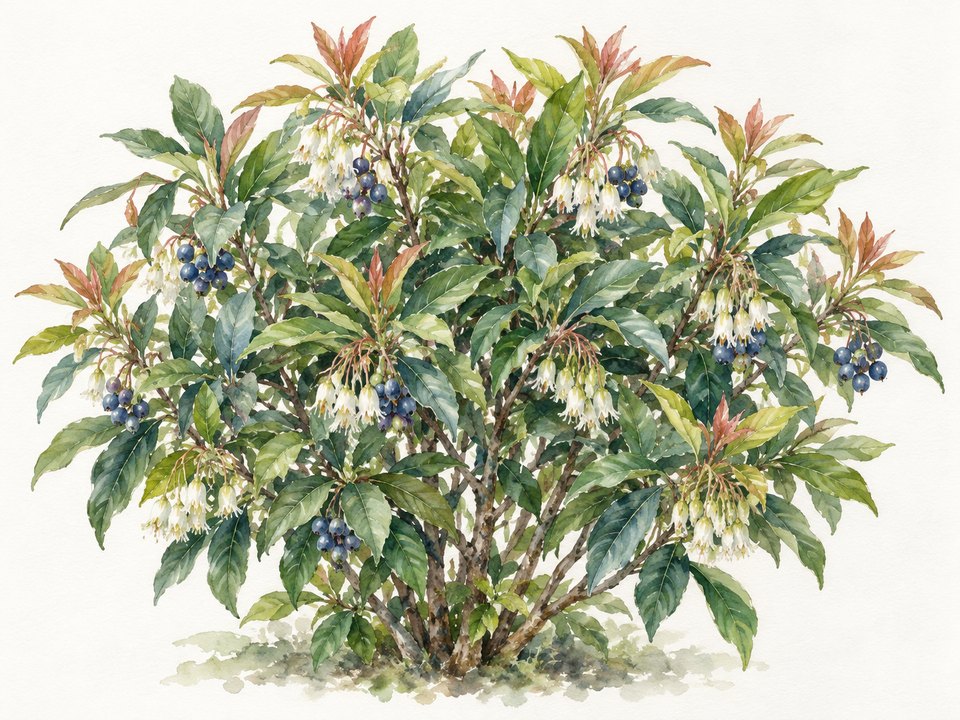
It is evergreen with white spring flowers and blue-black summer fruit. It has limited cold tolerance. The source describes a potentially large tree, not only a small clipped shrub.
When to Plant Japanese Blueberry
Japanese Blueberry is frost-tender in San Antonio. Plant it in spring after the last frost, usually around mid-March. Spring planting gives it a full growing season to establish before its first winter.
Even established plants can be damaged by hard freezes.
If you would like a hand, the Texas Allied Landscape team can plant your Japanese Blueberry and keep it thriving.
Planting
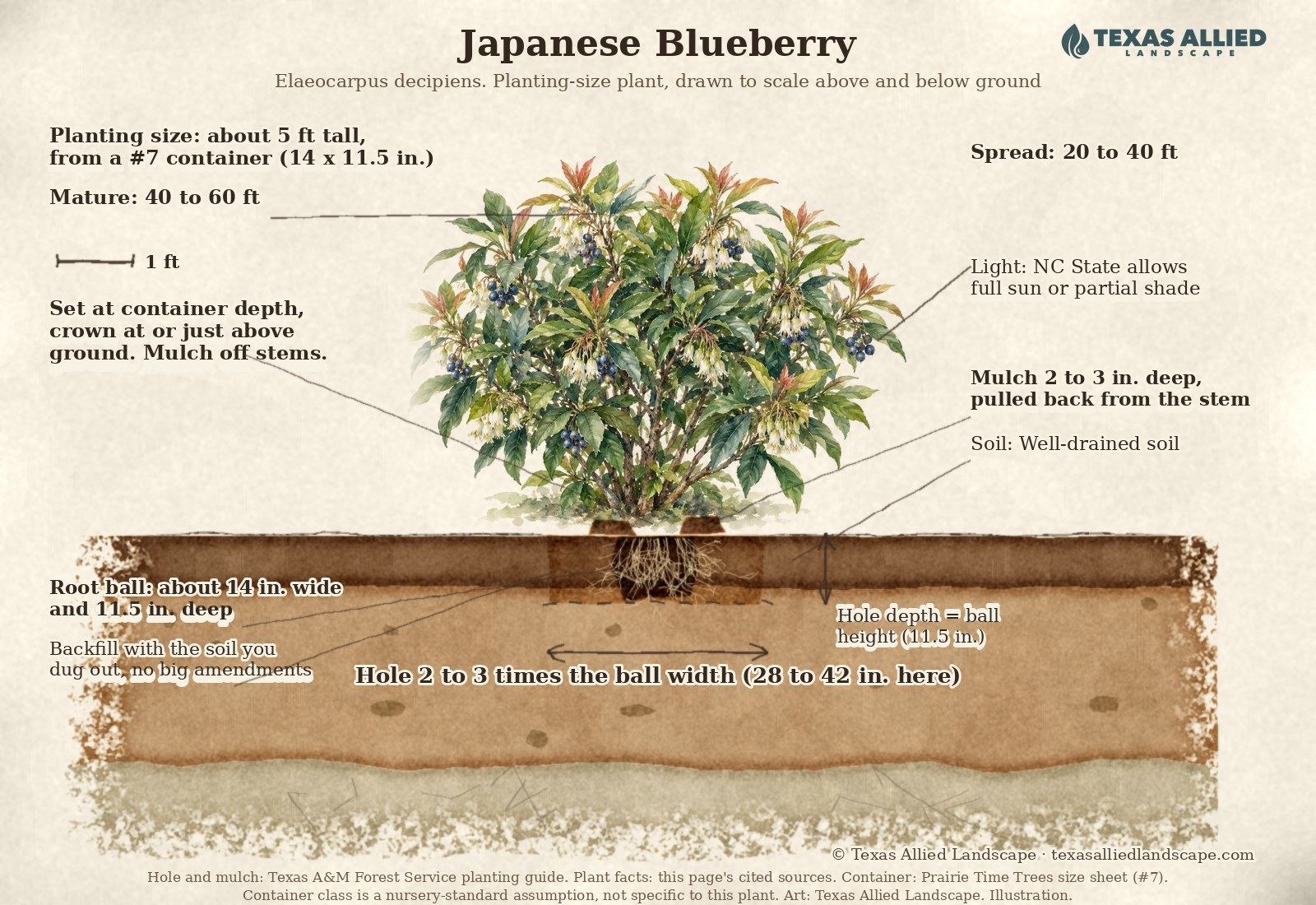
- Dig a hole at least twice as wide as the root ball and no deeper. That lets the roots grow out into the surrounding soil.[4]
- Fill the empty hole with water and check the drainage. If it takes longer than 24 hours to drain, choose another spot. Roots sitting under water will kill the plant.[4]
- Set it with the root collar (where the stems meet the roots) level with the ground. Take off the container and any twine or bags before backfilling.[4]
- Backfill with the same soil that came out of the hole, without amendments. Settle it with water rather than packing it down.[4]
- Give it room. It grows 30-40 ft tall. It becomes a real tree, often used as a tall, dense privacy screen.[5] Space plants so they can reach that size without crowding.
- For the site, NC State allows full sun or partial shade. UF/IFAS Sumter County advises a full-sun site.[1][2] For soil, it wants well-drained soil. It can become chlorotic in high-pH soil.[3]
- For timing, Japanese Blueberry is frost-tender in San Antonio. Plant it in spring after the last frost, usually around mid-March.
- Water regularly through the first growing season while roots establish, without overwatering. A thorough soaking beats light, frequent watering.[4] Once established, it needs regular water. It is not a drought tree. Deep, steady moisture keeps the foliage dense.[6]
- Mulch 2 to 3 inches deep, up to but not touching the stems. It needs no staking or other support. Do not fertilize during the first growing season.[4]
Could my Japanese blueberry's yellowing leaves relate to alkaline soil?
The Victoria County profile says Japanese blueberry can become chlorotic in high-pH soil. That is one possible site problem. It is not confirmation that a yellow leaf needs an iron product. Check the actual plant, soil and watering before selecting a treatment.
Are bronze young leaves on Japanese blueberry always a sign of damage?
Bronze-colored new leaves later become shiny dark green. That is new-growth color information. It is not confirmation that every red, brown or yellow older leaf is healthy.
Care Instructions for Your Japanese Blueberry
How to Water a Japanese Blueberry
A steady water supply is described by the Victoria County source.
Sunlight
NC State allows full sun or partial shade. UF/IFAS Sumter County advises a full-sun site.[1][2]
Soil and drainage
It wants well-drained soil. It can become chlorotic in high-pH soil.[3]
Mature height and spread
The Victoria County Master Gardener profile lists 40-60 feet tall. The same profile lists 20-40 feet wide.
Pruning
UF/IFAS Sumter County describes structural pruning starting about a year after planting. That covers the central leader, separation of crossing branches and a balanced canopy.
Normal seasonal behavior
It is evergreen with white spring flowers and blue-black summer fruit. It has limited cold tolerance. The source describes a potentially large tree, not only a small clipped shrub.
Japanese blueberry questions
Is Japanese blueberry cold hardy in Central Texas?
Marginally. Elaeocarpus decipiens is an evergreen tree for mild climates. A hard freeze can damage or kill it here, so it needs a protected spot.[7]
Next step: Our horticulturalists can site it against a warm, sheltered wall if you want to try one.
How big does Japanese blueberry get?
It grows 30-40 ft tall. It becomes a real tree, often used as a tall, dense privacy screen.[5]
Does Japanese blueberry make a mess?
It drops small olive-like fruit that can stain pavement. Keep it off the driveway side.[8]
How much water does it need?
It needs regular water. It is not a drought tree. Deep, steady moisture keeps the foliage dense.[6]
Let Texas Allied Landscape care for your Japanese Blueberry
Japanese Blueberry does best with steady, knowledgeable care. That means the right water, pruning at the right time, and a trained eye for stress. The horticulturists at Texas Allied Landscape care for plants like yours across the San Antonio area. They bring over 40 years of landscape experience.
In these community guides
Illustration. Illustration based on reference photos of The Dominion. Not a single literal view. The Dominion Landscaping
Plan your Dominion landscape with help on planting, irrigation and the ACC package. We check your lot's standards and…
Sources
- Elaeocarpus decipiens, NC State Extension.https://plants.ces.ncsu.edu/plants/elaeocarpus-decipiens/abc
- Japanese Blueberry (Elaeocarpus decipiens), UF/IFAS Extension Sumter County.https://blogs.ifas.ufl.edu/sumterco/2025/09/04/japanese-blueberry-elaeocarpus-dentatus/abc
- Japanese blueberry trees - The Gardener's Dirt, Victoria County Master Gardener Association / Texas A&M AgriLife Extension.https://vcmga.org/gardeners_dirt/2020_nov_6abc
- Planting, Texas A&M Forest Service.https://tfsweb.tamu.edu/trees/tree-care/planting/abcdef
- Verdant Tree Farm, "Japanese Blueberry Tree."https://verdanttreefarm.com/japanese-blueberry-tree-the-ultimate-houston-privacy-specimen-guide/ab
- Verdant Tree Farm, "Japanese Blueberry Tree."https://verdanttreefarm.com/japanese-blueberry-tree-the-ultimate-houston-privacy-specimen-guide/ab
- Trees and Shrubs Online, "Elaeocarpus decipiens."https://www.treesandshrubsonline.org/articles/elaeocarpus/elaeocarpus-decipiens/↑
- Mortellaros, "Elaeocarpus decipiens."https://www.mortellaros.com/plant/Elaeocarpus-decipiens↑