
Property owners
Pink Evening Primrose
- Plant
- Pink Evening Primrose
- Botanical name
- Oenothera speciosa
- Group
- Ground cover
Pink Evening Primrose (Oenothera speciosa): light, water, soil, size and care for San Antonio area landscapes.
On this page
Botanical name: Oenothera speciosa.
Light
Sun or partial shade.[1]
Soil and drainage
Thin, sandy and clay soils.
Height
An upright to sprawling perennial about 1-2 feet tall.[2]
Spread
6 inches to 12 inches.
Foliage
Herbaceous perennial that dies back to the roots in cold weather.
Water
Low to Medium Water; the plant cannot withstand complete soil dryness. Summer dormancy may be followed by regrowth with fall rains. If watering ever feels like a guessing game, our horticulturists can care for your Pink Evening Primrose on a schedule that fits your yard.
Pruning
Contain unwanted spread.
Seasonal behavior
Herbaceous perennial dying back to roots in cold weather. Pink spring flowers, sometimes through the warm season; spreads freely into dense mats in moist settings.
When to Plant Pink Evening Primrose
Plant Pink Evening Primrose in fall or early spring in Central Texas. A fall planting establishes roots through the cool season and is ready to grow and bloom the following year; spring planting works too if you water through the first summer.[3]
If you would like a hand, the Texas Allied Landscape team can plant your Pink Evening Primrose and keep it thriving.
Planting
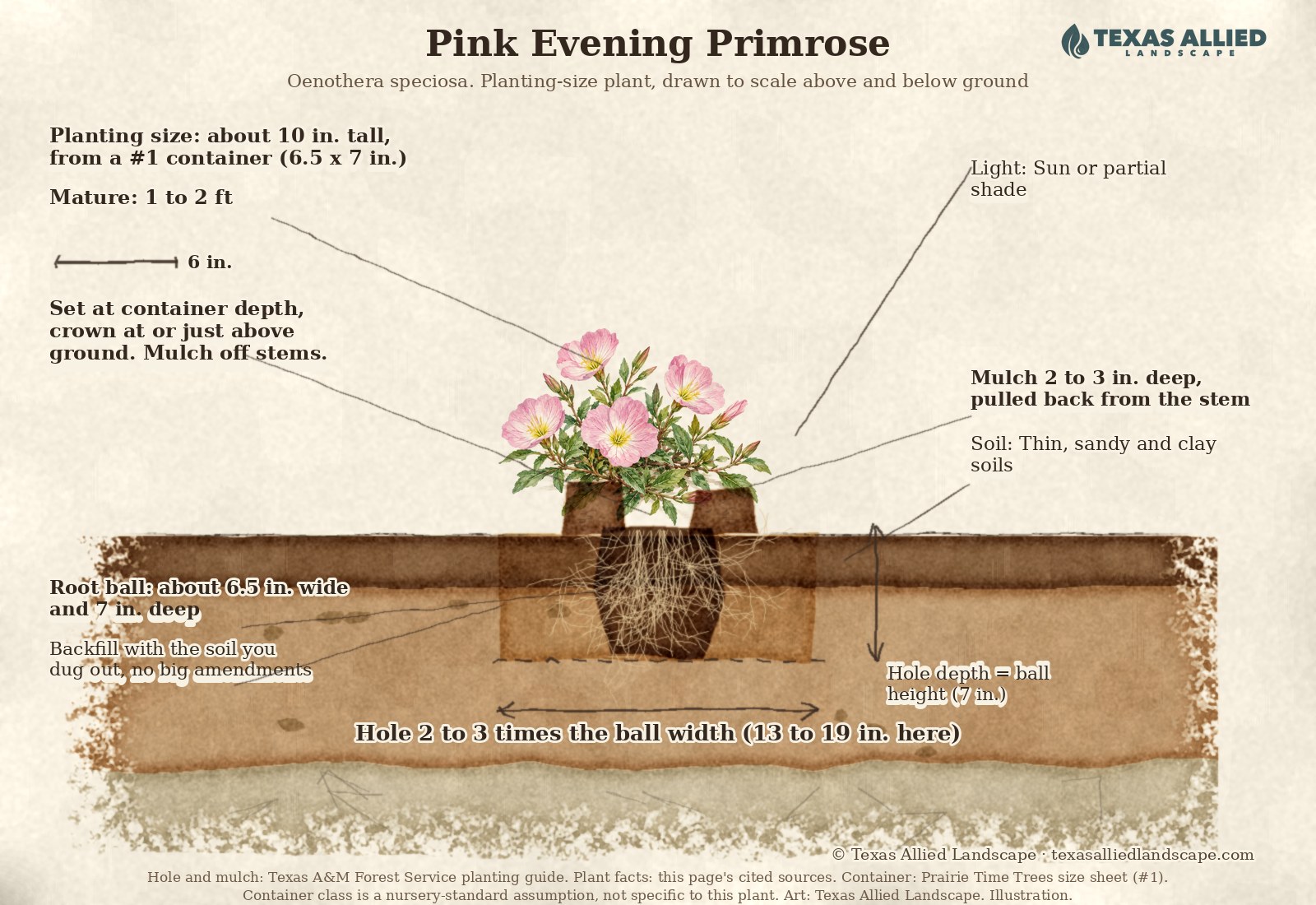
- Dig a hole twice as wide as the pot and no deeper, with sloping sides, and set the plant at the same depth it grew in its pot. Loosen any circling roots before backfilling.[4]
- For a new bed, clear grass and weeds first, roots and all.[4]
- Give it room: An upright to sprawling perennial about 1-2 feet tall.[2] Space plants for that full size, not the pot size.[4]
- Site: Sun or partial shade.[1]
- Soil: Thin, sandy and clay soils. An upright to sprawling perennial about 1-2 feet tall.[2]
- Timing: A fall planting establishes roots through the cool season and is ready to grow and bloom the following year; spring planting works too if you water through the first summer.[3]
- Soak it well at planting and keep watering while the roots establish.[4]
- Mulch 2 to 4 inches, kept a few inches away from the stems to prevent crown rot. It needs no staking or other support.[4]
Has summer dieback necessarily killed the plant?
Not necessarily - it often goes dormant in summer and resprouts with fall rains, though it should never dry out completely. If it does not return with the fall rains, then it is gone.
Care Instructions for Your Pink Evening Primrose
How to Water a Pink Evening Primrose
Low to Medium Water; the plant cannot withstand complete soil dryness. Summer dormancy may be followed by regrowth with fall rains.
Sunlight
Sun or partial shade.[1]
Soil and drainage
Thin, sandy and clay soils.
Mature height and spread
An upright to sprawling perennial about 1-2 feet tall.[2] 6 inches to 12 inches.
Pruning
Contain unwanted spread.
Normal seasonal behavior
Herbaceous perennial dying back to roots in cold weather. Pink spring flowers, sometimes through the warm season; spreads freely into dense mats in moist settings.
Pink evening primrose questions
Is pink evening primrose a Texas native?
Yes - Oenothera speciosa, the pink buttercup that sheets Texas roadsides in spring.[5]
Does pink evening primrose spread?
Aggressively - it runs on roots and will colonize a bed. Wonderful in a wild corner, a bully in a formal one.[6]
Next step: Our horticulturalists can give it room to run or keep it hoed back to its patch.
When does it bloom?
Spring is the big show - sheets of pink cups - with repeat flushes into summer.[7]
How much water does it need?
Essentially none - it thrives in poor, dry soil and full sun, and fades politely in summer heat.[8]
Let Texas Allied Landscape care for your Pink Evening Primrose
Pink Evening Primrose does best with steady, knowledgeable care: the right water, pruning at the right time, and a trained eye for stress. The horticulturists at Texas Allied Landscape care for plants like yours across the San Antonio area, backed by over 40 years of landscape experience.
In these community guides
- Art in progress
Esperanza Landscaping
Plan your Esperanza landscape with help on plants, irrigation and the approval package. We check your neighborhood, lot…
Sources
- Pink Evening Primrose - Garden Style San Antonio, San Antonio Water System.https://www.gardenstylesanantonio.com/plants/mexican-evening-primrose/abc
- Oenothera speciosa (Pink evening primrose) | Native Plants of North America, Lady Bird Johnson Wildflower Center.https://www.wildflower.org/plants/result.php?id_plant=oesp2abcd
- October Gardening Checklist, Travis County AgriLife Extension.https://travis-tx.tamu.edu/about-2/horticulture/monthly-gardening-calendar-for-austin-area/october-gardening-checklist-for-austin-and-central-texas/ab
- Back to basics: Planting perennials, Garden Style San Antonio (San Antonio Water System).https://www.gardenstylesanantonio.com/garden-articles/back-to-basics-planting-perennials/abcde
- Native Plant Society of Texas, "Oenothera speciosa."https://www.npsot.org/posts/native-plant/oenothera-speciosa/↑
- Lady Bird Johnson Wildflower Center, "Oenothera speciosa."https://www.wildflower.org/expert/show.php?frontpage=true&id=7206↑
- Texas Master Gardeners, "Buttercups Bring Both Bees and Memories."https://txmg.org/hendersonmg/publicity/buttercups-bring-bees-and-memories/↑
- High Plains Gardening, "Oenothera speciosa."https://www.highplainsgardening.com/plant-profiles/oenothera-speciosa↑