
Property owners
Prairie Zinnia
- Plant
- Prairie Zinnia
- Botanical name
- Zinnia grandiflora
- Group
- Ground cover
Prairie Zinnia (Zinnia grandiflora): light, water, soil, size and care for San Antonio area landscapes.
On this page
Botanical name: Zinnia grandiflora.
Light
Partial shade.[1]
Soil and drainage
Dry, calcareous, gravelly, well-drained soil.
Height
Up to about 8 inches.
Spread
Lubbock Master Gardeners list a 4-6-inch spread.[2]
Foliage
Lubbock Master Gardeners mark the plant D (deciduous).
Water
Low Water category. If watering ever feels like a guessing game, our horticulturists can care for your Prairie Zinnia on a schedule that fits your yard.
Pruning
Lubbock Master Gardeners say cut back in winter. No precise cut height, date or San Antonio timing confirmed.
Seasonal behavior
Spreads by rhizomes; color lasts much of summer. Sow seed in fall or spring; germination rates may be low. Cold, moist stratification of the seed may help.
When to Plant Prairie Zinnia
Plant Prairie Zinnia in fall or early spring in Central Texas. A fall planting establishes roots through the cool season and is ready to grow and bloom the following year; spring planting works too if you water through the first summer.[3]
If you would like a hand, the Texas Allied Landscape team can plant your Prairie Zinnia and keep it thriving.
Planting
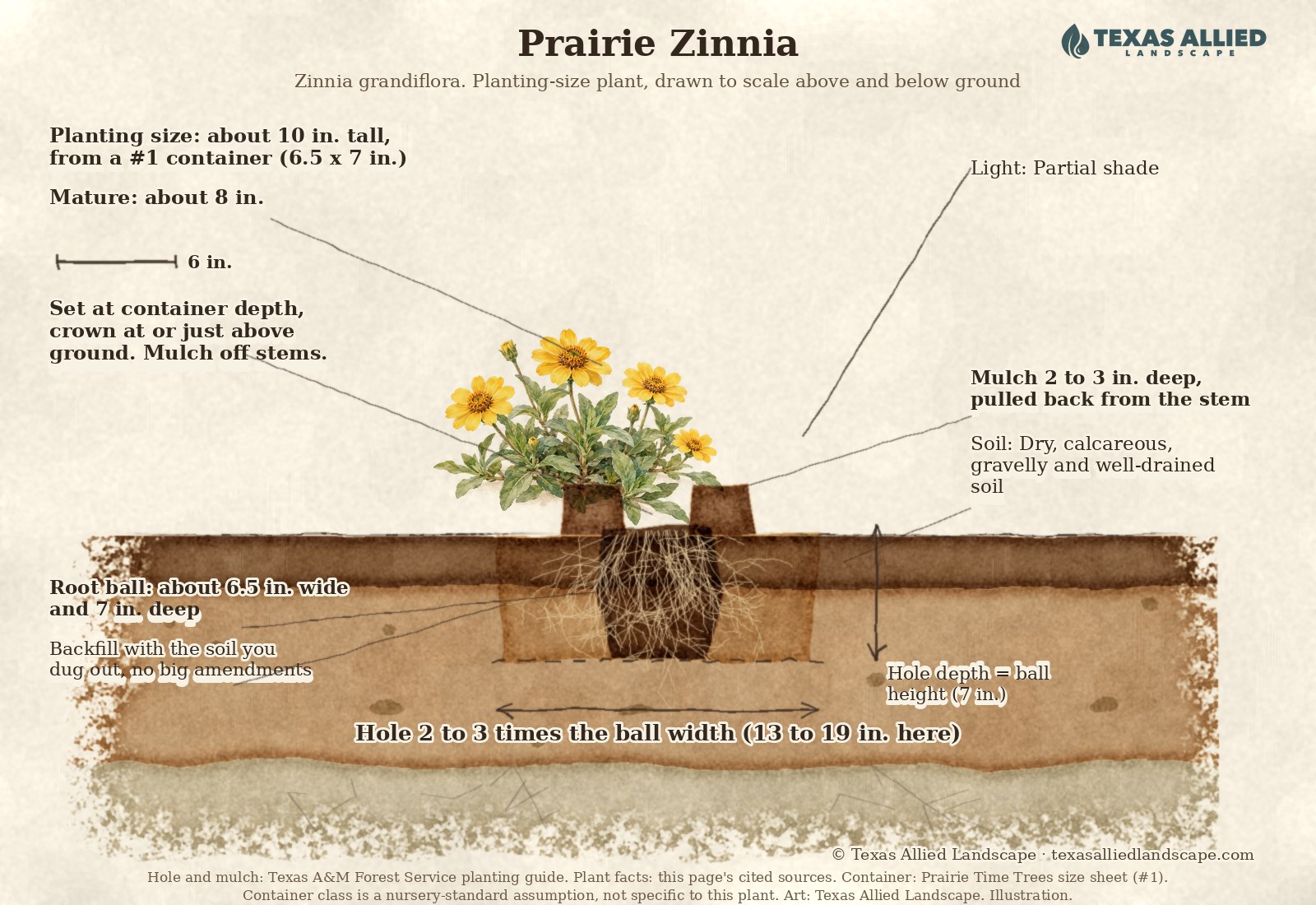
- Dig a hole twice as wide as the pot and no deeper, with sloping sides, and set the plant at the same depth it grew in its pot. Loosen any circling roots before backfilling.[4]
- For a new bed, clear grass and weeds first, roots and all.[4]
- Site: Partial shade.[1]
- Timing: A fall planting establishes roots through the cool season and is ready to grow and bloom the following year; spring planting works too if you water through the first summer.[3]
- Soak it well at planting and keep watering while the roots establish.[4]
- Mulch 2 to 4 inches, kept a few inches away from the stems to prevent crown rot. It needs no staking or other support.[4]
Why is prairie zinnia seed germinating unevenly?
Germination rates can be low; cold, moist stratification of the seed may help.
Can I use a weed preventer while trying to grow new plants from seed?
Do not assume it will spare the seedlings you want. Preemergence herbicides prevent seedling establishment. This plant has sourced seed-sowing or self-seeding guidance, so seed recruitment and weed prevention need to be planned together. No specific product or waiting interval has been verified for this record.[5]
Care Instructions for Your Prairie Zinnia
How to Water a Prairie Zinnia
Low Water category.
Sunlight
Partial shade.[1]
Soil and drainage
Dry, calcareous, gravelly, well-drained soil.
Mature height and spread
Up to about 8 inches. Lubbock Master Gardeners list a 4-6-inch spread.[2]
Pruning
Lubbock Master Gardeners say cut back in winter. No precise cut height, date or San Antonio timing confirmed.
Normal seasonal behavior
Spreads by rhizomes; color lasts much of summer. Sow seed in fall or spring; germination rates may be low. Cold, moist stratification of the seed may help.
Prairie zinnia questions
Is prairie zinnia a native?
Yes - Zinnia grandiflora is a native of the southern Great Plains and Texas, nothing like the bedding zinnias.[6]
What does prairie zinnia look like?
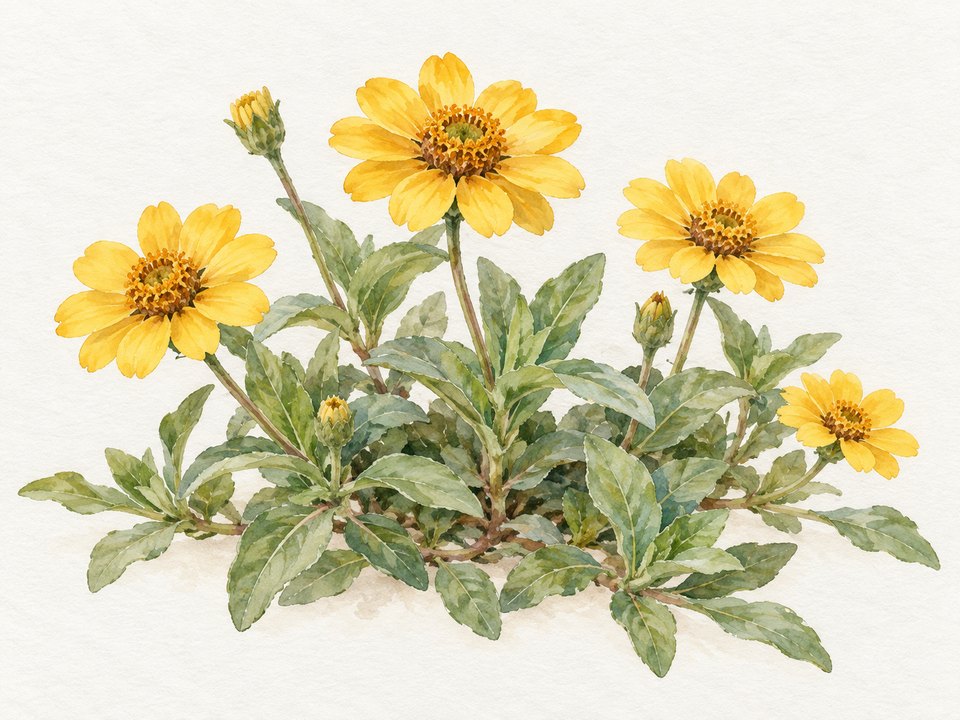
Low golden-yellow daisies on a mat-forming perennial - it creeps into a flowering groundcover about 6 inches tall.[7]
How much water does prairie zinnia need?
Very little - it is a dry-prairie native that blooms through summer heat on rainfall alone once established.[8]
When does prairie zinnia bloom?
Summer into fall - yellow flowers keep coming in the hottest months.[9]
Next step: Our horticulturalists can use it as a blooming, no-water edging in your hottest bed.
Let Texas Allied Landscape care for your Prairie Zinnia
Prairie Zinnia does best with steady, knowledgeable care: the right water, pruning at the right time, and a trained eye for stress. The horticulturists at Texas Allied Landscape care for plants like yours across the San Antonio area, backed by over 40 years of landscape experience.
In these community guides
- Art in progress
Esperanza Landscaping
Plan your Esperanza landscape with help on plants, irrigation and the approval package. We check your neighborhood, lot…
Sources
- Zinnia grandiflora (Plains zinnia) | Native Plants of North America, Lady Bird Johnson Wildflower Center.https://www.wildflower.org/plants/result.php?id_plant=zigrabc
- Prairie Zinnia, Lubbock Master Gardeners.https://txmg.org/lubbock/2019/01/26/prairie-zinnia/ab
- October Gardening Checklist, Travis County AgriLife Extension.https://travis-tx.tamu.edu/about-2/horticulture/monthly-gardening-calendar-for-austin-area/october-gardening-checklist-for-austin-and-central-texas/ab
- Back to basics: Planting perennials, Garden Style San Antonio (San Antonio Water System).https://www.gardenstylesanantonio.com/garden-articles/back-to-basics-planting-perennials/abcd
- Lectures 5 & 6: Preemergence Herbicides, NC State Extension.https://weeds.ces.ncsu.edu/weeds-teaching/landscape-weed-management/preemergence-herbicides/↑
- USDA Forest Service, "Zinnia grandiflora."https://www.fs.usda.gov/wildflowers/plant-of-the-week/zinnia_grandiflora.shtml↑
- NC State Extension, "Zinnia grandiflora."https://plants.ces.ncsu.edu/plants/zinnia-grandiflora/↑
- Colorado Springs Utilities, "Prairie Zinnia."https://www.csu.org/water-wise-plants/prairie-zinnia↑
- NC State Extension, "Zinnia grandiflora."https://plants.ces.ncsu.edu/plants/zinnia-grandiflora/↑