
Property owners
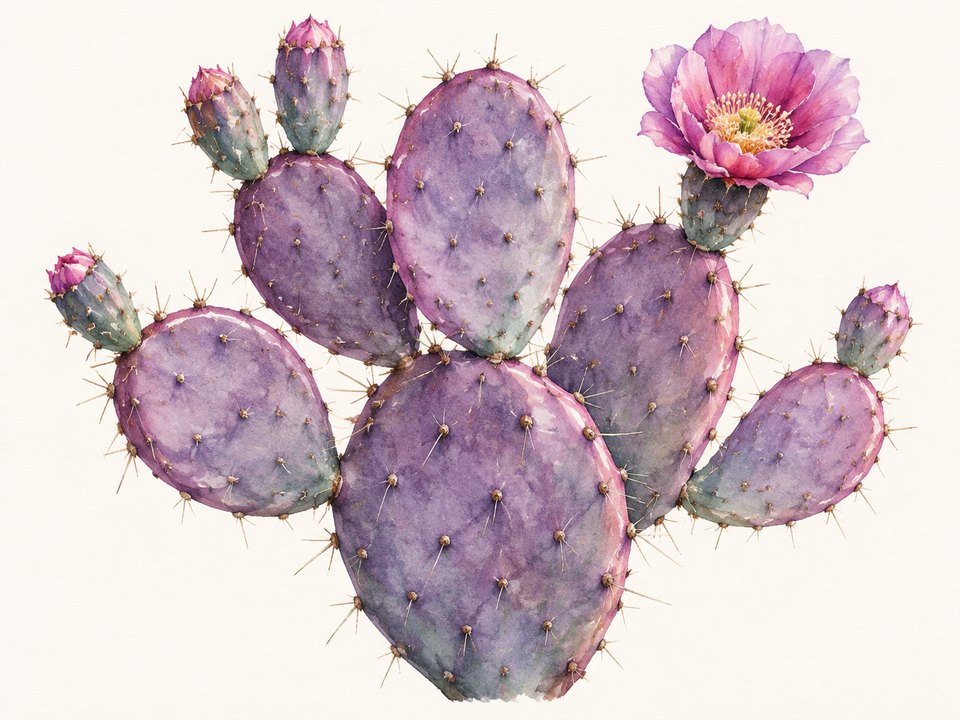
Purple Prickly Pear
- Plant
- Purple Prickly Pear
- Botanical name
- Opuntia 'Santa Rita'
- Cultivar
- 'Santa Rita'
- Group
- Succulents and cacti
Verified species-profile details for Santa Rita Prickly Pear, with a catalog-name qualifier.
On this page
The catalog writes the name as Opuntia 'Santa Rita'. The Wildflower Center lists the species Opuntia santa-rita and gives Purple Prickly Pear as a common name.
Size
The species profile lists up to about 6 feet tall.
Flowers and native range
Orange to yellow flowers are listed for March through June. Its U.S. native range includes Arizona, New Mexico and Texas. It has special value to native bees.[1]
When to Plant Purple Prickly Pear
Plant Purple Prickly Pear in spring through early fall, while the soil is warm. Drainage matters most going into winter: roots sitting in cold, wet soil rot, so a plant established long before winter handles the season better.
Avoid planting right before winter.
If you would like a hand, the Texas Allied Landscape team can plant your Purple Prickly Pear and keep it thriving.
Planting
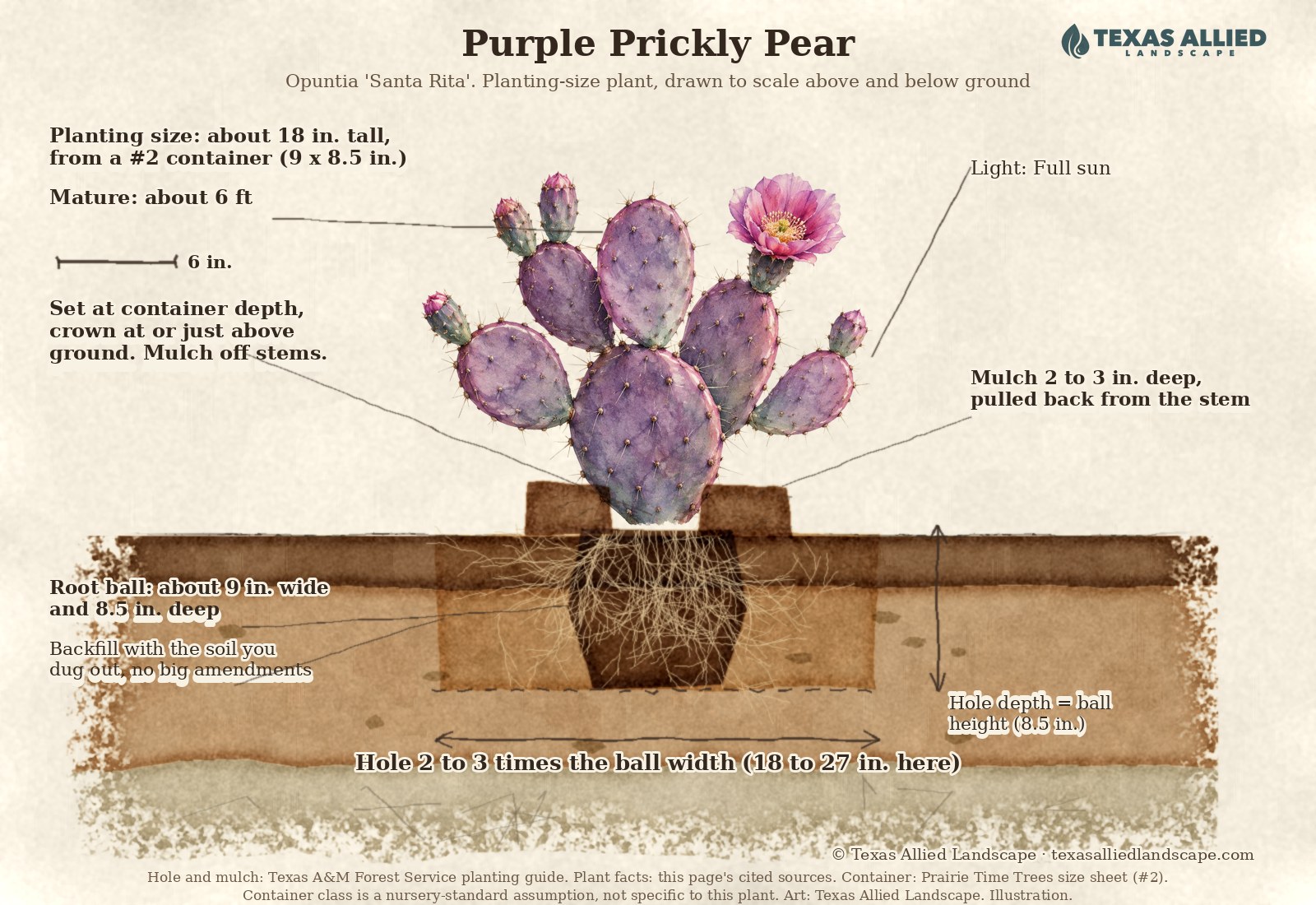
- Set the plant at the same depth it grew in its pot - never deeper - and ease it out of the container instead of pulling on the stems.[2]
- Site: Almost none - full sun, sharp drainage, and no irrigation once rooted.[3]
- Timing: Plant Purple Prickly Pear in spring through early fall, while the soil is warm.
- It needs no staking or other support.
Care Instructions for Your Purple Prickly Pear
How to Water a Purple Prickly Pear
Mature height and spread
The species profile lists up to about 6 feet tall.
Purple prickly pear questions
Why is the Santa Rita prickly pear purple?
Stress colors it - cold weather and drought deepen the pads to a striking violet-purple. It is Opuntia 'Santa Rita', a Southwestern selection grown for that color.[4]
Does Santa Rita prickly pear have spines?
Yes - unlike the spineless selections, this one has real spines and glochids, so place it away from paths and pets.[5]
Next step: Our horticulturalists can site it where the purple pads show off without snagging anyone.
Does it bloom?
Yes - bright yellow flowers in spring that contrast beautifully with the purple pads.[6]
How much water does it need?
Almost none - full sun, sharp drainage, and no irrigation once rooted.[3]
Let Texas Allied Landscape care for your Purple Prickly Pear
Purple Prickly Pear does best with steady, knowledgeable care: the right water, pruning at the right time, and a trained eye for stress. The horticulturists at Texas Allied Landscape care for plants like yours across the San Antonio area, backed by over 40 years of landscape experience.
In these community guides
- Art in progress
Esperanza Landscaping
Plan your Esperanza landscape with help on plants, irrigation and the approval package. We check your neighborhood, lot…
Sources
- Opuntia santa-rita (Santa Rita Prickly Pear), Lady Bird Johnson Wildflower Center.https://www.wildflower.org/plants/result.php?id_plant=opsa↑
- Back to basics: Planting perennials, SAWS Garden Style San Antonio.https://www.gardenstylesanantonio.com/garden-articles/back-to-basics-planting-perennials/↑
- Central Texas Gardener, "Prickly Pear Cactus."https://centraltexasgardener.org/resource/prickly-pear-cactus/ab
- Arizona-Sonora Desert Museum, "Opuntia santa-rita."https://desertmuseum.org/visit/sheets/Opusanrit.pdf↑
- Monrovia, "Santa Rita Tubac Prickly Pear."https://www.monrovia.com/santa-rita-tubac-prickly-pear.html↑
- Arizona-Sonora Desert Museum, "Opuntia santa-rita."https://desertmuseum.org/visit/sheets/Opusanrit.pdf↑