
Property owners
Southern Catalpa
- Plant
- Southern Catalpa
- Botanical name
- Catalpa bignonioides
- Group
- Shade trees
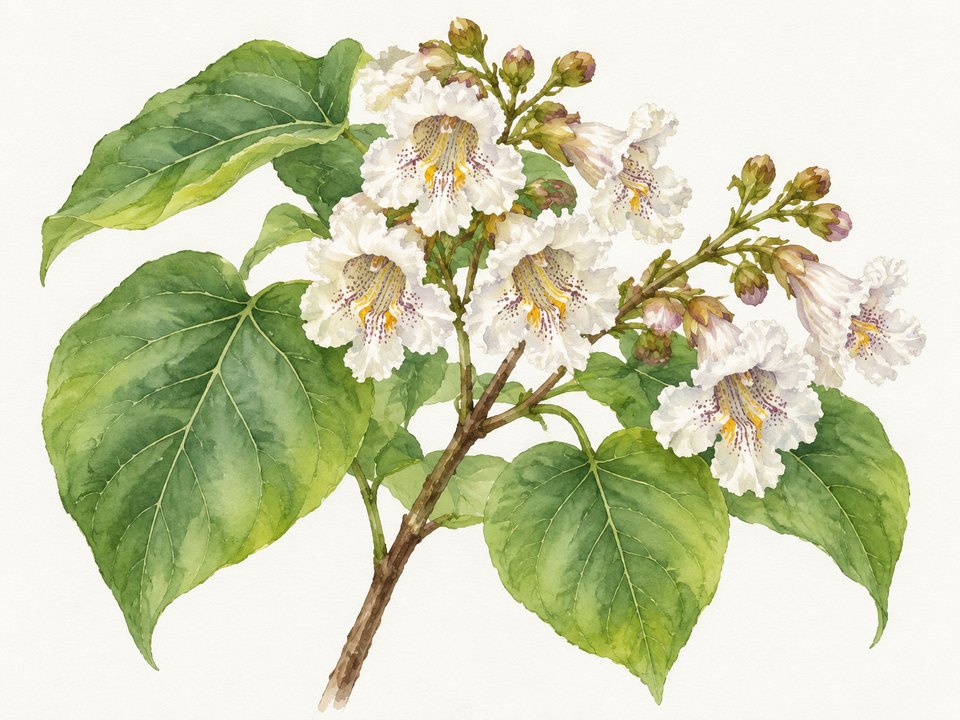
Southern catalpa is a fast, old-fashioned shade tree with orchid-like spring flowers, giant heart-shaped leaves, and famous fishing worms.
On this page
Its botanical name is Catalpa bignonioides.
It belongs to the shade trees group.
Light
It grows in full sun to part shade. It flowers best with sun.[1]
Soil and drainage
It is adaptable. It grows in ordinary soils, and it tolerates wet spots and clay better than most shade trees.[1]
Height
It reaches 40 to 60 feet at maturity.[1]
Spread
It spreads 30 to 40 feet in an irregular, broad crown. Give it room away from structures.[1]
Foliage
It has huge, heart-shaped leaves that cast dense shade. They can look ragged by late summer.[2]
Water
It needs medium water. It appreciates regular water in summer but handles ordinary rainfall once established.
Pruning
Prune it while young to build a strong structure. The wood is brittle and mature limbs can break.[1]
Seasonal behavior
Showy white orchid-like flower clusters open in late spring. Long bean-like seed pods then hang through winter. It is deciduous.
When to Plant Southern Catalpa
Plant southern catalpa in late fall through winter in Central Texas, while the tree is dormant. Bare-root or container trees establish best in the cool season, with spring growth ahead of them.[3]
If you would like a hand, the Texas Allied Landscape team can plant your southern catalpa and keep it thriving.
Planting
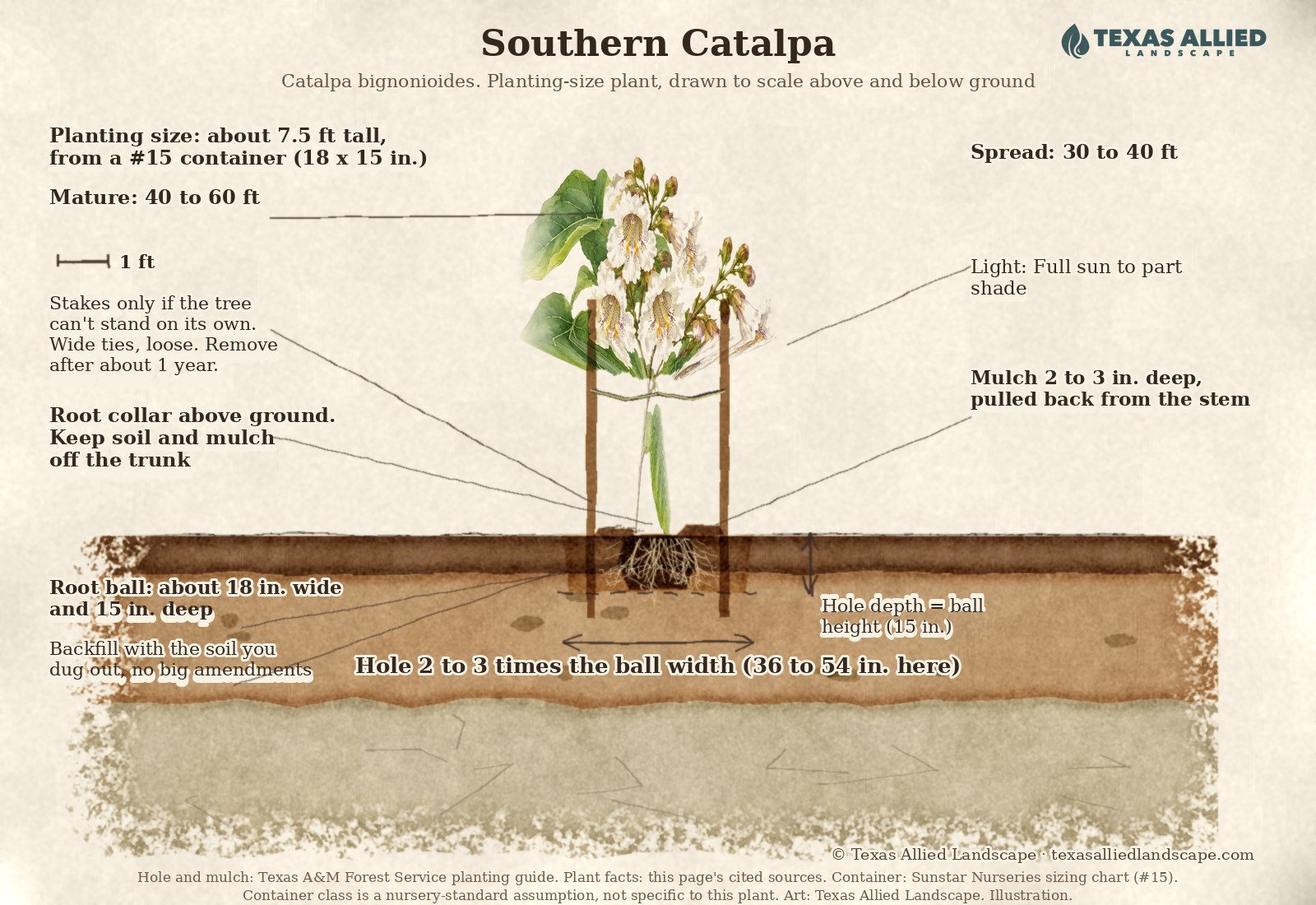
- Dig a hole at least twice as wide as the root ball and no deeper. A square hole keeps the roots from settling too deep while letting them grow out into the surrounding soil.[3]
- Fill the empty hole with water and check the drainage. If it takes longer than 24 hours to drain, choose another spot. Roots sitting under water will kill the tree.[3]
- Set it with the root collar (the flare just above the roots) level with or slightly above the ground. Take off all wire, twine, containers and bags before backfilling.[3]
- Backfill with the same soil that came out of the hole, without amendments. Settle the soil with water rather than packing it down.[3]
- Site and soil: It belongs to the shade trees group. It grows in full sun to part shade and flowers best with sun.[1] It is adaptable. It grows in ordinary soils, and it tolerates wet spots and clay better than most shade trees.[1]
- Timing: Plant southern catalpa in late fall through winter in Central Texas, while the tree is dormant. Bare-root or container trees establish best in the cool season, with spring growth ahead of them.[3]
- Water it for at least the first two years, but do not overwater. A thorough soaking beats light, frequent watering.[3] Once it is established, it needs medium water. It appreciates regular water in summer but handles ordinary rainfall. Prune it while young to build a strong structure. The wood is brittle and mature limbs can break.[1]
- Mulch 2 to 3 inches deep, out to the drip line and up to but not touching the trunk. Stake it only if it cannot stand on its own, and take the stakes off within a year. Most need no support. Do not fertilize during the first growing season.[3]
Care Instructions for Your Southern Catalpa
How to Water a Southern Catalpa
It needs medium water. It appreciates regular water in summer but handles ordinary rainfall once established.
Sunlight
It grows in full sun to part shade. It flowers best with sun.[1]
Soil and drainage
It is adaptable. It grows in ordinary soils, and it tolerates wet spots and clay better than most shade trees.[1]
Mature height and spread
It reaches 40 to 60 feet at maturity.[1] It spreads 30 to 40 feet in an irregular, broad crown, so give it room away from structures.[1]
Pruning
Prune it while young to build a strong structure. The wood is brittle and mature limbs can break.[1]
Normal seasonal behavior
Showy white orchid-like flower clusters open in late spring. Long bean-like seed pods then hang through winter. It is deciduous.
Southern catalpa questions
What are the worms eating my catalpa?
Those are catalpa worms, the caterpillars of the catalpa sphinx moth. They can strip a tree in summer, but the tree almost always leafs back out. Many people plant catalpa partly for them, since they make famous fishing bait.[4]
Next step: Our horticulturalists can treat a severe infestation on a young tree if the defoliation is stressing it.
Is southern catalpa a good shade tree for Texas?
It is a fast, tough, old-fashioned shade tree with beautiful spring flowers. The tradeoffs are brittle wood, messy pods, and the summer worms.[5]
Are catalpa trees messy?
Yes. Expect big leaves in fall, long seed pods, and flower petals in spring. Plant it where the litter is a feature, not over a patio.[6]
How fast does catalpa grow?
It grows fast, several feet a year when young. That is part of why the wood stays soft.[7]
Let Texas Allied Landscape care for your southern catalpa
Southern catalpa does best with steady, knowledgeable care. That means the right water, structural pruning at the right time, and a trained eye for stress. The horticulturists at Texas Allied Landscape care for trees like yours across the San Antonio area. They are backed by over 40 years of landscape experience.
Sources
- Catalpa, Texas Tree Selector, Texas A&M Forest Service.https://texastreeplanting.tamu.edu/Display_Onetree.aspx?tid=11abcdefghijklm
- Catalpa bignonioides, Lady Bird Johnson Wildflower Center.https://www.wildflower.org/expert/show.php?id=1253↑
- Planting, Texas A&M Forest Service.https://tfsweb.tamu.edu/trees/tree-care/planting/abcdefgh
- Penn State Extension, "Catalpa Worm (Catalpa Sphinx Moth)."https://extension.psu.edu/catalpa-worm-catalpa-sphinx-moth↑
- Texas Tree Selector, Texas A&M Forest Service, "Catalpa."https://texastreeplanting.tamu.edu/Display_Onetree.aspx?tid=11↑
- Texas A&M Plant Disease Handbook, "Catalpa."https://plantdiseasehandbook.tamu.edu/landscaping/trees/catalpa/↑
- Texas Tree Selector, Texas A&M Forest Service, "Catalpa."https://texastreeplanting.tamu.edu/Display_Onetree.aspx?tid=11↑