
Property owners
Spotted Manfreda
- Plant
- Spotted Manfreda
- Botanical name
- Manfreda 'Spot'
- Cultivar
- 'Spot'
- Group
- Succulents and cacti
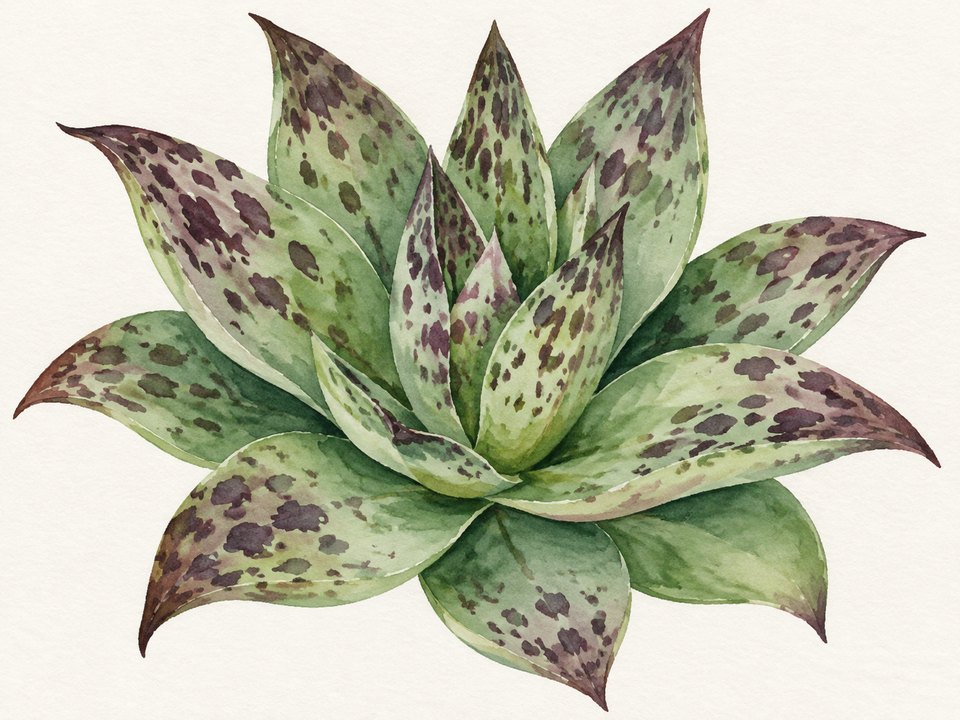
Spotted manfreda is a small succulent with long, wavy leaves stamped in burgundy spots - foliage drama for shady, dry beds.
On this page
Its botanical name is Manfreda 'Spot'.
It belongs to the succulents and cacti group.
Light
It likes part shade to morning sun. It keeps its best color out of harsh afternoon sun.[1]
Soil and drainage
It needs gritty, well-drained soil. Like all manfredas, it rots in wet ground.[2]
Height
It grows to about 1 foot tall. Its flower spikes rise higher in summer.[3]
Spread
Each rosette spreads 1 to 2 feet. It slowly offsets into a small colony.[1]
Foliage
The foliage is the show. The long, wavy-edged leaves are heavily spotted in burgundy over olive green. It is a succulent with real foliage interest.[3]
Water
It needs little water. Water it to get it established, and then water sparingly. It stores water in its fleshy roots and leaves.
Pruning
It needs no pruning beyond removing a spent flower spike or a winter-damaged leaf.
Seasonal behavior
The rosettes are semi-evergreen in mild winters. In summer, mature plants send up tall, fragrant flower spikes. The flowers attract night pollinators.[4]
When to Plant Spotted Manfreda
Plant spotted manfreda in spring after the last freeze, or in early fall with time to root before cold. A spring planting has the whole warm season to settle in.
If you would like a hand, the Texas Allied Landscape team can plant your spotted manfreda and keep it thriving.
Planting
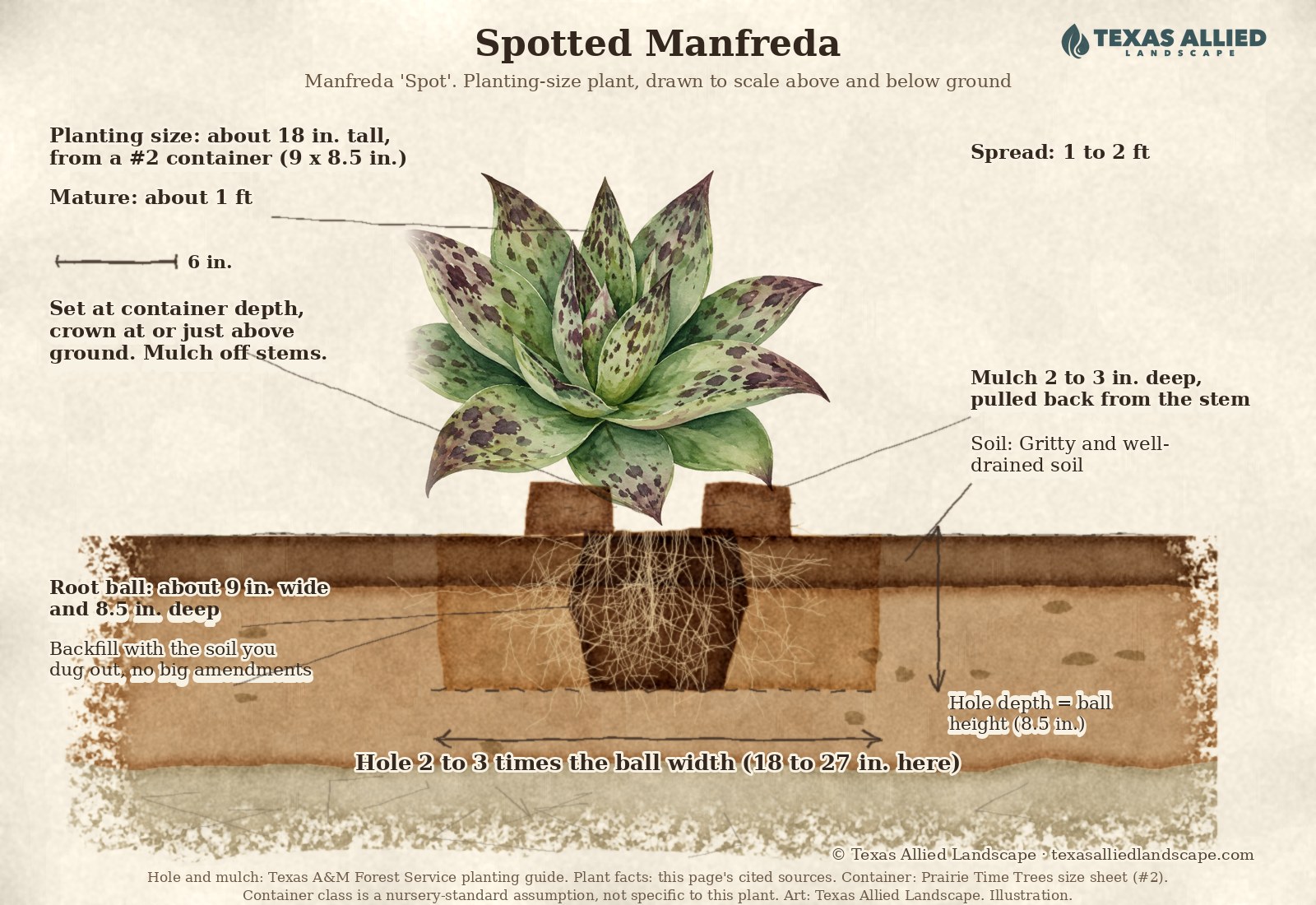
- Set the plant at the same depth it grew in its pot, and never deeper. Ease it out of the container instead of pulling on the stems.[5]
- Soil and drainage: It needs gritty, well-drained soil. Like all manfredas, it rots in wet ground.[2]
- Site: It likes part shade to morning sun. It keeps its best color out of harsh afternoon sun.[1]
- Timing: Plant spotted manfreda in spring after the last freeze, or in early fall with time to root before cold.
- It needs no staking or other support.
Care Instructions for Your Spotted Manfreda
How to Water a Spotted Manfreda
It needs little water. Water it to get it established, and then water sparingly. It stores water in its fleshy roots and leaves.
Sunlight
It likes part shade to morning sun. It keeps its best color out of harsh afternoon sun.[1]
Soil and drainage
It needs gritty, well-drained soil. Like all manfredas, it rots in wet ground.[2]
Mature height and spread
It grows to about 1 foot tall, and its flower spikes rise higher in summer.[3] Each rosette spreads 1 to 2 feet, and it slowly offsets into a small colony.[1]
Pruning
It needs no pruning beyond removing a spent flower spike or a winter-damaged leaf.
Normal seasonal behavior
The rosettes are semi-evergreen in mild winters. In summer, mature plants send up tall, fragrant flower spikes that attract night pollinators.[4]
Spotted manfreda questions
Is spotted manfreda cold hardy in Central Texas?
Yes, marginally. It handles our typical winters, but a hard freeze can damage the leaves. Overhead cover or mulch helps it through.[6]
What makes the 'Spot' manfreda special?
The foliage makes it special. The long, wavy leaves are stamped with dark burgundy spots. It looks unlike any agave or succulent around it.[7]
Sun or shade for spotted manfreda?
Part shade is ideal. Deep shade dulls the spotting, and harsh afternoon sun scorches it.[8]
Next step: Our horticulturalists can site it in dappled light where the spots stay bold.
Does spotted manfreda bloom?
Yes. It sends up a tall spike of fragrant, lily-like flowers in summer. The flowers are pollinated at night.[9]
Let Texas Allied Landscape care for your spotted manfreda
Spotted manfreda does best with steady, knowledgeable care. That means the right water, good drainage, and a trained eye for freeze stress. The horticulturists at Texas Allied Landscape care for plants like yours across the San Antonio area. They are backed by over 40 years of landscape experience.
In these community guides
- Art in progress
Esperanza Landscaping
Plan your Esperanza landscape with help on plants, irrigation and the approval package. We check your neighborhood, lot…
Sources
- Agave virginica 'Spot', Perennials.com.https://www.perennials.com/plants/agave-virginica-spot.htmlabcde
- Manfreda 'Spot', Greg.https://greg.app/plant-care/manfreda-undulata-spot-manfreda-spotabc
- Manfreda 'Spot', PlantLust.https://plantlust.com/plants/6361/manfreda-spot/abc
- All Season Aloes, Manfredas and Mangaves, Vego Garden.https://www.vegogarden.com/blogs/academy/all-season-aloes-manfredas-and-mangavesab
- Back to basics: Planting perennials, SAWS Garden Style San Antonio.https://www.gardenstylesanantonio.com/garden-articles/back-to-basics-planting-perennials/↑
- PlantLust, "Manfreda 'Spot'."https://plantlust.com/plants/6361/manfreda-spot/↑
- Perennials.com, "Agave virginica 'Spot'."https://www.perennials.com/plants/agave-virginica-spot.html↑
- Greg, "Manfreda 'Spot'."https://greg.app/plant-care/manfreda-undulata-spot-manfreda-spot↑
- Vego Garden, "All Season Aloes, Manfredas and Mangaves."https://www.vegogarden.com/blogs/academy/all-season-aloes-manfredas-and-mangaves↑