
Property owners
Texas Primrose
- Plant
- Texas Primrose
- Botanical name
- Calylophus berlandieri
- Group
- Ground cover
Texas Primrose (Calylophus berlandieri): light, water, soil, size and care for San Antonio area landscapes.
On this page
Its botanical name is Calylophus berlandieri.
Light
It grows in sun or partial shade.[1]
Soil and drainage
It grows in sandy or rocky soil, and its profile lists moist soil conditions.
Height
It is a 4-20-inch plant, with size notes up to about 20 inches.
Foliage
It is deciduous.
Water
It is in the Low Water category, but that is not evidence for a never-water rule. If watering ever feels like a guessing game, our horticulturists can care for your Texas Primrose on a schedule that fits your yard.
Seasonal behavior
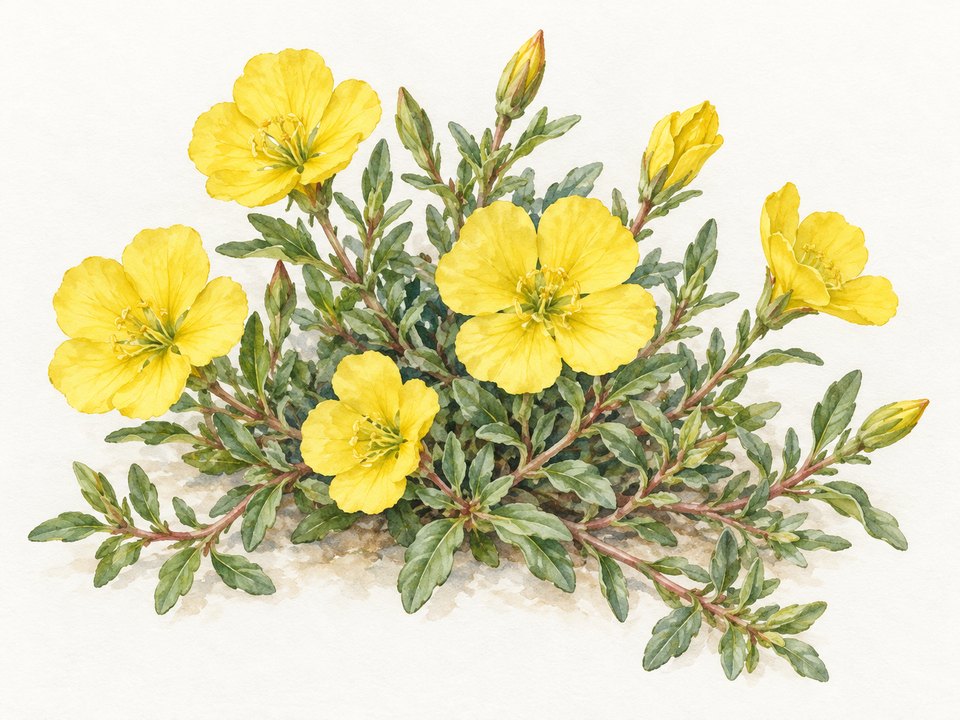
It is bushy and sometimes woody at the base, with broad yellow four-petaled flowers. Fall seed sowing is favored, and cuttings are taken from new growth in early spring.
When to Plant Texas Primrose
Plant Texas Primrose in fall or early spring in Central Texas. A fall planting establishes roots through the cool season and is ready to grow and bloom the following year. Spring planting works too if you water through the first summer.[2]
If you would like a hand, the Texas Allied Landscape team can plant your Texas Primrose and keep it thriving.
Planting
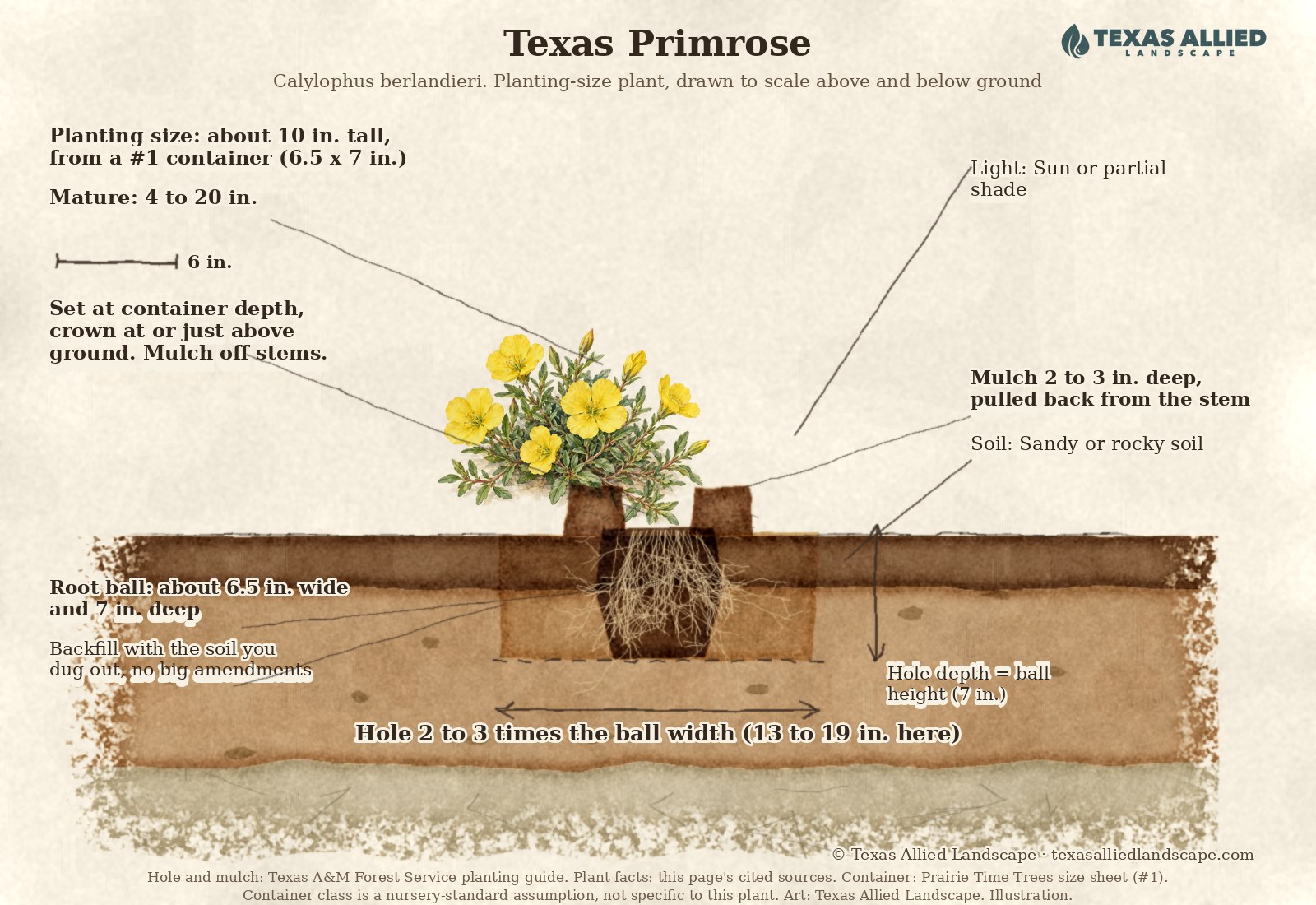
- Dig a hole at least twice as wide as the root ball and no deeper, so the roots can grow out into the surrounding soil.[3]
- Fill the empty hole with water and check the drainage. If it takes longer than 24 hours to drain, choose another spot. Roots sitting under water will kill the plant.[3]
- Set it with the root collar (where the stems meet the roots) level with the ground, and take off the container and any twine or bags before backfilling.[3]
- Backfill with the same soil that came out of the hole, without amendments, and settle it with water rather than packing it down.[3]
- Site: It grows in sun or partial shade.[1]
- Timing: A fall planting establishes roots through the cool season and is ready to grow and bloom the following year. Spring planting works too if you water through the first summer.[2]
- Water regularly through the first growing season while roots establish, without overwatering. A thorough soaking beats light, frequent watering.[3]
- Mulch 2 to 3 inches deep, up to but not touching the stems. It needs no staking or other support. Do not fertilize during the first growing season.[3]
Does a Low Water rating mean I should keep Texas primrose completely dry?
No. The LBJWC profile lists Low Water and Moist soil conditions together. Those categories do not establish a never-water rule or an exact irrigation interval, especially for a new planting.
Care Instructions for Your Texas Primrose
How to Water a Texas Primrose
It is in the Low Water category, but that is not evidence for a never-water rule.
Sunlight
It grows in sun or partial shade.[1]
Soil and drainage
It grows in sandy or rocky soil, and its profile lists moist soil conditions.
Mature height and spread
It is a 4-20-inch plant, with size notes up to about 20 inches.
Normal seasonal behavior
It is bushy and sometimes woody at the base, with broad yellow four-petaled flowers. Fall seed sowing is favored, and cuttings are taken from new growth in early spring.
Texas primrose questions
Is Texas primrose a Texas native?
Yes. Calylophus berlandieri, Berlandier's sundrops, is a native wildflower of South and Central Texas.[4]
How long does Texas primrose bloom?
It blooms from spring through fall. The bright yellow cups keep coming in heat that stops most bloomers.[5]
How much water does Texas primrose need?
It needs very little. It is a drought-proof native for hot, sunny, rocky spots.[6]
Is Texas primrose deer resistant?
Generally yes. Deer usually leave it alone.[7]
Next step: Our horticulturalists can edge a sunny bed with it for nearly year-round color.
Let Texas Allied Landscape care for your Texas Primrose
Texas Primrose does best with steady, knowledgeable care. That means the right water, pruning at the right time, and a trained eye for stress. The horticulturists at Texas Allied Landscape care for plants like yours across the San Antonio area. They are backed by over 40 years of landscape experience.
In these community guides
- Art in progress
Esperanza Landscaping
Plan your Esperanza landscape with help on plants, irrigation and the approval package. We check your neighborhood, lot…
Sources
- Calylophus berlandieri (Berlandier's sundrops), Lady Bird Johnson Wildflower Center Native Plants Database.https://www.wildflower.org/plants/result.php?id_plant=cabe6abc
- October Gardening Checklist, Travis County AgriLife Extension.https://travis-tx.tamu.edu/about-2/horticulture/monthly-gardening-calendar-for-austin-area/october-gardening-checklist-for-austin-and-central-texas/ab
- Planting, Texas A&M Forest Service.https://tfsweb.tamu.edu/trees/tree-care/planting/abcdef
- Native Plant Society of Texas, "Oenothera berlandieri."https://www.npsot.org/posts/native-plant/oenothera-berlandieri/↑
- City of Austin Grow Green plant guide, "Calylophus, Square-bud Primrose."https://www.austintexas.gov/department/grow-green/plant-guide/calylophus-square-bud-primrose↑
- Dallas County Master Gardeners, "Calylophus berlandieri."https://dallascountymastergardeners.org/calylophus-berlandieri-berlandiers-sundrops/↑
- Central Texas Gardener, "Calylophus."https://centraltexasgardener.org/resource/calylophus/↑