
Property owners
Thornless Texas Honey Mesquite
- Plant
- Thornless Texas Honey Mesquite
- Botanical name
- Prosopis glandulosa 'Maverick'
- Cultivar
- 'Maverick'
- Group
- Shade trees
Sourced care for the thornless Maverick selection of Texas Honey Mesquite.
On this page
This page describes the Maverick selection of Prosopis glandulosa, not every honey mesquite. Maverick is a thornless selection associated with Bexar County. The grower describes its nursery tree as grafted.[1][2]
Light and water
Full sun. Give infrequent, deep irrigation.[2]
Height and spread
The grower lists about 35 feet tall and wide. Leave room for its spreading crown.[2]
Foliage and seasonal behavior
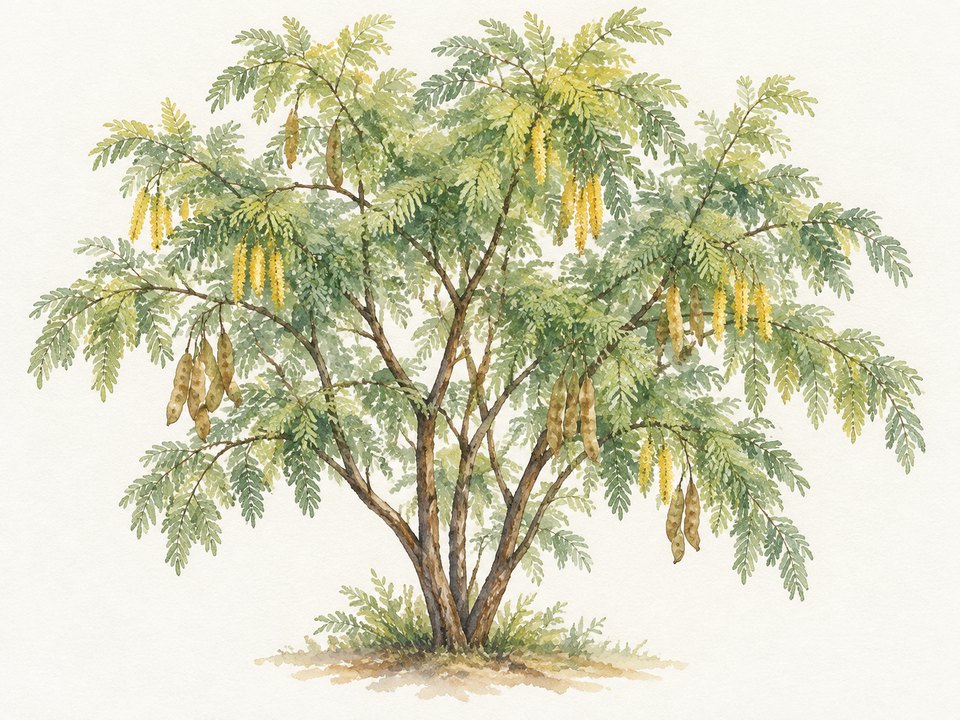
Deciduous, with lacy bright-green foliage and smooth gray bark. Yellow catkins appear in spring after the tree leafs out. The grower describes a fast growth habit.[2]
When to Plant Thornless Texas Honey Mesquite
Spring through early summer is the best window to plant Thornless Texas Honey Mesquite in San Antonio. It roots actively in warm soil, and young plants can be frost-tender, so a plant set out in spring establishes well before winter.
Fall planting leaves a young plant too little time before cold weather.
If you would like a hand, the Texas Allied Landscape team can plant your Thornless Texas Honey Mesquite and keep it thriving.
Planting
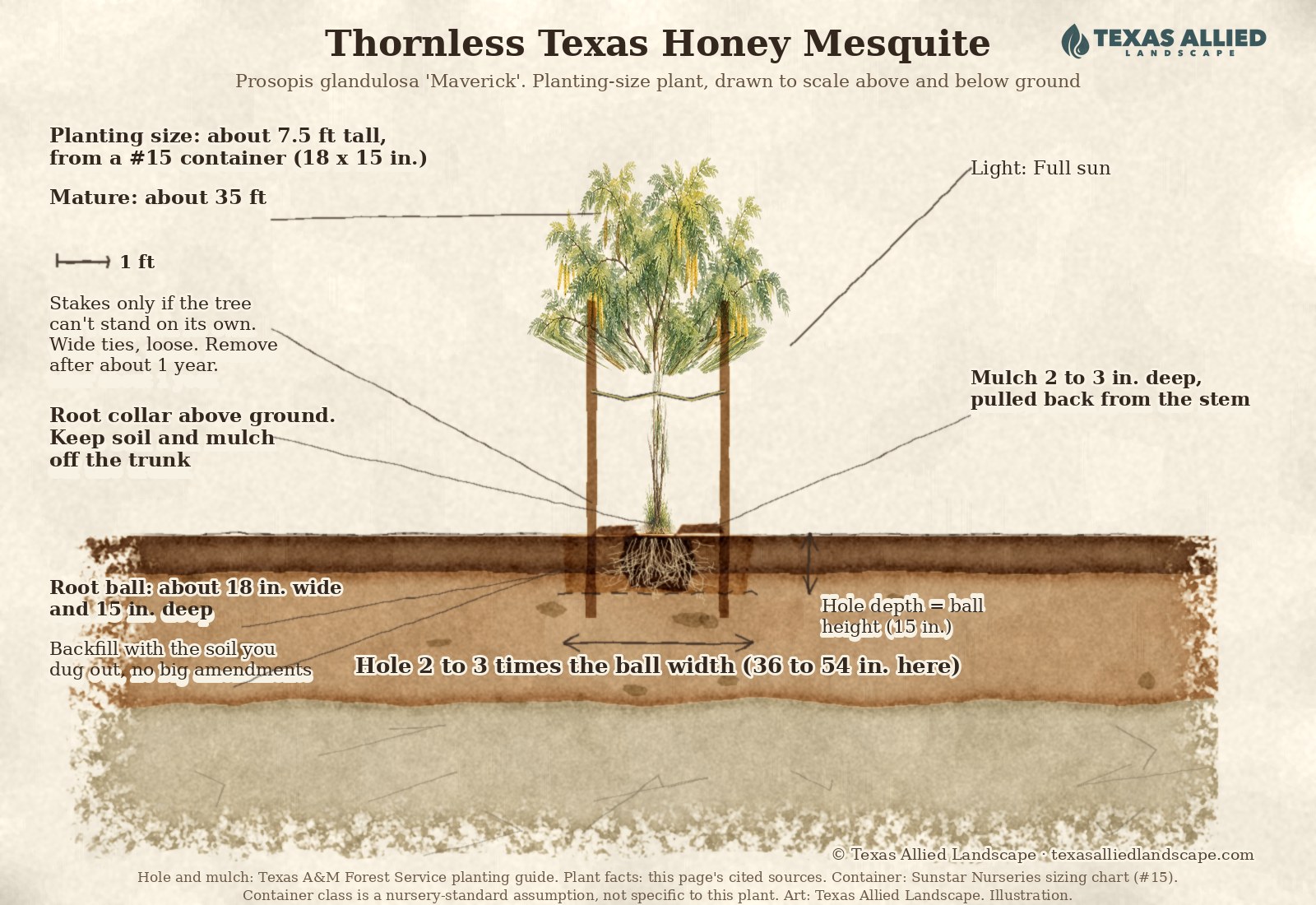
- Dig a hole at least twice as wide as the root ball and no deeper - a square hole keeps the roots from settling too deep while letting them grow out into the surrounding soil.[3]
- Fill the empty hole with water and check the drainage. If it takes longer than 24 hours to drain, choose another spot: roots sitting under water will kill the tree.[3]
- Set it with the root collar (the flare just above the roots) level with or slightly above the ground, and take off all wire, twine, containers and bags before backfilling.[3]
- Backfill with the same soil that came out of the hole, without amendments, and settle it with water rather than packing it down.[3]
- Give it room: The grower lists about 35 feet tall and wide. Leave room for its spreading crown.[2] Give the canopy and roots plenty of vertical and horizontal room.[3]
- Site: Full sun. Give infrequent, deep irrigation.[2]
- Timing: Spring through early summer is the best window to plant Thornless Texas Honey Mesquite in San Antonio.
- Water for at least the first two years, without overwatering: a thorough soaking beats light, frequent watering.[3] Once established: Deep but infrequent - it is a desert native whose roots chase water deep; shallow, frequent watering makes weak, surface roots.[4]
- Mulch 2 to 3 inches deep, out to the drip line and up to but not touching the trunk. Stake only if it cannot stand on its own and take stakes off within a year - most need no support. Do not fertilize during the first growing season.[3]
Care Instructions for Your Thornless Texas Honey Mesquite
Sunlight and water
Full sun. Give infrequent, deep irrigation.[2]
Mature height and spread
The grower lists about 35 feet tall and wide. Leave room for its spreading crown.[2]
Normal seasonal behavior
Deciduous, with lacy bright-green foliage and smooth gray bark. Yellow catkins appear in spring after the tree leafs out. The grower describes a fast growth habit.[2]
Thornless honey mesquite questions
Is the Maverick mesquite really thornless?
Yes - Maverick is a thornless selection of our native honey mesquite, so you get the shade tree without the spines.[5]
How big does a thornless mesquite get?
About 35 ft tall and wide - a broad, spreading shade tree; give it room.[6]
How much water does mesquite need?
Deep but infrequent - it is a desert native whose roots chase water deep; shallow, frequent watering makes weak, surface roots.[4]
Next step: Our horticulturalists can set up a deep-watering schedule for its first two summers.
Does mesquite drop pods?
Yes - it produces bean pods in summer. They are a minor cleanup, and wildlife and livestock relish them.[7]
Let Texas Allied Landscape care for your Thornless Texas Honey Mesquite
Thornless Texas Honey Mesquite does best with steady, knowledgeable care: the right water, pruning at the right time, and a trained eye for stress. The horticulturists at Texas Allied Landscape care for plants like yours across the San Antonio area, backed by over 40 years of landscape experience.
Sources
- Tree options for patio in Sun City West, Arizona, Lady Bird Johnson Wildflower Center Ask Mr. Smarty Plants.https://www.wildflower.org/expert/show.php?id=6517↑
- Prosopis glandulosa v. glandulosa Maverick (Thornless Texas Honey Mesquite), Mountain States Wholesale Nursery.https://mswn.com/plants/prosopis-glandulosa-maverick-thornless-texas-honey-mesquite/abcdefghij
- Planting, Texas A&M Forest Service.https://tfsweb.tamu.edu/trees/tree-care/planting/abcdefg
- Red Hills Desert Garden, "Maverick Mesquite."https://redhillsdesertgarden.com/plant/maverick-mesquite/ab
- Mountain States Wholesale Nursery, "Prosopis glandulosa 'Maverick'."https://mswn.com/plants/prosopis-glandulosa-maverick-thornless-texas-honey-mesquite/↑
- Mountain States Wholesale Nursery, "Prosopis glandulosa 'Maverick'."https://mswn.com/plants/prosopis-glandulosa-maverick-thornless-texas-honey-mesquite/↑
- Mountain States Wholesale Nursery, "Prosopis glandulosa 'Maverick'."https://mswn.com/wp-content/uploads/info-sheets/Prosopis-glandulosa-v.-glandulosa-Maverick%C2%AE.pdf↑