
Property owners
Tropical Milkweed
- Plant
- Tropical Milkweed
- Botanical name
- Asclepias curassavica
- Group
- Medium shrubs and perennials
Tropical Milkweed (Asclepias curassavica): light, water, soil, size and care for San Antonio area landscapes.
On this page
Its botanical name is Asclepias curassavica.
Foliage
It seldom goes dormant in the South Texas climate, so it can grow year-round. Native milkweeds by contrast die back to the ground in winter.[1][2]
Pruning
Tropical milkweed should be cut back every autumn, before the year's southbound monarchs arrive.[3]
Seasonal behavior
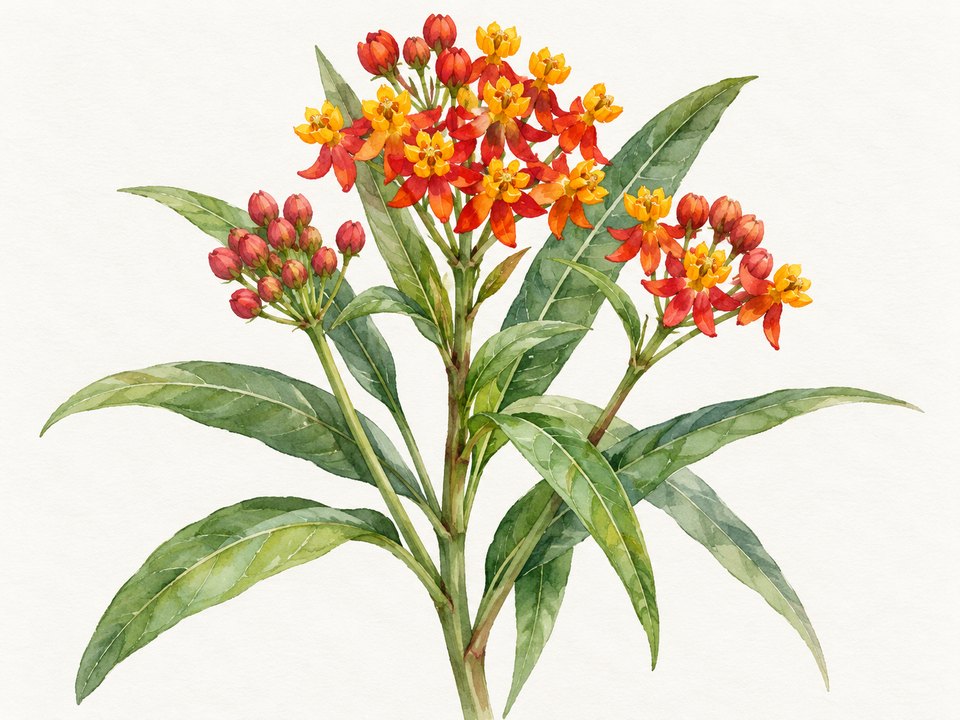
It has bright orange-yellow flowers. Monarchs readily lay eggs on it. Because it seldom goes dormant, it can play host to the OE parasite. It can sustain year-round monarch breeding, which keeps the infection cycle going. Another source recommends planting native milkweeds instead.
Light
Full sun.[4]
Soil and drainage
Moist, fertile, well-drained soil.[4]
Height
2 to 3 ft tall and 1 to 2 ft wide.[4]
When to Plant Tropical Milkweed
Tropical Milkweed is frost-tender, so plant it in spring after the last frost. That is around mid-March in San Antonio. It needs warm months ahead to establish. It often dies back to the roots in winter.
If you would like a hand, the Texas Allied Landscape team can plant your Tropical Milkweed and keep it thriving.
Planting
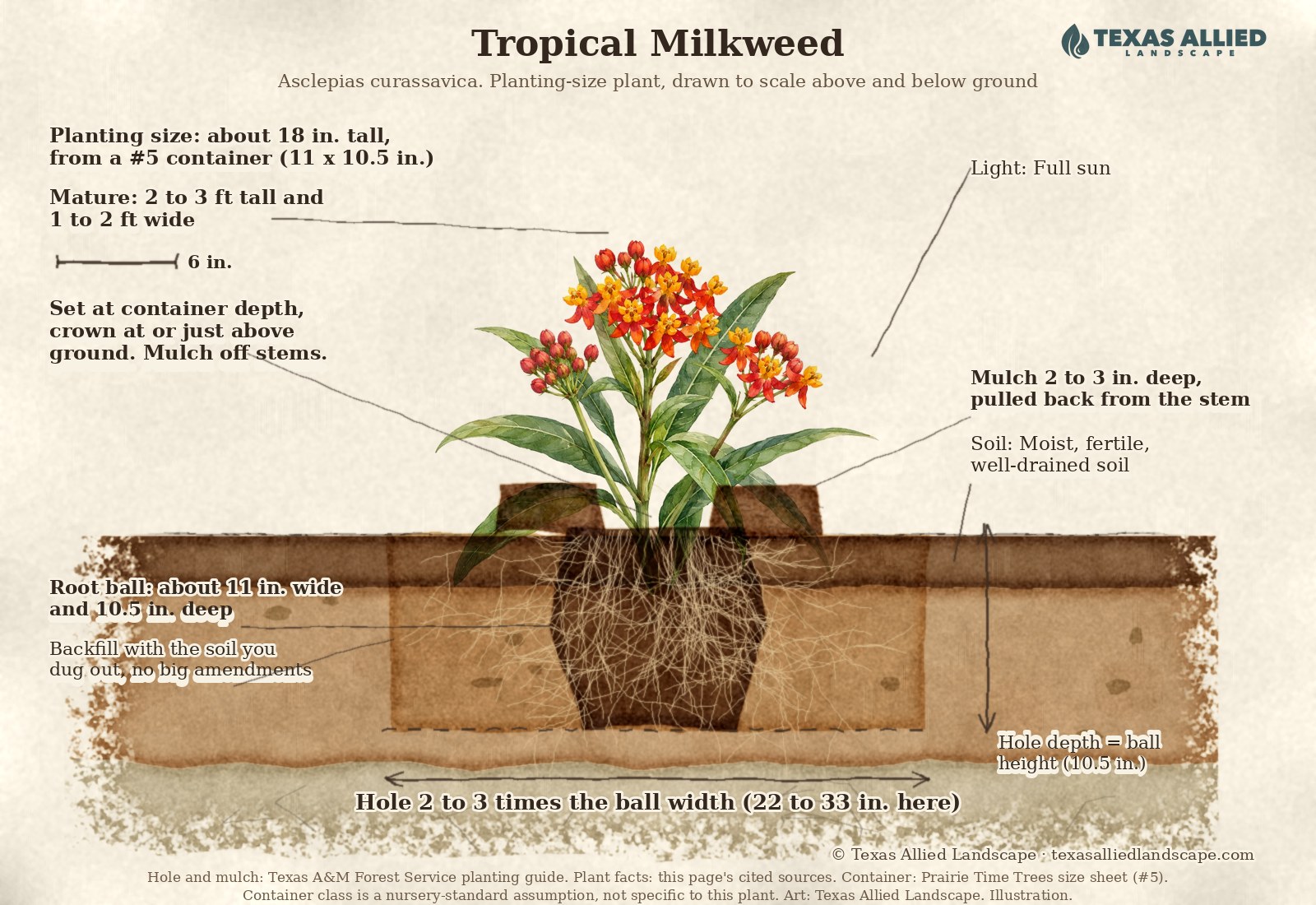
- Dig a hole twice as wide as the pot and no deeper, with sloping sides. Set the plant at the same depth it grew in its pot. Loosen any circling roots before backfilling.[5]
- For a new bed, clear grass and weeds first, roots and all.[5]
- For timing, tropical milkweed is frost-tender. Plant it in spring after the last frost, around mid-March in San Antonio.
- Soak it well at planting and keep watering while the roots establish.[5]
- Mulch 2 to 4 inches, kept a few inches away from the stems to prevent crown rot. It needs no staking or other support.[5]
Should I plant tropical milkweed for monarchs?
Choose native milkweeds instead. Tropical milkweed seldom goes dormant in South Texas, which can foster the OE parasite and year-round breeding. If you keep it, another source says to cut it back every autumn before the southbound monarchs arrive.
Care Instructions for Your Tropical Milkweed
How to Water a Tropical Milkweed
Pruning
Tropical milkweed should be cut back every autumn, before the year's southbound monarchs arrive.[3]
Normal seasonal behavior
It has bright orange-yellow flowers. Monarchs readily lay eggs on it. Because it seldom goes dormant, it can play host to the OE parasite. It can sustain year-round monarch breeding, which keeps the infection cycle going. Another source recommends planting native milkweeds instead.
Tropical milkweed questions
Is tropical milkweed bad for monarchs?
It can be. Because it stays green late, monarchs linger and a parasite (OE) builds up on it. The fix in South Texas is simple: cut it to the ground every fall.[6]
When should I cut back tropical milkweed?
Cut it every October or November, to within a few inches of the ground. That way migrating monarchs move on and parasites do not overwinter.[7]
Next step: Our horticulturalists can put the annual fall cutback on your maintenance calendar.
Does tropical milkweed come back after a freeze?
Usually yes, in Central Texas. It dies to the ground in a freeze and returns from the roots in spring.[8]
Should I plant native milkweeds instead?
Native milkweeds like butterfly weed and antelope horns are the better choice where they fit. They go dormant on schedule with the monarchs.[9]
Let Texas Allied Landscape care for your Tropical Milkweed
Tropical Milkweed does best with steady, knowledgeable care. That means the right water, pruning at the right time, and a trained eye for stress. The horticulturists at Texas Allied Landscape care for plants like yours across the San Antonio area. They bring over 40 years of landscape experience.
In these community guides
- Art in progress
Esperanza Landscaping
Plan your Esperanza landscape with help on plants, irrigation and the approval package. We check your neighborhood, lot…
Sources
- Milkweed for Monarchs, San Antonio Water System - Garden Style San Antonio.https://www.gardenstylesanantonio.com/garden-articles/milkweed-monarchs/↑
- Should Mexican milkweed (Asclepias curassavica) not be used to attract Monarch butterflies?, Lady Bird Johnson Wildflower Center - Ask Mr. Smarty Plants.https://www.wildflower.org/expert/show.php?id=11318↑
- Use native milkweeds for migrating monarchs, San Antonio Water System - Garden Style San Antonio.https://www.gardenstylesanantonio.com/garden-articles/use-native-milkweeds-for-migrating-monarchs/ab
- Asclepias curassavica (Tropical Milkweed), North Carolina Extension Gardener Plant Toolbox.https://plants.ces.ncsu.edu/plants/asclepias-curassavica/abc
- Back to basics: Planting perennials, SAWS Garden Style San Antonio.https://www.gardenstylesanantonio.com/garden-articles/back-to-basics-planting-perennials/abcd
- City of Austin Grow Green plant guide, "Butterfly Weed, Mexican (Tropical Milkweed)."https://www.austintexas.gov/watershed-protection/plant-guide/butterfly-weed-mexican-tropical-milkweed↑
- Dallas County Master Gardeners, "How to Help the Monarch Butterflies."https://dallascountymastergardeners.org/how-to-help-the-monarch-butterflies/↑
- City of Austin Grow Green plant guide, "Butterfly Weed, Mexican (Tropical Milkweed)."https://www.austintexas.gov/watershed-protection/plant-guide/butterfly-weed-mexican-tropical-milkweed↑
- Texas Living Coast, "Texas Native Milkweeds."https://www.tlcnp.org/texas-native-milkweeds↑