
Property owners
Variegated Flax Lily
- Plant
- Variegated Flax Lily
- Botanical name
- Dianella tasmanica
- Group
- Low shrubs and perennials
Variegated Flax Lily (Dianella tasmanica): light, water, soil, size and care for San Antonio area landscapes.
On this page
Its botanical name is Dianella tasmanica.
Light
It likes part shade to filtered sun. It tolerates full sun only in cooler climates with adequate moisture.[1]
Soil and drainage
It likes humus-rich, well-drained loam, sandy loam or improved clay. Avoid constantly wet soil.
Height
It typically grows 1.5 to 3 feet tall. Some forms reach 3 to 4 feet.
Spread
It often grows 2 to 4 feet wide. It spreads slowly by creeping rhizomes.
Foliage
It is an evergreen, rhizomatous perennial.
Water
It wants regular to moderate moisture. It is not a xeric plant. If watering ever feels like a guessing game, our horticulturists can care for your Variegated Flax Lily on a schedule that fits your yard.
Seasonal behavior
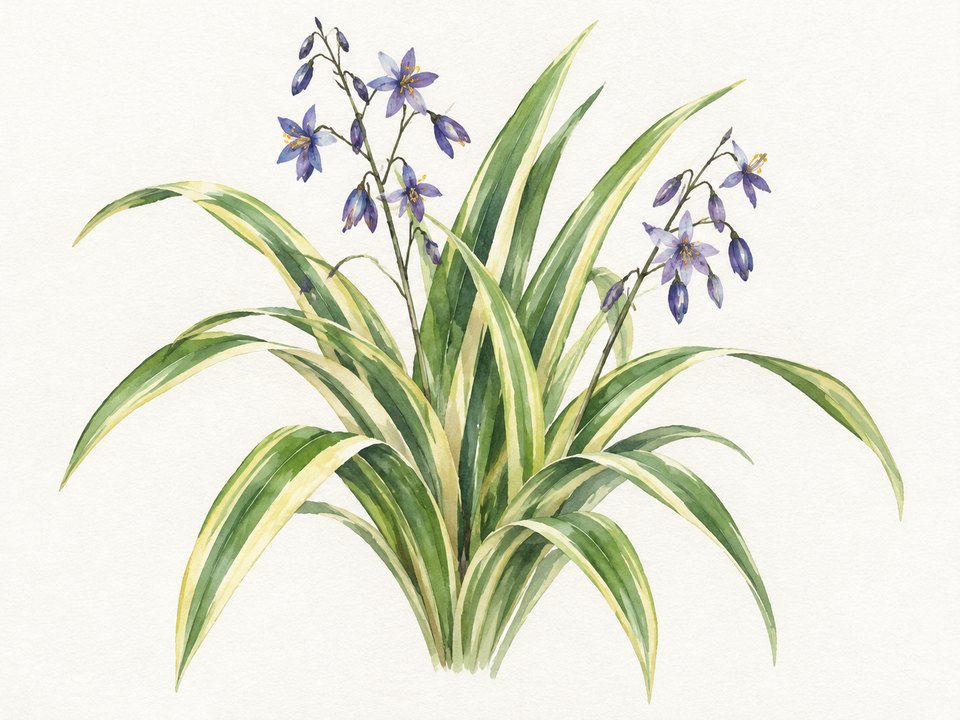
It has blue starry flowers, followed by ornamental violet-blue berries. The foliage is the main feature.
When to Plant Variegated Flax Lily
Variegated Flax Lily is frost-tender, so plant it in spring after the last frost, around mid-March in San Antonio. It needs warm months ahead to establish. It often dies back to the roots in winter.
If you would like a hand, the Texas Allied Landscape team can plant your Variegated Flax Lily and keep it thriving.
Planting
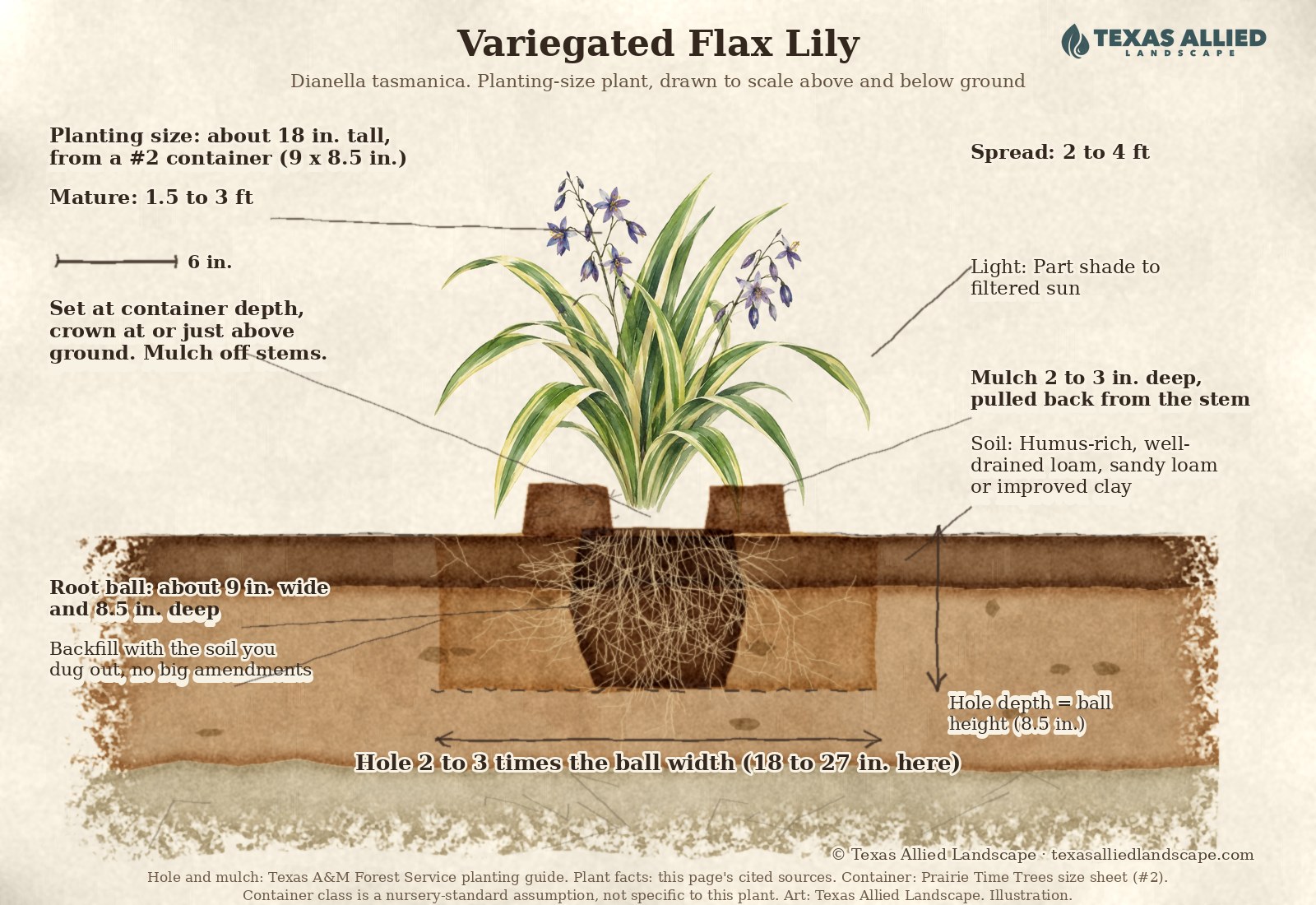
- Dig a hole twice as wide as the pot and no deeper, with sloping sides. Set the plant at the same depth it grew in its pot. Loosen any circling roots before backfilling.[2]
- For a new bed, clear grass and weeds first, roots and all.[2]
- Site: It likes part shade to filtered sun. It tolerates full sun only in cooler climates with adequate moisture.[1]
- Timing: Variegated Flax Lily is frost-tender, so plant it in spring after the last frost, around mid-March in San Antonio.
- Soak it well at planting and keep watering while the roots establish.[2] Once it is established, give it regular water at first and then moderate water. It is tougher than it looks, but it is not desert-dry.[3]
- Add 2 to 4 inches of mulch, kept a few inches away from the stems to prevent crown rot. It needs no staking or other support.[2]
How much sun can variegated flax lily take?
It takes part shade to filtered sun, and the source warns against constantly wet soil. Full sun works only in cooler climates with adequate moisture. So in Central Texas, treat it as a shade plant.
Care Instructions for Your Variegated Flax Lily
How to Water a Variegated Flax Lily
It wants regular to moderate moisture. It is not a xeric plant.
Sunlight
It likes part shade to filtered sun. It tolerates full sun only in cooler climates with adequate moisture.[1]
Soil and drainage
It likes humus-rich, well-drained loam, sandy loam or improved clay. Avoid constantly wet soil.
Mature height and spread
It typically grows 1.5 to 3 feet tall, and some forms reach 3 to 4 feet. It often grows 2 to 4 feet wide, spreading slowly by creeping rhizomes.
Normal seasonal behavior
It has blue starry flowers, followed by ornamental violet-blue berries. The foliage is the main feature.
Variegated flax lily questions
Sun or shade for variegated flax lily?
Give it shade to part shade. It is one of the best striped-foliage plants for brightening dark beds.[4]
Is flax lily cold hardy here?
Marginally. It sails through mild winters, but a hard freeze burns or kills the top. It often returns from the roots. Mulch it before a freeze.[5]
How big does flax lily get?
It grows about 1 to 2 feet tall and slowly spreads into clumps. It makes a tidy border or mass under trees.[6]
How much water does flax lily need?
Give it regular water to establish it, and then moderate water. It is tougher than it looks, but it is not desert-dry.[3]
Next step: Our horticulturalists can set its zone with your other shade plants.
Let Texas Allied Landscape care for your Variegated Flax Lily
Variegated Flax Lily does best with steady, knowledgeable care. That means the right water, pruning at the right time, and a trained eye for stress. The horticulturists at Texas Allied Landscape care for plants like yours across the San Antonio area. They are backed by over 40 years of landscape experience.
In these community guides
Illustration. Illustration based on reference photos of The Dominion. Not a single literal view. The Dominion Landscaping
Plan your Dominion landscape with help on planting, irrigation and the ACC package. We check your lot's standards and…
Sources
- Tasman flax lily (Dianella tasmanica), Gardenia.net.https://www.gardenia.net/plant/daniella-tasmanica-tasman-flax-lily-grow-care-guideabc
- Back to basics: Planting perennials, SAWS Garden Style San Antonio.https://www.gardenstylesanantonio.com/garden-articles/back-to-basics-planting-perennials/abcd
- Comal County Master Gardeners, "Featured Plant: Flax Lily."https://comalmg.org/featured-plant-3/ab
- Comal County Master Gardeners, "Featured Plant: Flax Lily."https://comalmg.org/featured-plant-3/↑
- Texas Master Gardeners, "Variegated Flax Lily."https://txmg.org/hendersonmg/files/2020/06/FLAX-LILY-VARIEGATED.pdf↑
- Chicago Botanic Garden, "Dianella tasmanica 'Variegata'."https://www.chicagobotanic.org/plant-information/plant-finder/dianella-tasmanica-variegata-variegated-flax-lily↑