
Property owners
Huntington Landscaping
Enjoy shade, planting and outdoor space that fit your Huntington home. Start with your lot rules and a clear plan for approval, installation and care.
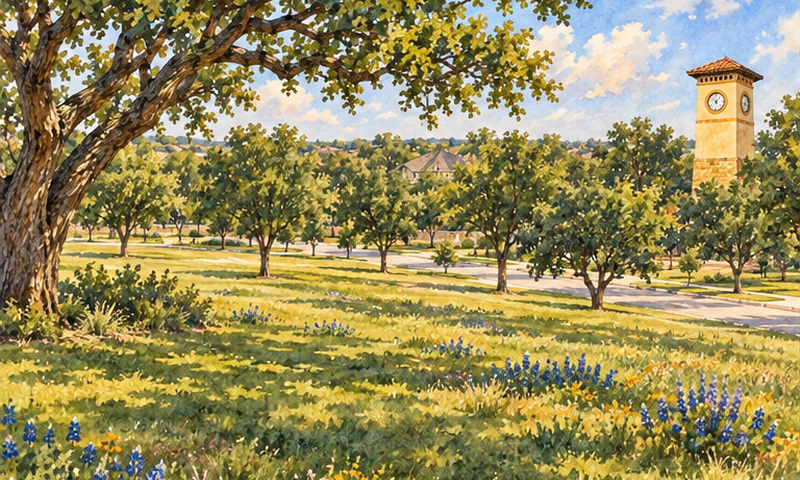
Get a quoteIllustration based on reference photos of Huntington. Not a single literal view.
On this page
Make your Huntington yard a comfortable place to relax. Gather and enjoy the shade. Thoughtful planting and watering can work together. Outdoor space can fit the way you live. Start with your lot's rules and a clear plan. You can build the approved design with fewer surprises.
Plan, submit, review, then build
Confirm the current checklist before filing. Check the documents for your lot too. These steps follow the base review process.[1]
Prepare the site and planting plan.
Prepare preliminary plans before final plans. List the qualified contractor. Give expected start and finish dates. For initial home construction, provide two scaled landscape plans. The minimum scale is 1 inch to 10 feet. The ACC may change the submittal requirements. Show structures, paving and other site features. Name each plant and show its size and location. Map existing trees at least 6 inches in diameter. Show their approximate location, size and type.[1]
Submit before installation.
Get Architectural Control Committee, or ACC, approval before installation. It must cover landscape designs and plant materials. Specific approval is also needed to remove certain trees. This covers trees over 6 inches in diameter. You may want to change an installed approved plan later. That needs a written request. Check for separate clearing or drainage requirements before work. Check for public permit requirements too.[1]
Wait for the written decision.
The base review period is 30 days. It starts when the required plans and written approval request are received. Incomplete plans do not start the clock. Deemed approval cannot permit a covenant violation or an unsubmitted change. It cannot permit a matter needing a written variance either. A variance needs express written approval. Silence after 30 days means denial.[1]
Return the approval letter, then install.
Sign and return the approval letter before construction begins. Build to the approved plan. Obtain written approval for exterior changes. Initial landscaping must be installed within 90 days of first occupancy. So must irrigation. For an existing yard, confirm the deadline that applies to your project.[1]
Yard coverage, sightlines and hardscape
Rock and materials other than dirt and vegetation have a limit. Keep them within 10% of the defined front-yard area. Exclude approved driveways and sidewalks. This limit measures those materials only. A minimum turf percentage is not established by it. Artificial vegetation is prohibited in front and side yards.[1]
Keep hedges behind the main structure's front setback line. Apply that rule to hedges. Check flowers, groundcovers and building setbacks. Check easements and corner sightlines under the rules that govern them.[1]
The corner sightline rule bars obstructions within a triangle. It covers heights between 2 and 6 feet above the road. Measure using points 25 feet from the curb-line intersection. Tree foliage must stay high enough to preserve those views. A platted clear-vision easement has a stricter rule. No structure, wall, fence or vegetation may exceed 2 feet high. Confirm the exact plat before planting.[1]
Drainage-easement planting needs an ACC-approved landscape plan. Grade and drainage work must not impede or speed up the natural flow. It must not divert or increase it either. Check the approved engineering plan before proposing planting there. Check utility access rights too.[1]
All hardscape selections need ACC approval. Railroad-tie retaining walls are prohibited. Keep certain items out of front and side yards. They include statues, statuary fountains and multi-tier planters. Above-ground pots or plant holders are included too. So is concrete or other lawn furniture. Lot-specific and later documents still need checking.[1]
Check the phase, plat and lot
Phase II, III, IV and V land listed in the annexations comes under the base declaration. Added terms apply. Those four annexations add no new named plant palette. Check the other terms for your lot.[2][3][4][5]
Phase V includes residential Lots 2120-2133, Block 34, and 2176-2190, Block 36. Its 2022 annexation also identifies common areas. These are Lots 2142 and 2143, Block 34. Work affecting grade, drainage, berms or swales must follow its attached drainage plan. The declaration applies too. Street-light easements affect the designated lots and adjoining lots.[5]
The Phase V fence terms are also specific. They call for an 8-foot wooden fence with cap and trim. It goes along the rear of Lots 2130-2133, Block 34. It also covers the western side of Lots 2129 and 2143, Block 34. Fence-lot owners maintain it. The association has a right to maintain or replace it. It has no duty to do so. A 5-foot fence easement supports that work. Use this 8-foot requirement only for the listed locations.[5]
Phase IV and V allow separate written instruments for consolidated lots. They may change lines, setbacks, fencing and landscaping. Other reviewed waivers address specific lots. Check that chain before applying a setback or plant rule to an address.[2][3][4][5]
Later records can change common-area boundaries too. An October 2025 deed refers to replatted Lot 2145. Its attached survey describes a portion of former Lot 2142. Use the current plat and deed together. This helps place a planting boundary.[6]
Drainage and aquifer protection
Follow the water-quality controls that apply to your site. The recovered 2005 TCEQ approval letter sets conditions for erosion. It covers soil stabilization and pollution prevention too. Stop work if a previously unidentified sensitive feature is found during construction. Notify the agency. The complete approved engineering application is still missing.[1][7]
The rules also name a separate Cave Protection Management Plan. That plan is still missing. So is the complete current water-quality engineering set. Confirm today's acreage and impervious-cover limits from the actual plans. Earthwork and drainage changes need the actual plan before installation. So does work near a sensitive feature. Get any required public approvals first too.[1][7]
Plan for at least four front-yard trees
Keep or plant at least four trees in each front yard. Choose from this list:
- Live oaks must be at least 3 inches in diameter.
- Cedar elms must be at least 3 inches in diameter.
- Red oak must be at least 3 inches in diameter.
- Multi-trunk mountain laurel must be at least 6 feet high.[1]
These choices cover the four-tree front-yard minimum. Get the full approved plant list. Do this before choosing the rest of the yard. The live-oak and red-oak names leave the scientific species unresolved. Have the ACC confirm them before ordering nursery stock.
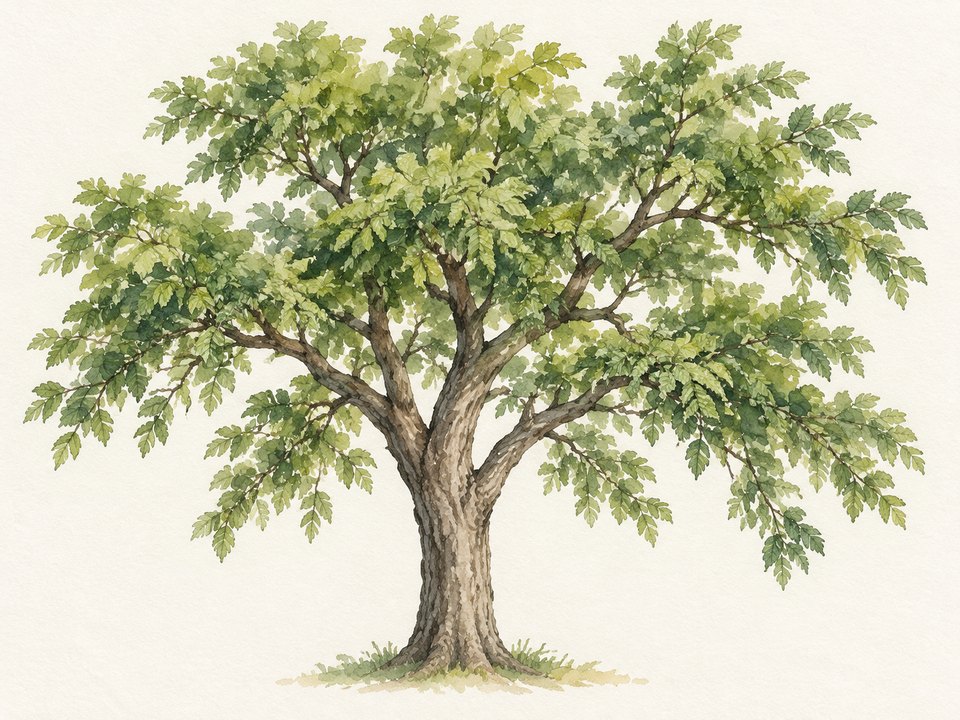
The cards below illustrate cedar elm and Texas mountain laurel. Keep the required size on your plan. Show the approval too. Live-oak and red-oak cards are held back. First, the species must be confirmed.
 Illustration
Cedar ElmUlmus crassifoliaIllustration 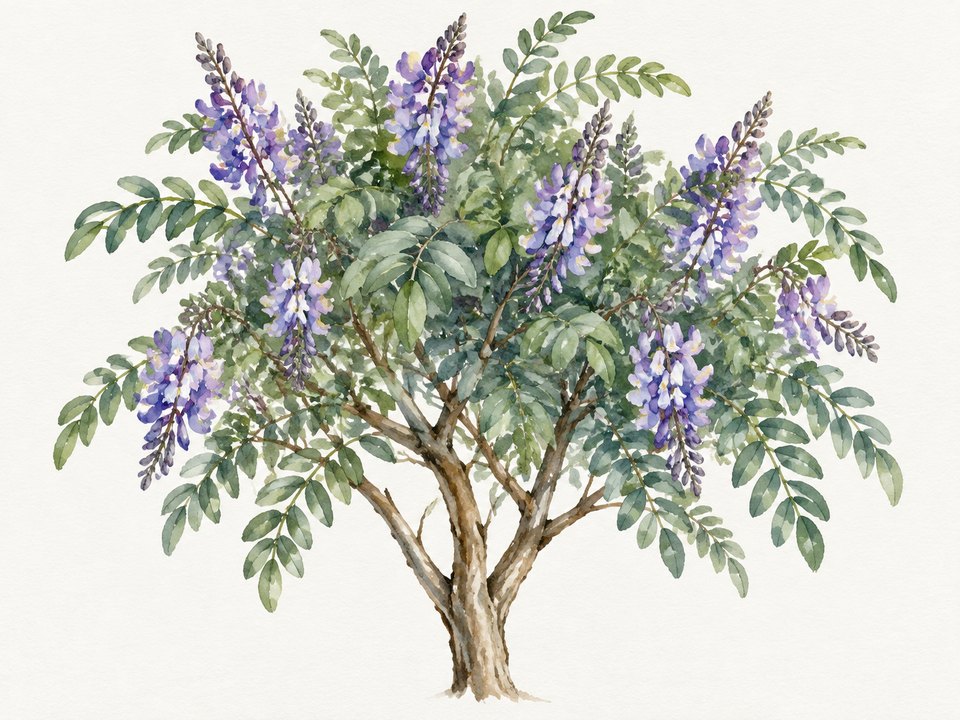 Illustration
Mountain LaurelSophora secundifloraIllustration
Get ACC approval for all plant material. Use drought-tolerant plants and trees. They should need little water to survive and grow. Indigenous plants may be used with approval. Ask the ACC for its approved plant list. It must make that list available. That separate list remains unrecovered in the records checked so far.[1]
Mulch, water and screening
Complete landscaping is required in front yards. It is required along the street side of corner lots too. Native mulch is recommended for planted and landscaped areas. Use at least 4 inches.[1]
Owners must water and maintain planting. This includes landscape and pedestrian easements. Low-flow, water-efficient irrigation is recommended. It should cover at least the front and side yards. The separate maintenance clause covers existing irrigation systems. They must stay in working order.[1]
Evergreen planting must screen broad concrete areas at circular drives. This also applies at certain side-loaded three- or four-car drives. Circular-drive and parking-court planting areas have a separate rule. They need a 24-inch berm or material screening. Outdoor equipment must be out of view from streets and common areas. Otherwise, fully screen it with evergreen planting or fencing.[1]
Artificial turf needs a lot-specific decision
Artificial vegetation is prohibited in front and side yards. A 2022 recorded variance allowed artificial turf for one lot at 127 Whittingham Road. It covered only the areas shown on that owner's attached plan. The owners must keep the turf in good condition. The variance does not cover future development of that property. For any other lot or future development, get a separate written decision.[1][8]
Tree care and chemical rules need a careful check
Use naturally occurring fertilizers and pesticides under the base chemical rule. It bars traditional commercially produced chemicals. A separate older oak-wilt clause names a fungicide. It is a fungus treatment. Get the conflict resolved before choosing a treatment.[1]
Older pruning and wound-dressing directions also remain in the recorded rules. Confirm the governing rule and applicable law before pruning or treatment. Get current advice from a qualified tree-care professional too.
Fences and security lighting
Use the front-fence standards adopted in the 2021 security policy. A front fence may be no more than 3 feet high. So may a side-fence section forward of the house front. Use wrought iron with black powder coating or black epoxy paint. Netting, mesh, windscreens and other screening materials are prohibited. Other perimeter fencing follows the declaration. New or changed security measures need architectural approval. Get it before work.[9]
Security lighting must stay on the owner's property. Keep it there. Limit spillover. A fence crossing drainage must not significantly interfere with water flow. It must meet public regulations. These are dated policy terms. Later policies and lot-specific supplements still need checking.[9]
Maintenance by lot type
Follow the maintenance standards recorded November 3, 2026. They replace earlier policies on the same subjects. They cover land under the declaration. They cover land annexed into the association too. Use the requirements for your lot type:[10]
- Unimproved lots have a 12-inch limit throughout the lot. Keep grass, weeds, brush and similar vegetation within it. Remove dead vegetation and debris. Maintain signs and temporary barriers. Do not use the lot to store equipment, trailers, machinery or building materials. Maintenance is required at least in January, April, July and October. Inspections come at the end of those months. Violations may be found outside that schedule too. They may also be addressed then.
- Lots under active construction have the same 12-inch vegetation limit. Keep materials orderly and use dumpsters. Remove waste regularly and maintain temporary barriers. Remove temporary installations promptly when construction ends. Remove debris too.
- Improved lots have a 6-inch limit throughout the yard. Keep grass, weeds and similar vegetation within it. Remove dead vegetation and debris. Do not store equipment, trailers, machinery or company vehicles in street view. The governing documents may permit exceptions.[10]
Notice, fines and association-arranged work remain subject to the governing documents and law. So do other remedies. This maintenance policy adds no new fine amount. It adds no new plant palette. Check tree-removal approval separately.
Keep deliveries off the private streets
Keep landscape and construction materials off association road property, even temporarily. Keep dumpsters, pallets and heavy equipment off it too. These road-protection terms were recorded November 3, 2026. Deliver inside the lot or another lawful place. Do not wash or sweep materials into streets or gutters. Keep them out of drainage areas and neighboring land too. Report an accidental spill to management and remove it safely right away.[11]
Owners, builders and developers must tell contractors about the policy before work begins. Tell delivery companies too. The Board must find that the prohibited activity caused verified road damage. In that case, the policy lists a $2,500 fine per occurrence. Actual damage comes on top. So do reasonable inspection, cleanup, testing, repair and restoration costs. Placing materials on the road without verified damage is still a violation. The policy directs that case to the general enforcement policy.[11]
The policy requires the applicable notice and hearing process first. This applies before a fine or property-damage charge. Request a hearing by the thirtieth day after notice is mailed. Its first page has a handwritten October 28, 2026 effective date. Its certification says effective upon recording. This guide does not decide responsibility for an earlier event. It uses neither date for that purpose.[11]
Service vehicles and parking
Do not park on grass, mulch, gravel or other natural surfaces. That is under the March 18, 2025 parking rules. Service and delivery vehicles may park temporarily on the street in daylight. Stay only for the time reasonably needed for service or delivery. Necessary construction vehicles have a separate exception. It covers the time of necessity. Do not block traffic, sidewalks, emergency access or hydrants.[12]
Keep the temporary parking exception separate from the later road-property ban. That ban covers storing heavy equipment or materials. Check the delivery and staging plan before work. On lots, construction equipment has a limited temporary exception. It applies to an ACC-approved project. General equipment storage needs the right screening and location. Follow the policy for both.[11][12]
Fines and hearing terms
The fine schedule recorded November 3, 2026 replaces earlier policies on the same subjects. Lawn and landscape maintenance fines are listed at $500 per occurrence or $500 per day. An exception covers conditions protected by Section 202.008 of the Texas Property Code. Tree maintenance has the same listed amount. Installing an unapproved improvement has a separate category. It is $500 per occurrence or $500 per week. These are written-policy amounts. Current law and the facts of the case still matter. Actual enforcement behavior remains unverified.[13]
For a curable violation that does not threaten health or safety, a demand letter is required. It must give a reasonable cure deadline. It must explain the right to request a Board hearing. That request is due within 30 days after mailing. If cured by the stated date, this policy bars a fine for that violation. Courtesy and violation letters are optional. A demand letter may be the first notice. The same or a similar violation may recur within six months. A separate notice exception covers that case.[13]
The timing for remedies remains unclear. Two clauses describe remedies after the 30-day hearing-request period. This applies when no hearing is requested. Another allows remedies after mailing, regardless of a hearing request. Ask for the deadline in writing. Specified cost recovery and association-arranged work are also allowed. So are legal action and access suspensions. Policy terms and law apply.[13]
Deposit, fees and missing records
For initial required landscape installation, the base rule requires a $2,000 security deposit. Submit it with the required plans. Keep this deposit separate from any application fee. The association may use it for covered obligations. After compliant installation, it returns the remaining balance. The owner must not be in default. Confirm whether this dated initial-installation term applies to your work. A deposit for every existing-yard project remains unverified.[1]
The ACC may charge reasonable application-processing fees. Confirm the current project fee and submission route before filing. Both remain unverified here. The separate architectural guidelines and full approved plant list remain open checks. So do current water-quality plans. A complete rule chain for a specific lot is another gap.
Huntington landscape questions
Do the four tree choices cover all plants for my yard?
They cover the front-yard tree minimum. Ask the ACC for its full approved plant list. Confirm live-oak and red-oak species before buying. Every plant choice needs approval.[1]
May I copy another owner's artificial turf?
Where should a landscape delivery go?
Keep materials, pallets, dumpsters and heavy equipment off association road property. Arrange space inside the lot or another lawful place. Tell contractors and delivery companies before work.[11]
Plan your Huntington yard
Texas Allied Landscape can help turn your ideas into a clear plan. It can cover plants and materials. Share your address, survey and goals. We can review tree work, drainage, irrigation and planting together. Then we build after the required written approvals.
Documents and limits of this guide
Sources were reviewed November 9, 2026. Twenty-eight packets were read in text. They totaled 238 pages. The operative passages used here were checked in another way too. They were checked against page images. This is a dated guide to the reviewed documents. It is not legal advice or a complete rule set for every address.
Your community profile
Huntington has landscape-review rules and front-yard tree choices. It has separate rules for drainage, maintenance and deliveries. Check the phase and lot on your deed and survey. Do this before using a rule for your home.
Community profile
Huntington
1 permissive5 protective
| Design latitude | — |
|---|---|
| Approval scope | 5/5 |
| Approval layers | — |
| Approval cost | — |
| Plan preparation | 3/5 |
| Enforcement capability | 4/5 |
Higher means more documented control or burden, not a better community.
Design latitude
—
- 1
- 2
- 3
- 4
- 5
How much of the plant and design palette is prescribed. A higher score means less design freedom.
Why this score
Yard choices have several limits, but the separate architectural guidelines and full approved plant list remain unrecovered. The four front-yard tree choices cover the tree minimum only. Design latitude stays unverified.
Approval scope
5/5
- 1
- 2
- 3
- 4
- 5 (this score)
How much exterior work needs written sign-off.
Why this score
Get ACC approval for landscape designs and all plant material. Submit detailed plans before installation, get specific tree-removal approval and request later changes in writing. This score covers the reviewed rules; check exceptions for your lot.
Approval layers
—
- 1
- 2
- 3
- 4
- 5
Counts distinct required community reviewers only. City, county and state permits, optional steps and repeat submissions are not counted.
Why this score
The ACC reviews landscaping in the located rules. The separate guidelines and complete rule chain for your lot remain unverified, so the total number of community reviewers stays unknown. Public permits are separate.
Approval cost
—
- 1
- 2
- 3
- 4
- 5
What the community's own approval process costs to apply.
Why this score
A $2,000 security deposit is named for initial landscaping. Reasonable processing fees are allowed. Confirm the current charge for your project; a fixed fee for every existing-yard change remains unverified.
Plan preparation
3/5
- 1
- 2
- 3 (this score)
- 4
- 5
How much drawing and documentation an application needs.
Why this score
Submit scaled plans with plant names, sizes and locations, existing-tree details and contractor information. These are plan-package requirements. The reviewed plan terms do not by themselves require a professional designer for every landscape plan.
Enforcement capability
4/5
- 1
- 2
- 3
- 4 (this score)
- 5
Which remedies the verified governing documents and adopted policies provide. The score reflects verified documented provisions, not observed enforcement practice or legal conclusions. Not finding an express clause is not a conclusion that no authority exists.
Why this score
The fine schedule recorded November 3, 2026 lists lawn and landscape maintenance fines at $500 per occurrence or $500 per day, tree maintenance at the same amount, and installing an unapproved improvement at $500 per occurrence or $500 per week, subject to its notice and hearing terms.
This guide covers the 2008 declaration and Phase II-V annexations. It covers later recorded policies through November 2026 too. The separate architectural guidelines remain unrecovered in the records checked. So does the full approved plant list. A complete rule chain for your lot also remains open. Consolidated lots, easements and recorded waivers may change the answer.[1][2][3][4][5]
Sources
- Shavano Park Unit 19C Phase I Declaration, Doc. 20080063331, recorded March 27, 2008, Book 13416 p. 1936. ACC process PDF pp. 9-11 and 33; maintenance and oak wilt pp. 36-37; yards p. 41; artificial vegetation p. 42; drainage, screening and sightlines pp. 45-48; landscape, tree choices, deposit and chemicals pp. 49-51. Sourcehttps://bexar.tx.publicsearch.us/doc/9181559abcdefghijklmnopqrstuvw
- Phase II annexation, Doc. 20130004209. All 10 pages read. Sourcehttps://bexar.tx.publicsearch.us/doc/12469671abc
- Phase III annexation, Doc. 20160026282. All eight pages read. Sourcehttps://bexar.tx.publicsearch.us/doc/13253697abc
- Phase IV annexation, Doc. 20180177560. All 10 pages read, including lot-specific and consolidated-lot terms. Sourcehttps://bexar.tx.publicsearch.us/doc/16656379abc
- Phase V Certificate of Annexation and Supplemental Declaration, Doc. 20220153372, recorded June 21, 2022. All nine pages read; lot scope pp. 1-2, drainage, lights and fence terms p. 2, consolidation and incorporation p. 3, drainage plan p. 5. Sourcehttps://bexar.tx.publicsearch.us/doc/117706082abcde
- Special Warranty Deed, Doc. 20250191984, recorded October 15, 2025. All six pages read. Deed p. 1 names replatted Lot 2145, Block 34, with plat Vol. 20003 pp. 1289-1290; survey and field notes pp. 3-5 describe part of Lot 2142 on the earlier plat. Sourcehttps://bexar.tx.publicsearch.us/doc/288398039↑
- Recorded water-pollution abatement instrument, Doc. 20050225913, Book 11673 p. 98, including the September 1, 2005 TCEQ approval letter. All 11 pages read. This record is not the full approved application or a current engineering certification. Sourcehttps://bexar.tx.publicsearch.us/doc/8564509ab
- Huntington lot-specific Variance to Restrictions, Doc. 20220230075, recorded September 23, 2022, PDF pp. 1-2 and attached plan p. 5. Sourcehttps://bexar.tx.publicsearch.us/doc/147503094ab
- Huntington 2021 recorded policy bundle, Doc. 20210360484, recorded December 29, 2021. All 24 pages read in text; Security Measures Policy PDF pp. 17-20 also visually checked. Sourcehttps://bexar.tx.publicsearch.us/doc/106461892ab
- Huntington Lot Maintenance Policy, Doc. 20260215593, recorded November 3, 2026. All five PDF pages read. Sourcehttps://bexar.tx.publicsearch.us/doc/332227313ab
- Huntington Road Protection, Damage, and Fine Policy, Doc. 20260215598, recorded November 3, 2026. All five PDF pages read in text and images. Conduct, responsibility and fine pp. 1-2; notice, hearing and effective-date terms p. 3. Sourcehttps://bexar.tx.publicsearch.us/doc/332227333abcde
- Huntington Parking and Towing Policy, Doc. 20250047128, recorded March 18, 2025. All nine PDF pages read in text; scope and operative parking pages 1 and 4-7 visually checked. Sourcehttps://bexar.tx.publicsearch.us/doc/233476300ab
- Huntington Enforcement and Fine Policy, Doc. 20260215588, recorded November 3, 2026. All nine PDF pages read in text and images. Notice and hearing terms pp. 2-3 and 5-7; remedy-timing tension pp. 3-4; fine table pp. 4-5. Sourcehttps://bexar.tx.publicsearch.us/doc/332227319abc