
Property owners
American Elm
- Plant
- American Elm
- Botanical name
- Ulmus americana
- Group
- Shade trees
Sourced light, water, size and care details for American Elm.
On this page
Its botanical name is Ulmus americana.
It belongs to the large trees group.
Light
Soil and drainage
It is adaptable. It grows in clay to sandy soils and tolerates both wet bottomlands and ordinary yards. It is a tough native of Texas river bottoms.[3]
Height
It reaches 60 to 80 feet at maturity, and it is fast-growing.
Spread
It spreads 40 to 60 feet into the classic high vase-shaped canopy.
Foliage
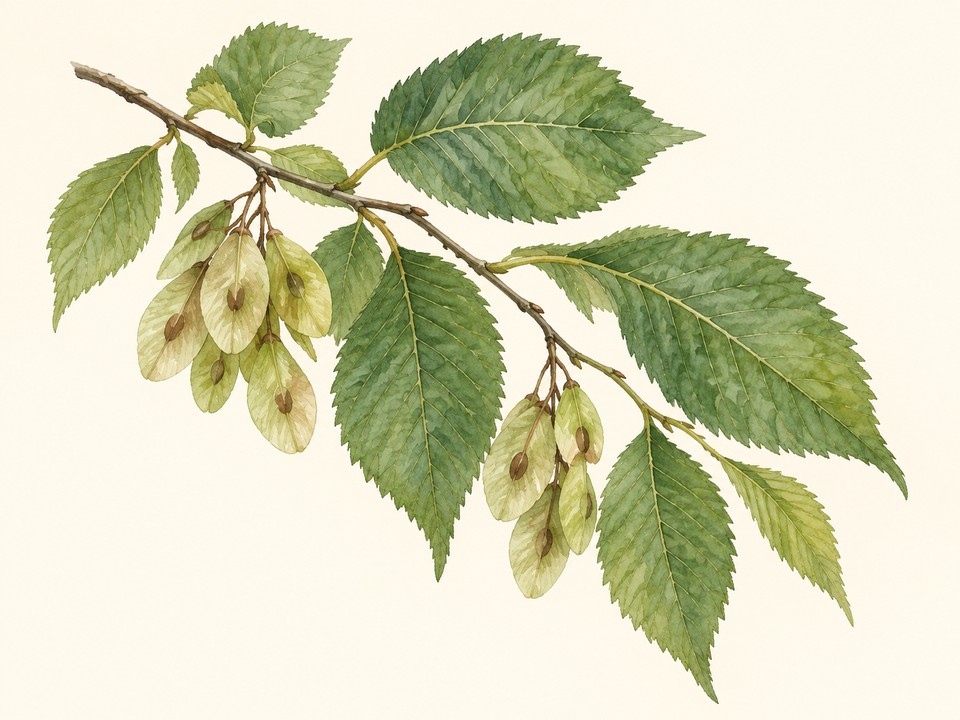
It is deciduous, with oval toothed leaves. They turn yellow in fall.
Water
It has medium water needs. It handles drought once established, but it grows best with deep watering in long dry spells. If watering ever feels like a guessing game, our horticulturists can care for your American Elm on a schedule that fits your yard.[1]
Pruning
Prune it only in the dormant season. Open wounds in spring and summer attract the beetles that carry Dutch elm disease. Remove dead wood and raise the canopy gradually.[4]
Seasonal behavior
It is leafless in winter and drops small winged seeds in spring. The danger sign is summer wilting on scattered branches, which points to Dutch elm disease.
When to Plant American Elm
Plant American Elm in fall or early spring in Central Texas. A fall planting establishes roots through the cool season and is ready to grow the following year. Spring planting works too if you water through the first summer.[5]
If you would like a hand, the Texas Allied Landscape team can plant your American Elm and keep it thriving.
Planting
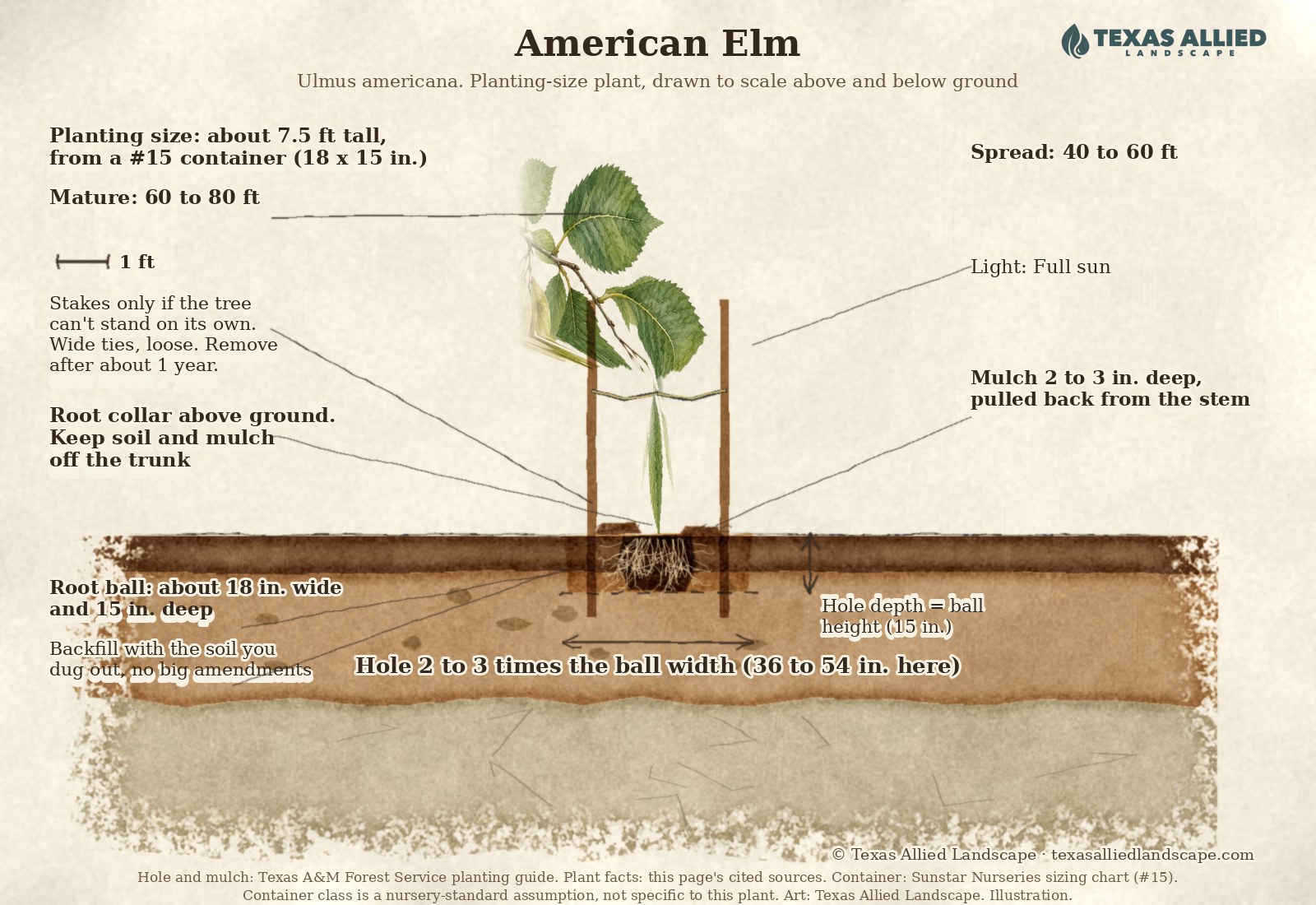
- Dig a hole at least twice as wide as the root ball and no deeper. A square hole keeps the roots from settling too deep while letting them grow out into the surrounding soil.[6]
- Fill the empty hole with water and check the drainage. If it takes longer than 24 hours to drain, choose another spot. Roots sitting under water will kill the tree.[6]
- Set it with the root collar (the flare just above the roots) level with or slightly above the ground. Take off all wire, twine, containers and bags before backfilling.[6]
- Backfill with the same soil that came out of the hole, without amendments. Settle the soil with water rather than packing it down.[6]
- Site and soil: It needs full sun.[1][2] It is adaptable, growing in clay to sandy soils, and it tolerates both wet bottomlands and ordinary yards. It is a tough native of Texas river bottoms.[3]
- Timing: A fall planting establishes roots through the cool season and is ready to grow the following year. Spring planting works too if you water through the first summer.[5]
- Water it for at least the first two years, but do not overwater. A thorough soaking beats light, frequent watering.[6]
- Mulch 2 to 3 inches deep, out to the drip line and up to but not touching the trunk. Stake it only if it cannot stand on its own, and take the stakes off within a year. Most trees need no support. Do not fertilize during the first growing season.[6]
Care Instructions for Your American Elm
Sunlight
Soil and drainage
It is adaptable. It grows in clay to sandy soils and tolerates both wet bottomlands and ordinary yards. It is a tough native of Texas river bottoms.[3]
Mature height and spread
It reaches 60 to 80 feet at maturity, and it is fast-growing. It spreads 40 to 60 feet into the classic high vase-shaped canopy.
Pruning
Prune it only in the dormant season. Open wounds in spring and summer attract the beetles that carry Dutch elm disease. Remove dead wood and raise the canopy gradually.[4]
Normal seasonal behavior
It is leafless in winter and drops small winged seeds in spring. The danger sign is summer wilting on scattered branches, which points to Dutch elm disease.
American elm questions
What is Dutch elm disease and should I worry?
It is a fungus spread by elm bark beetles, and it has killed millions of elms. In Texas it shows as wilting, yellowing "flags" on scattered branches in summer. Prune only in winter, and have any flagging branches checked fast.[7]
Next step: Wilting branches on your elm in summer are urgent - our horticulturalists can inspect before it spreads through the tree.
How fast do American elms grow?
Fast. They are among the quicker shade trees, often growing 3 to 6 feet a year while young. They are on their way to 60 to 80 feet.[8]
Are American elms messy?
They drop small seeds in spring and their leaves in fall. Older trees also shed small dead twigs in wind. That is reasonable cleanup for the canopy they give.[9]
Should I prune my elm in summer?
No. Fresh cuts in the growing season release scent that draws the beetles carrying Dutch elm disease. Do your pruning in the dormant winter months.[10]
Let Texas Allied Landscape care for your American Elm
American Elm does best with steady, knowledgeable care. That means the right water, pruning at the right time, and a trained eye for stress. The horticulturists at Texas Allied Landscape care for plants like yours across the San Antonio area. They are backed by over 40 years of landscape experience.
In these community guides
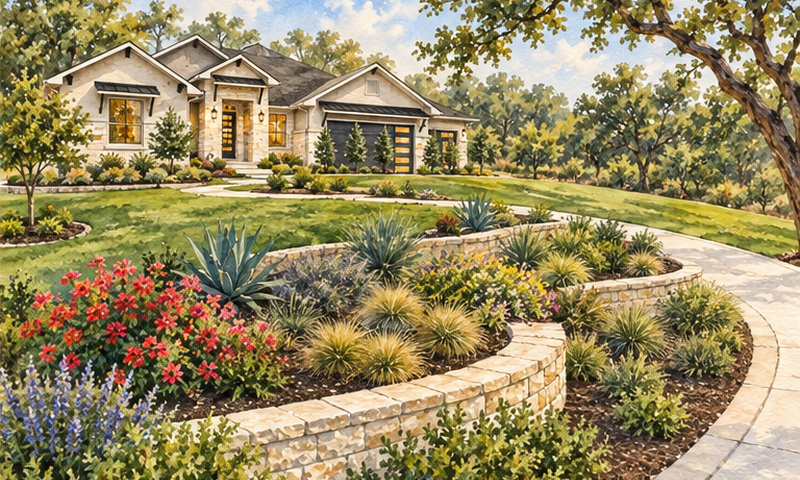
Illustration. Illustration based on reference photos of Arbors of Fair Oaks. Not a single literal view. Arbors of Fair Oaks Landscaping
Bring your address, unit and yard ideas. Texas Allied Landscape helps design the planting and irrigation, prepare the…
Sources
- American Elm, Texas Tree Selector, Texas A&M Forest Service.https://texastreeplanting.tamu.edu/display_onetree.aspx?tid=99abcde
- Ulmus americana, American Elm, University of Florida IFAS.https://hort.ifas.ufl.edu/woody/Pages/ulmame/ulmame.shtmlabc
- Wilt Diseases of Elms in Texas, Texas A&M Forest Service.https://mytexas.ag.tamu.edu/publications/wilt-diseases-of-elms-in-texas/abc
- Dutch Elm Disease in Texas, Texas Invasives.https://www.texasinvasives.org/resources/publications/DUTCH_ELM_DISEASE_Appel.pdfab
- October Gardening Checklist, Travis County AgriLife Extension.https://travis-tx.tamu.edu/about-2/horticulture/monthly-gardening-calendar-for-austin-area/october-gardening-checklist-for-austin-and-central-texas/ab
- Planting, Texas A&M Forest Service.https://tfsweb.tamu.edu/trees/tree-care/planting/abcdef
- Texas A&M Forest Service, "Wilt Diseases of Elms in Texas."https://mytexas.ag.tamu.edu/publications/wilt-diseases-of-elms-in-texas/↑
- Texas Tree Selector, Texas A&M Forest Service, "American Elm."https://texastreeplanting.tamu.edu/display_onetree.aspx?tid=99↑
- University of Florida IFAS, "Ulmus americana, American Elm."https://hort.ifas.ufl.edu/woody/Pages/ulmame/ulmame.shtml↑
- Texas Invasives, "Dutch Elm Disease in Texas."https://www.texasinvasives.org/resources/publications/DUTCH_ELM_DISEASE_Appel.pdf↑