
Property owners
Arizona Cypress
- Plant
- Arizona Cypress
- Botanical name
- Hesperocyparis arizonica
- Group
- Shade trees
Sourced light, water, size and care details for Arizona Cypress.
On this page
Its botanical name is Hesperocyparis arizonica (formerly Cupressus arizonica).
It belongs to the large trees group.
Light
Soil and drainage
It thrives in our rocky, alkaline, thin soils. It is one of the few evergreens genuinely at home on Hill Country ground, as long as it drains.[3]
Height
It reaches 30-40 ft at maturity, and sometimes taller. It is a medium-fast grower.
Spread
It spreads 15-20 ft in a dense pyramidal form.
Foliage
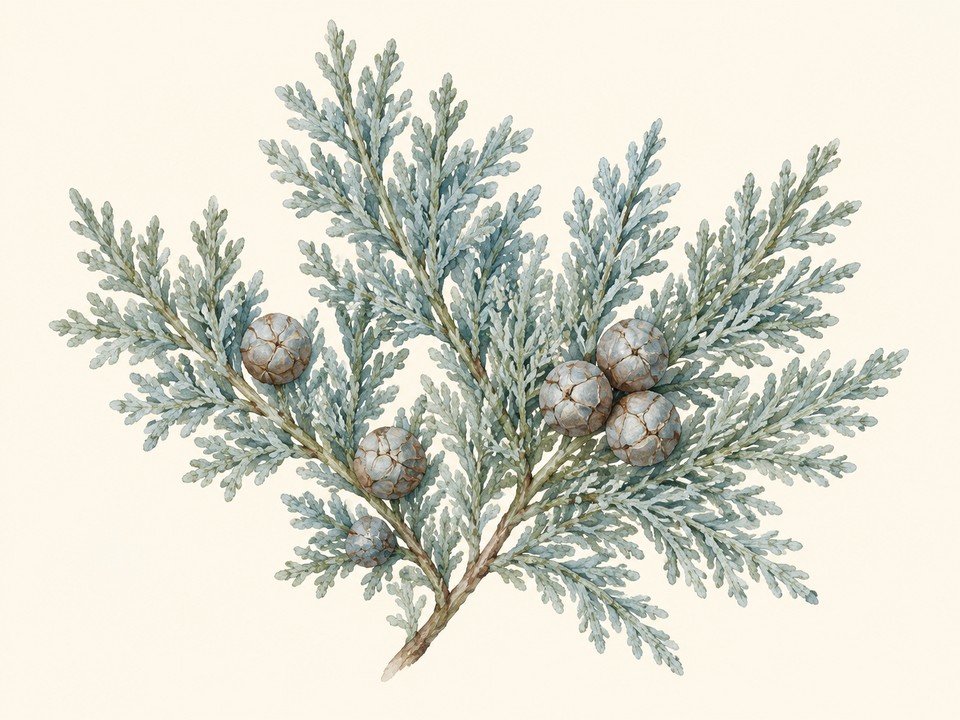
It is an evergreen conifer. It has silvery blue-green scale foliage and handsome shredding bark with age.
Water
It needs low water once established. It is a desert-Southwest native that needs only deep, occasional water in extreme drought. If watering ever feels like a guessing game, our horticulturists can care for your Arizona Cypress on a schedule that fits your yard.[1]
Pruning
It needs little pruning. Remove dead branches, and never shear it into a formal shape. It looks best natural. Spider mites can brown it in hot, dry spells.[4]
Seasonal behavior
It is evergreen year-round. It makes a fast, dense screen or windbreak. It holds its color through both drought and our winters.
When to Plant Arizona Cypress
Plant Arizona Cypress in fall or early spring in Central Texas. A fall planting establishes roots through the cool season. It is ready to grow the following year. Spring planting works too if you water through the first summer.[5]
If you would like a hand, the Texas Allied Landscape team can plant your Arizona Cypress and keep it thriving.
Planting
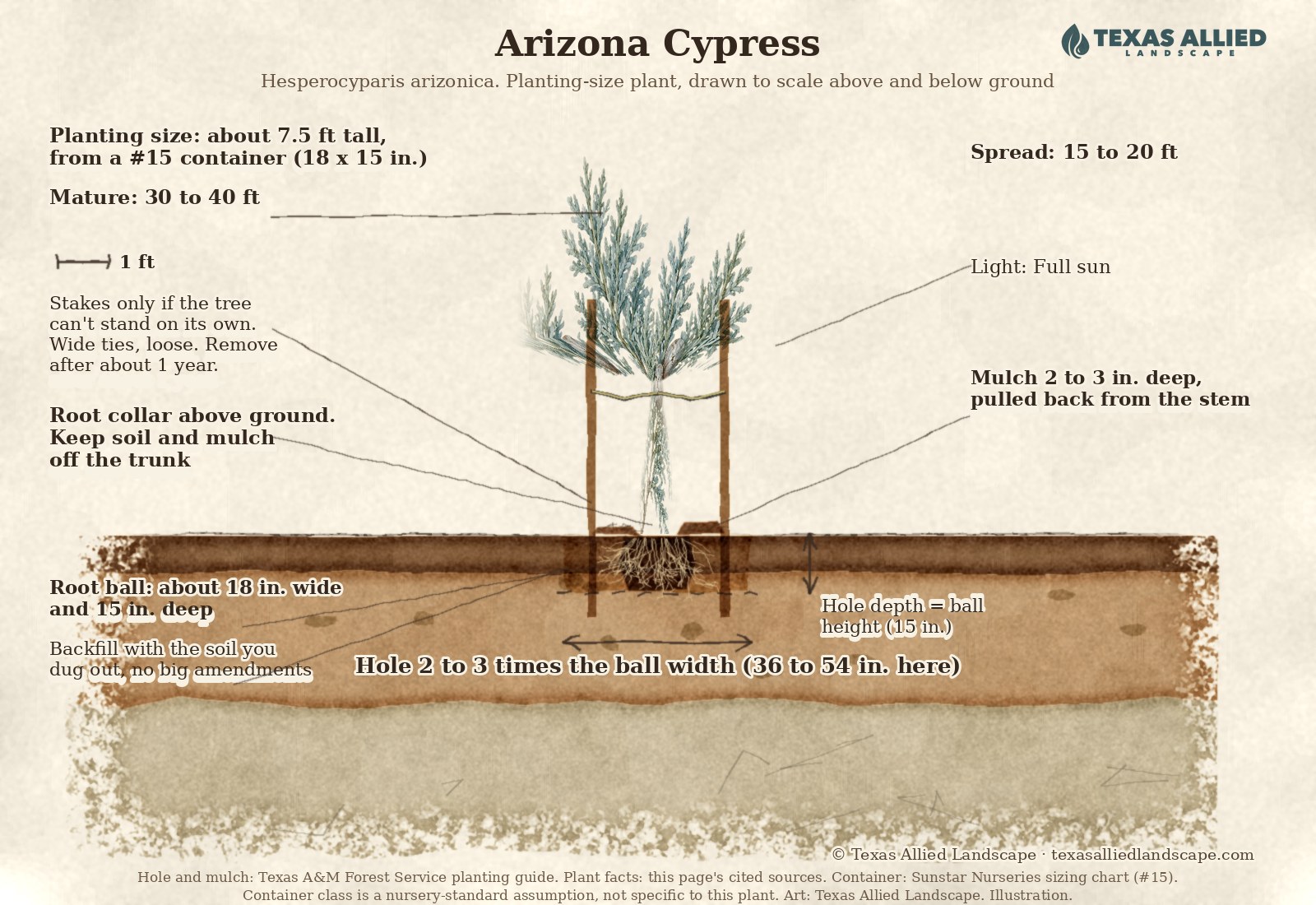
- Dig a hole at least twice as wide as the root ball and no deeper. A square hole keeps the roots from settling too deep. It also lets them grow out into the surrounding soil.[6]
- Fill the empty hole with water and check the drainage. If it takes longer than 24 hours to drain, choose another spot. Roots sitting under water will kill the tree.[6]
- Set it with the root collar (the flare just above the roots) level with or slightly above the ground. Take off all wire, twine, containers and bags before backfilling.[6]
- Backfill with the same soil that came out of the hole. Do not add amendments. Settle it with water rather than packing it down.[6]
- For the site and soil, it needs full sun.[1][2] It thrives in our rocky, alkaline, thin soils. It is one of the few evergreens genuinely at home on Hill Country ground, as long as it drains.[3]
- For timing, a fall planting establishes roots through the cool season. It is ready to grow the following year. Spring planting works too if you water through the first summer.[5]
- Water for at least the first two years, without overwatering. A thorough soaking beats light, frequent watering.[6]
- Mulch 2 to 3 inches deep, out to the drip line and up to but not touching the trunk. Stake only if it cannot stand on its own, and take stakes off within a year. Most need no support. Do not fertilize during the first growing season.[6]
Care Instructions for Your Arizona Cypress
Sunlight
Soil and drainage
It thrives in our rocky, alkaline, thin soils. It is one of the few evergreens genuinely at home on Hill Country ground, as long as it drains.[3]
Mature height and spread
It reaches 30-40 ft at maturity, and sometimes taller. It is a medium-fast grower. It spreads 15-20 ft in a dense pyramidal form.
Pruning
It needs little pruning. Remove dead branches, and never shear it into a formal shape. It looks best natural. Spider mites can brown it in hot, dry spells.[4]
Normal seasonal behavior
It is evergreen year-round. It makes a fast, dense screen or windbreak. It holds its color through both drought and our winters.
Arizona cypress questions
Is Arizona cypress good for Central Texas?
It is one of the best-adapted evergreens we have. It handles our alkaline rock, heat, drought and winters with almost no care. It is a native of the Southwest.[7]
How fast does Arizona cypress grow?
It is medium-fast for a conifer. Expect a couple of feet a year in youth on the way to 30-40 ft. That is quick enough to build a privacy screen in a few seasons.[8]
Why is my Arizona cypress turning brown inside?
In hot, dry stretches, spider mites are the usual cause. Look for fine webbing and dusty, browning interior foliage. A hard spray of water and corrected watering usually turn it around.[9]
Next step: Browning that climbs the tree deserves a look from our horticulturalists before you lose it.
Is Arizona cypress deer resistant?
Yes. Deer rarely bother the aromatic scale foliage. That is one more reason it is a Hill Country standby.[10]
Let Texas Allied Landscape care for your Arizona Cypress
Arizona Cypress does best with steady, knowledgeable care. That means the right water, pruning at the right time, and a trained eye for stress. The horticulturists at Texas Allied Landscape care for plants like yours across the San Antonio area. They bring over 40 years of landscape experience.
In these community guides
Sources
- Cypress, Arizona, City of Austin Watershed Protection - Grow Green.https://www.austintexas.gov/department/grow-green/plant-guide/cypress-arizonaabcde
- Arizona Cypress, Central Texas Gardener.https://centraltexasgardener.org/resource/arizona-cypress/abc
- Hesperocyparis arizonica, Native Plant Society of Texas.https://www.npsot.org/posts/native-plant/hesperocyparis-arizonica/abc
- Arizona Cypress, Parker County Master Gardener Association.https://pcmg-texas.org/arizona-cypressab
- October Gardening Checklist, Travis County AgriLife Extension.https://travis-tx.tamu.edu/about-2/horticulture/monthly-gardening-calendar-for-austin-area/october-gardening-checklist-for-austin-and-central-texas/ab
- Planting, Texas A&M Forest Service.https://tfsweb.tamu.edu/trees/tree-care/planting/abcdef
- City of Austin Grow Green plant guide, "Cypress, Arizona."https://www.austintexas.gov/department/grow-green/plant-guide/cypress-arizona↑
- Central Texas Gardener, "Arizona Cypress."https://centraltexasgardener.org/resource/arizona-cypress/↑
- Parker County Master Gardener Association, "Arizona Cypress."https://pcmg-texas.org/arizona-cypress↑
- Native Plant Society of Texas, "Hesperocyparis arizonica."https://www.npsot.org/posts/native-plant/hesperocyparis-arizonica/↑