
Property owners
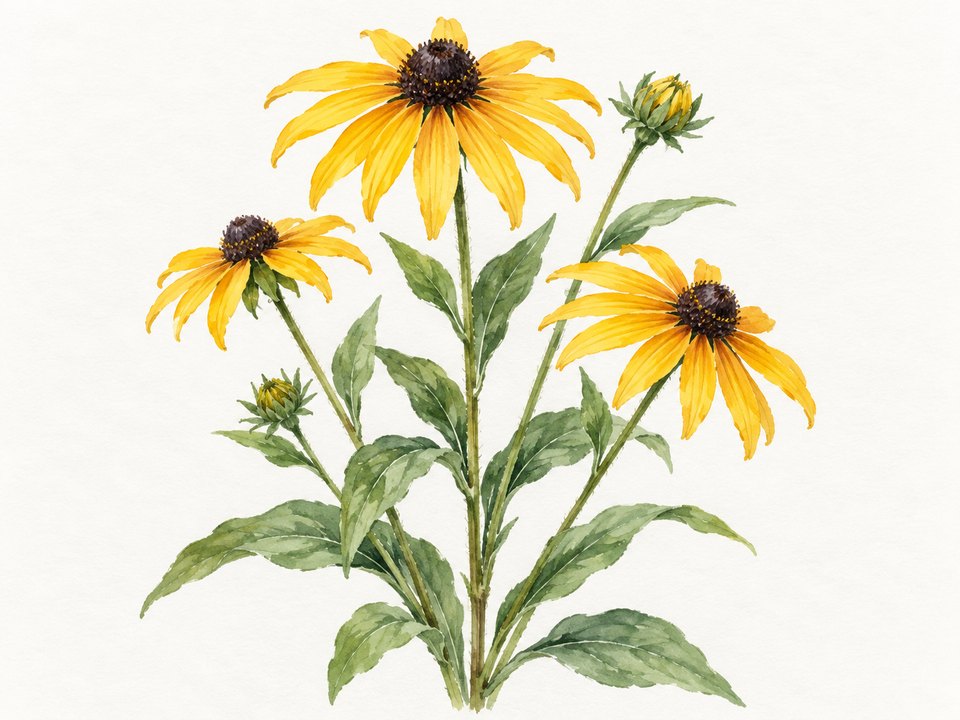
Black Eyed Susan
- Plant
- Black Eyed Susan
- Botanical name
- Rudbeckia fulgida 'Goldsturm'
- Cultivar
- 'Goldsturm'
- Group
- Low shrubs and perennials
Black Eyed Susan (Rudbeckia fulgida 'Goldsturm'): light, water, soil, size and care for San Antonio area landscapes.
On this page
Botanical name: Rudbeckia fulgida 'Goldsturm'.
Light
Full sun.[1]
Soil and drainage
Various soils; moist.
Height
Up to about 4 ft for the species; 'Goldsturm' stays shorter in practice.
Spread
Self-sows and produces abundant offsets - expect clumps to widen.
Foliage
Herbaceous perennial.
Water
Moist soil per the species profile. If watering ever feels like a guessing game, our horticulturists can care for your Black Eyed Susan on a schedule that fits your yard.
Seasonal behavior
Orange-yellow daisy flowers Jul-Oct; easy and trouble-free; attracts birds and native bees.
Why won't my 'Goldsturm' rudbeckia bloom?
'Goldsturm' a very reliable bloomer, so a stunted, non-blooming plant points to site conditions - their troubleshooting case involved sandy soil top-dressed with black dirt.[2]
When to Plant Black Eyed Susan
Plant Black Eyed Susan in fall or early spring in Central Texas. A fall planting establishes roots through the cool season and is ready to grow and bloom the following year; spring planting works too if you water through the first summer.[3]
If you would like a hand, the Texas Allied Landscape team can plant your Black Eyed Susan and keep it thriving.
Planting
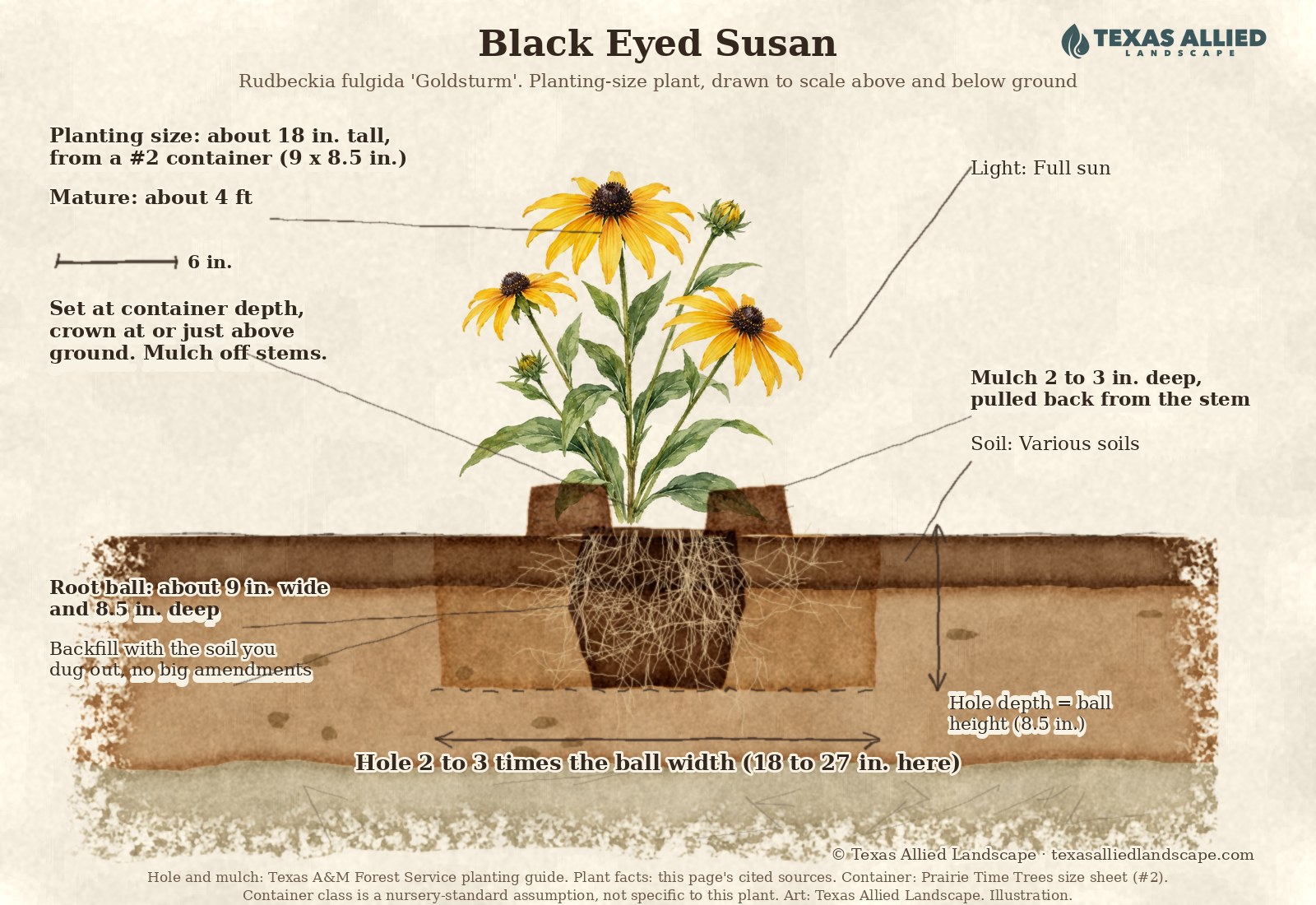
- Dig a hole twice as wide as the pot and no deeper, with sloping sides, and set the plant at the same depth it grew in its pot. Loosen any circling roots before backfilling.[4]
- For a new bed, clear grass and weeds first, roots and all.[4]
- Site: Full sun.[1]
- Soil: Orange-yellow daisy flowers Jul-Oct; easy and trouble-free; attracts birds and native bees. 'Goldsturm' a very reliable bloomer, so a stunted, non-blooming plant points to site conditions - their troubleshooting case involved sandy soil top-dressed with black dirt.[2]
- Timing: A fall planting establishes roots through the cool season and is ready to grow and bloom the following year; spring planting works too if you water through the first summer.[3]
- Soak it well at planting and keep watering while the roots establish.[4] Once established: A fall planting establishes roots through the cool season and is ready to grow and bloom the following year; spring planting works too if you water through the first summer.[3]
- Mulch 2 to 4 inches, kept a few inches away from the stems to prevent crown rot. It needs no staking or other support.[4]
Care Instructions for Your Black Eyed Susan
How to Water a Black Eyed Susan
Moist soil per the species profile.
Sunlight
Full sun.[1]
Soil and drainage
Various soils; moist.
Mature height and spread
Up to about 4 ft for the species; 'Goldsturm' stays shorter in practice. Self-sows and produces abundant offsets - expect clumps to widen.
Normal seasonal behavior
Orange-yellow daisy flowers Jul-Oct; easy and trouble-free; attracts birds and native bees.
Black-eyed Susan questions
Do black-eyed Susans come back every year in Texas?
Rudbeckia hirta is a short-lived perennial or self-sowing annual here - individual plants last a couple of years, but they seed themselves so the patch keeps going.[5]
How much sun do black-eyed Susans need?
Full sun to light shade. The more sun, the heavier the bloom - they flower from late spring into fall in Central Texas with almost no care.[6]
Should I deadhead black-eyed Susans?
Deadheading stretches the bloom season, but leave some seed heads in fall - goldfinches love them, and that is how the patch resows itself.[7]
Are black-eyed Susans deer resistant?
Moderately - deer may browse them but usually prefer other plants, and the rough hairy foliage helps. In heavy deer country, protect young plants the first season.[8]
Let Texas Allied Landscape care for your Black Eyed Susan
Black Eyed Susan does best with steady, knowledgeable care: the right water, pruning at the right time, and a trained eye for stress. The horticulturists at Texas Allied Landscape care for plants like yours across the San Antonio area, backed by over 40 years of landscape experience.
In these community guides
- Art in progress
Cordillera Ranch Landscaping
Bring your address, survey and yard ideas. We check the right guideline set, plan planting and irrigation, prepare the…
Sources
- Rudbeckia fulgida (Orange coneflower), Lady Bird Johnson Wildflower Center Native Plants Database.https://www.wildflower.org/plants/result.php?id_plant=rufu2abc
- Goldsturm Rudbeckia Stunted and Doesn't Bloom, Lady Bird Johnson Wildflower Center Ask Mr. Smarty Plants.https://www.wildflower.org/expert/show.php?id=10902ab
- October Gardening Checklist, Travis County AgriLife Extension.https://travis-tx.tamu.edu/about-2/horticulture/monthly-gardening-calendar-for-austin-area/october-gardening-checklist-for-austin-and-central-texas/abc
- Back to basics: Planting perennials, SAWS Garden Style San Antonio.https://www.gardenstylesanantonio.com/garden-articles/back-to-basics-planting-perennials/abcd
- Native Plant Society of Texas, "Rudbeckia hirta."https://www.npsot.org/posts/native-plant/rudbeckia-hirta/↑
- Denton County Master Gardener Association, "Black-eyed Susan - Rudbeckia hirta."https://www.dcmga.com/wp-content/uploads/docs/plant-facts-flowering-plants/pf-black-eyed-susan.pdf↑
- Henderson County Master Gardeners, "Black-eyed Susan 'Indian Summer'."https://txmg.org/hendersonmg/files/2019/04/BLACK-EYED-SUSAN-INDIAN-SUMMER.pdf↑
- Denton County Master Gardener Association, "Black-eyed Susan - Rudbeckia hirta."https://www.dcmga.com/wp-content/uploads/docs/plant-facts-flowering-plants/pf-black-eyed-susan.pdf↑