
Property owners
Black Walnut
- Plant
- Black Walnut
- Botanical name
- Juglans nigra
- Group
- Shade trees
Black Walnut care for Juglans nigra: light, soil, mature size, juglone and nut-drop considerations.
On this page
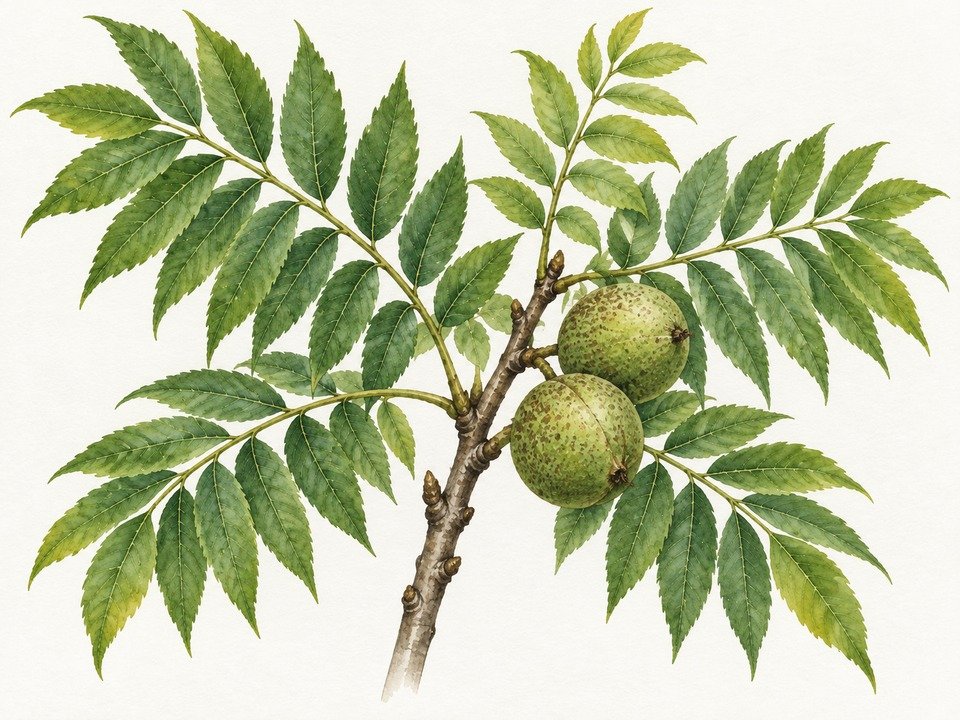
Its botanical name is Juglans nigra. This is black walnut, not the separate Texas Black Walnut entry in the community plant lists.[1]
Light and soil
It prefers full sun. It tolerates partial shade, but not full shade. Choose moist, fertile, well-drained soil, and allow room for a large tree. Poorer sites can limit growth and quality.[1]
Size and placement
The NC State profile gives a mature size of about 50 to 75 feet tall and 50 to 70 feet wide. The tree develops a deep taproot. That makes established trees difficult to transplant.[1]
Water and neighboring plants
The tree prefers moisture but tolerates some drought. Its leaves, stems and roots contain juglone. Juglone can inhibit sensitive plants below the canopy. Check compatibility before placing azaleas, peonies or a vegetable garden nearby.[1]
Nuts and cleanup
The nuts are edible but difficult to remove from their husks. The husks can stain skin and clothing. Keep nut drop in mind when choosing a location near walks, patios or parking.[1]
When to Plant Black Walnut
In the San Antonio area, October and November are the best months to plant trees and shrubs. Roots keep growing through our mild winters. So a fall-planted Black Walnut is established before summer heat. Spring planting also works. Try to avoid planting in peak summer.[2]
If you would like a hand, the Texas Allied Landscape team can plant your Black Walnut and keep it thriving.
Planting
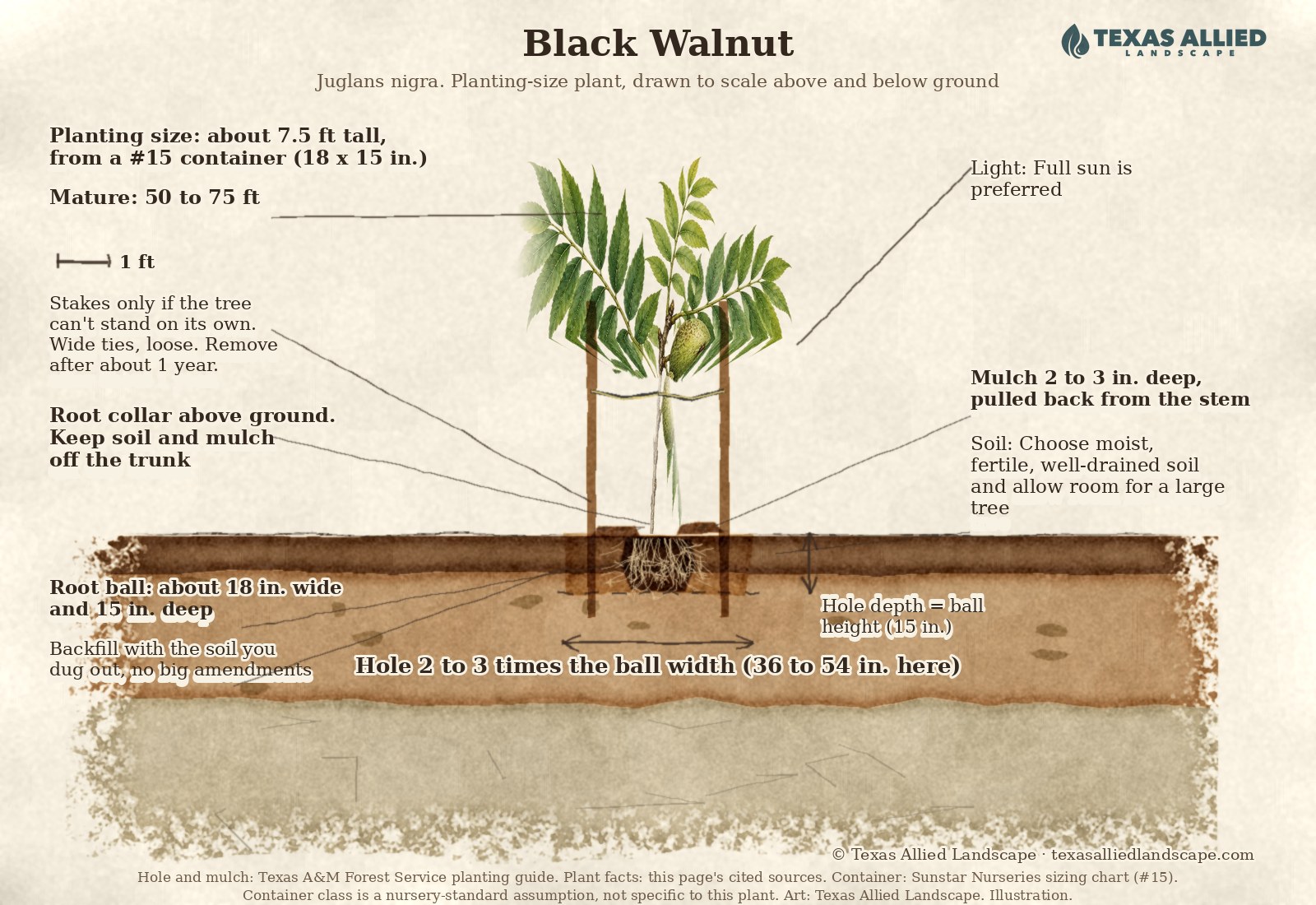
- Dig a hole at least twice as wide as the root ball and no deeper. A square hole keeps the roots from settling too deep. It also lets them grow out into the surrounding soil.[3]
- Fill the empty hole with water and check the drainage. If it takes longer than 24 hours to drain, choose another spot. Roots sitting under water will kill the tree.[3]
- Set the tree with the root collar (the flare just above the roots) level with or slightly above the ground. Carry it by the container or root ball, never the trunk. Take off all wire, twine, containers and bags before backfilling.[3]
- Backfill with the same soil that came out of the hole, without amendments. Settle the soil with water rather than packing it down.[3]
- Give it room. The NC State profile gives a mature size of about 50 to 75 feet tall and 50 to 70 feet wide. The tree develops a deep taproot. That makes established trees difficult to transplant.[1] Give the canopy and roots plenty of vertical and horizontal room.[3]
- Soil: Choose moist, fertile, well-drained soil and allow room for a large tree. Poorer sites can limit growth and quality.[1]
- Water it for at least the first two years, but do not overwater. A thorough soaking beats light, frequent watering.[3]
- Mulch 2 to 3 inches deep, out to the drip line and up to but not touching the trunk. Stake the tree only if it cannot stand on its own, and take the stakes off within a year. Most trees need no support. Do not fertilize during the first growing season.[3]
Care Instructions for Your Black Walnut
How to Water a Black Walnut
Sunlight and soil
It prefers full sun. It tolerates partial shade, but not full shade. Choose moist, fertile, well-drained soil, and allow room for a large tree. Poorer sites can limit growth and quality.[1]
Black walnut questions
What is juglone and why does it matter?
Black walnut roots release juglone. Juglone is a natural chemical that stunts or kills sensitive plants nearby, such as tomatoes, azaleas and many others. Keep vulnerable plants out from under and beyond its drip line.[4]
Is black walnut a good tree for Texas yards?
It is a beautiful big native tree. It grows 50 to 75 feet tall, with valuable wood and edible nuts. But it is best on large lots. The juglone, the falling nuts and the size make it a poor fit for small yards.[5]
Can I compost black walnut leaves?
Yes, in moderation. Juglone breaks down in a hot compost pile over time. Avoid piling fresh walnut leaves or hulls directly on garden beds.[6]
Are the nuts from a black walnut edible?
Yes. They are rich and distinctive, though hard to crack, and the squirrels usually get there first. The green hulls stain everything, so wear gloves.[7]
In these community guides
Sources
- NC State Extension: Juglans nigra .https://plants.ces.ncsu.edu/plants/juglans-nigra/abcdefgh
- SAWS, "Autumn is for planting trees."https://www.saws.org/autumn-is-for-planting-trees/↑
- Planting, Texas A&M Forest Service.https://tfsweb.tamu.edu/trees/tree-care/planting/abcdefg
- The Morton Arboretum, "Black Walnut Toxicity."https://mortonarb.org/plant-and-protect/tree-plant-care/plant-care-resources/black-walnut-toxicity/↑
- Texas Tree Selector, Texas A&M Forest Service, "Black Walnut."https://texastreeplanting.tamu.edu/display_onetree.aspx?tid=41↑
- The Morton Arboretum, "Black Walnut Toxicity."https://mortonarb.org/plant-and-protect/tree-plant-care/plant-care-resources/black-walnut-toxicity/↑
- Cross Timbers Urban Forestry Council, "Black Walnut Tree."https://ctufc.org/black-walnut-tree/↑