
Property owners
Black Willow
- Plant
- Black Willow
- Botanical name
- Salix nigra
- Group
- Shade trees
Black willow is a fast native shade tree for the wet spots where other trees sulk - pond edges, creeks, and low ground.
On this page
Botanical name: Salix nigra.
Plant group: Trees.
Light
Full sun to part shade - more sun means faster, denser growth.[1]
Soil and drainage
Loves moisture: stream banks, pond edges, and low spots that stay damp. It tolerates ordinary garden soil if watered, but it is the wrong tree for a dry hilltop.[1]
Height
30-60 ft here, fast - among the fastest-growing native trees.[2]
Spread
30-50 ft wide with an open, irregular crown.
Foliage
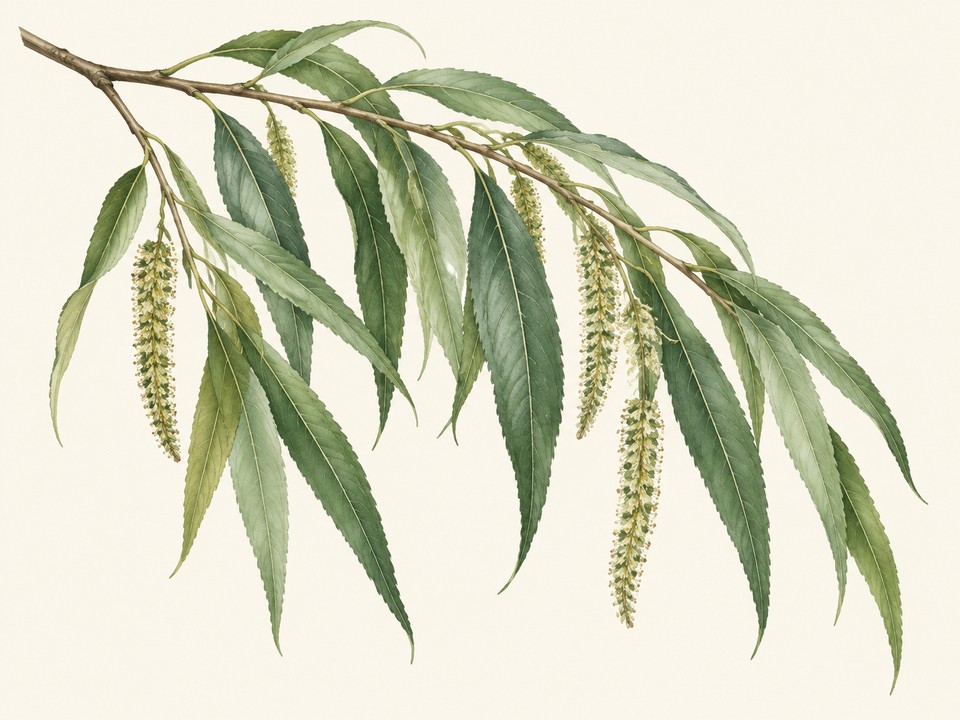
Deciduous. Long, narrow green leaves that flutter on slim stems and turn soft yellow in fall.[1]
Water
High - this is a water-loving willow. Young trees want steady moisture; planted near a pond or creek it mostly takes care of itself.
Pruning
Prune in late winter for structure. The wood is brittle, so remove crossing and weak-angled limbs early while they are small.[2]
Seasonal behavior
Leafs out very early in spring, drops leaves late in fall; separate male and female trees, with female trees releasing cottony seed in late spring.[1]
When to Plant Black Willow
Plant black willow in late fall through winter in Central Texas, while the tree is dormant. Cool-season planting lets roots grow ahead of the summer demand this thirsty tree puts on them.[2]
If you would like a hand, the Texas Allied Landscape team can plant your Black Willow and keep it thriving.
Planting
- Dig a hole at least twice as wide as the root ball and no deeper - a square hole keeps the roots from settling too deep while letting them grow out into the surrounding soil.[3]
- Fill the empty hole with water and check the drainage. If it takes longer than 24 hours to drain, choose another spot: roots sitting under water will kill the tree.[3]
- Set it with the root collar (the flare just above the roots) level with or slightly above the ground, and take off all wire, twine, containers and bags before backfilling.[3]
- Backfill with the same soil that came out of the hole, without amendments, and settle it with water rather than packing it down.[3]
- Site: Full sun to part shade - more sun means faster, denser growth.[1]
- Timing: Cool-season planting lets roots grow ahead of the summer demand this thirsty tree puts on them.[2]
- Water for at least the first two years, without overwatering: a thorough soaking beats light, frequent watering.[3]
- Mulch 2 to 3 inches deep, out to the drip line and up to but not touching the trunk. Stake only if it cannot stand on its own and take stakes off within a year - most need no support. Do not fertilize during the first growing season.[3]
Care Instructions for Your Black Willow
How to Water a Black Willow
High - this is a water-loving willow. Young trees want steady moisture; planted near a pond or creek it mostly takes care of itself.
Sunlight
Full sun to part shade - more sun means faster, denser growth.[1]
Soil and drainage
Loves moisture: stream banks, pond edges, and low spots that stay damp. It tolerates ordinary garden soil if watered, but it is the wrong tree for a dry hilltop.[1]
Mature height and spread
30-60 ft here, fast - among the fastest-growing native trees.[2] 30-50 ft wide with an open, irregular crown.
Pruning
Prune in late winter for structure. The wood is brittle, so remove crossing and weak-angled limbs early while they are small.[2]
Normal seasonal behavior
Leafs out very early in spring, drops leaves late in fall; separate male and female trees, with female trees releasing cottony seed in late spring.[1]
Black willow questions
Where should I plant a black willow?
Near water or in a low, damp spot - it is our native streamside willow and wants consistently moist soil. In a dry yard it struggles; in a wet one it thrives.[4]
How big and how fast does black willow grow?
Fast and big - 30-60 ft, growing several feet a year when young. Give it room away from the house, pipes and septic lines, because willow roots seek water.[5]
Are black willow roots a problem for pipes?
They can be - like all willows, the roots run toward water and can invade old sewer and irrigation lines. Plant well away from underground utilities.[6]
Next step: Not sure how far is far enough? Our horticulturalists can site it safely on a visit.
Is black willow good for erosion control?
Excellent - its fibrous roots hold creek banks and pond edges, which is its natural job along Texas waterways.[7]
Let Texas Allied Landscape care for your Black Willow
Black Willow does best with steady, knowledgeable care: the right water, pruning at the right time, and a trained eye for stress. The horticulturists at Texas Allied Landscape care for trees like yours across the San Antonio area, backed by over 40 years of landscape experience.
In these community guides
Sources
- Salix nigra, North Carolina Extension Gardener Plant Toolbox.https://plants.ces.ncsu.edu/plants/salix-nigra/abcdefgh
- Black Willow, Clark Gardens Botanical Park.https://clarkgardens.org/plant/black-willow/abcdef
- Planting, Texas A&M Forest Service.https://tfsweb.tamu.edu/trees/tree-care/planting/abcdef
- Clark Gardens Botanical Park, "Black Willow."https://clarkgardens.org/plant/black-willow/↑
- Lady Bird Johnson Wildflower Center, "Salix nigra."https://www.wildflower.org/plants/result.php?id_plant=SANI↑
- Short's Resort Field Station, "Black Willow (Salix nigra)."https://shortsfieldstation.org/species/black-willow↑
- Clark Gardens Botanical Park, "Black Willow."https://clarkgardens.org/plant/black-willow/↑