
Property owners
Blue Fescue
- Plant
- Blue Fescue
- Botanical name
- Festuca glauca
- Group
- Ornamental grasses
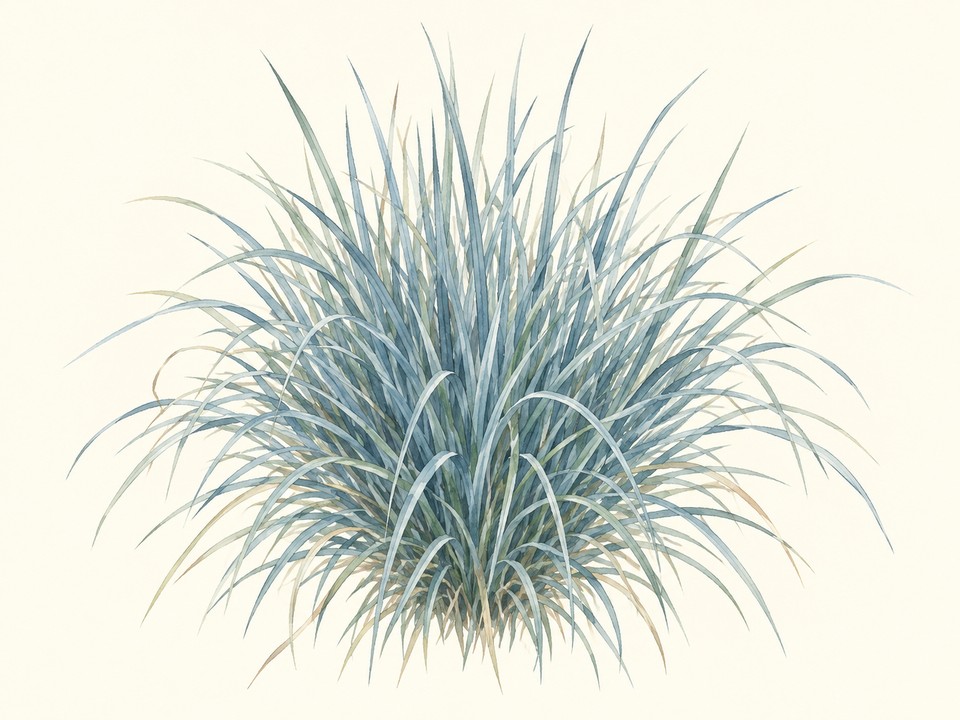
Blue fescue is a foot-tall tuft of steel-blue bristles that edges beds and paths in full sun.
On this page
Botanical name: Festuca glauca.
Plant group: Ornamental grasses.
Light
Full sun - the blue color is strongest in bright light and fades in shade.[1]
Soil and drainage
Lean, sharply drained soil. Wet clay, especially over a hot summer, is the one thing that reliably kills it in Texas.[2]
Height
About 1 ft in bloom; the blue tuft itself stays under 10 inches.[2]
Spread
Tufts widen slowly to about a foot; it stays a neat clump, never a runner.
Foliage
Evergreen, steel-blue bristles in a perfect little mound - planted in rows it reads as a blue edging.[1]
Water
Low - water to establish, then sparingly. Too much water does more harm than too little. If watering ever feels like a guessing game, our horticulturists can set a schedule that fits your beds.
Pruning
Comb out dead blades and shear lightly in late winter; remove the tawny flower stalks if you want a pure blue look.[2]
Seasonal behavior
Blue all year. Tan flower spikes in early summer; clumps can thin out in the center after a few hot, wet summers and are easy to divide or replace.[2]
When to Plant Blue Fescue
Plant blue fescue in fall or early spring in Central Texas. Cool-season planting gives roots time to establish before the summer heat that stresses this grass most.[1]
If you would like a hand, the Texas Allied Landscape team can plant your Blue Fescue and keep it thriving.
Planting
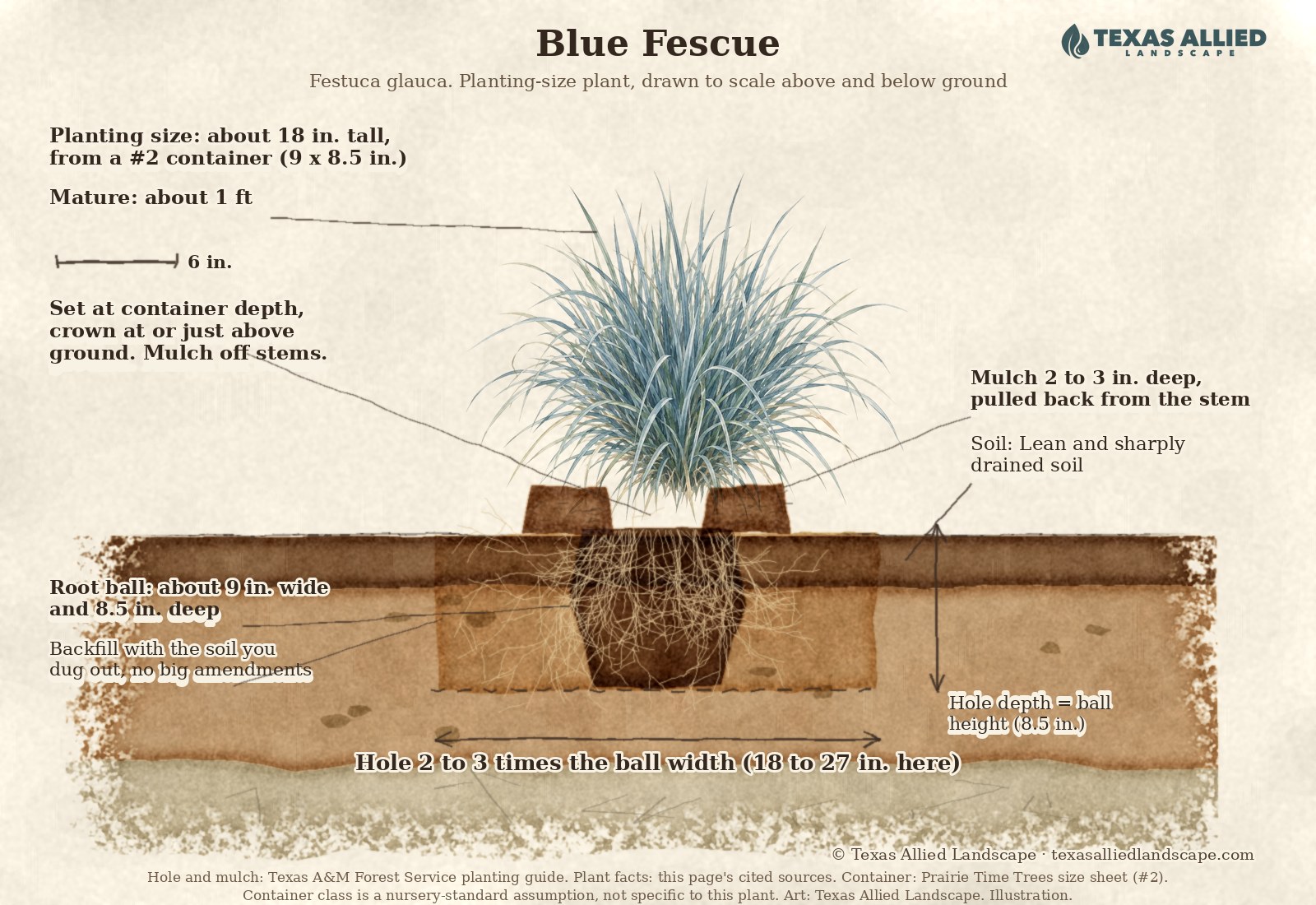
- Dig a hole twice as wide as the pot and no deeper, with sloping sides, and set the plant at the same depth it grew in its pot. Loosen any circling roots before backfilling.[3]
- For a new bed, clear grass and weeds first, roots and all.[3]
- Site: Full sun - the blue color is strongest in bright light and fades in shade.[1]
- Soil: Wet clay, especially over a hot summer, is the one thing that reliably kills it in Texas.[2]
- Timing: Cool-season planting gives roots time to establish before the summer heat that stresses this grass most.[1]
- Soak it well at planting and keep watering while the roots establish.[3]
- Mulch 2 to 4 inches, kept a few inches away from the stems to prevent crown rot. It needs no staking or other support.[3]
Care Instructions for Your Blue Fescue
How to Water a Blue Fescue
Low - water to establish, then sparingly. Too much water does more harm than too little.
Sunlight
Full sun - the blue color is strongest in bright light and fades in shade.[1]
Soil and drainage
Lean, sharply drained soil. Wet clay, especially over a hot summer, is the one thing that reliably kills it in Texas.[2]
Mature height and spread
About 1 ft in bloom; the blue tuft itself stays under 10 inches.[2] Tufts widen slowly to about a foot; it stays a neat clump, never a runner.
Pruning
Comb out dead blades and shear lightly in late winter; remove the tawny flower stalks if you want a pure blue look.[2]
Normal seasonal behavior
Blue all year. Tan flower spikes in early summer; clumps can thin out in the center after a few hot, wet summers and are easy to divide or replace.[2]
Blue fescue questions
Does blue fescue do well in Texas heat?
It is the weak point - blue fescue prefers cooler summers and often melts out in our worst heat, especially in wet soil. Give it morning sun, sharp drainage and lean soil for the best odds.[4]
Why is the center of my blue fescue dying out?
Classic age plus summer stress - clumps open in the middle after a few years. Dig, divide and replant the healthy outer pieces in fall to refresh the planting.[5]
Next step: Our horticulturalists can divide and reset tired clumps during a fall bed visit.
How much water does blue fescue need?
Little - it is drought-tolerant and rots with too much. Water to establish, then only in extended dry spells.[6]
Should I cut back blue fescue?
Comb out dead blades and shear lightly in late winter; remove the flower stalks after bloom if you want the tight blue tuft look. Never cut into the crown.[7]
Let Texas Allied Landscape care for your Blue Fescue
Blue Fescue does best with steady, knowledgeable care: the right water, pruning at the right time, and a trained eye for stress. The horticulturists at Texas Allied Landscape care for plants like yours across the San Antonio area, backed by over 40 years of landscape experience.
In these community guides
Sources
- Blue Fescue, Texas SmartScape.https://www.txsmartscape.com/plant-search/blue-fescueabcdef
- Blue Fescue, Festuca glauca, Wisconsin Horticulture.https://hort.extension.wisc.edu/articles/blue-fescue-festuca-ovina-glauca/abcdefghi
- Back to basics: Planting perennials, SAWS Garden Style San Antonio.https://www.gardenstylesanantonio.com/garden-articles/back-to-basics-planting-perennials/abcd
- Texas SmartScape, "Blue Fescue."https://www.txsmartscape.com/plant-search/blue-fescue↑
- The Morton Arboretum, "Blue Fescue."https://mortonarb.org/plant-and-protect/trees-and-plants/blue-fescue/↑
- Lubbock Master Gardeners, "Waterwise Grasses."https://txmg.org/lubbock/files/2019/09/Printable-PDF-List-of-Water-wise-Grasses-for-Lubbock-County.pdf↑
- The Morton Arboretum, "Blue Fescue."https://mortonarb.org/plant-and-protect/trees-and-plants/blue-fescue/↑