
Property owners
Bottonbush
- Plant
- Bottonbush
- Botanical name
- Cephalanthus occidentalis
- Group
- Medium shrubs and perennials
Buttonbush: Full sun to part shade.[^bb-clemson]
On this page
Buttonbush
Botanical name: Cephalanthus occidentalis.
Plant group: Medium shrubs and perennials.
Light
Full sun to part shade.[1]
Soil and drainage
Moist to wet ground is its natural home - pond edges, swales, low spots - but it adapts to ordinary garden soil with water.[1]
Height
6-12 feet.[1]
Spread
6-8 feet.[1]
Foliage
Glossy green oval leaves; deciduous.[2]
Water
High to medium - a Texas native of streambanks and wetlands that appreciates moisture.[3]
Pruning
Low - it tolerates hard cutting back in late winter and resprouts vigorously.[1]
Seasonal behavior
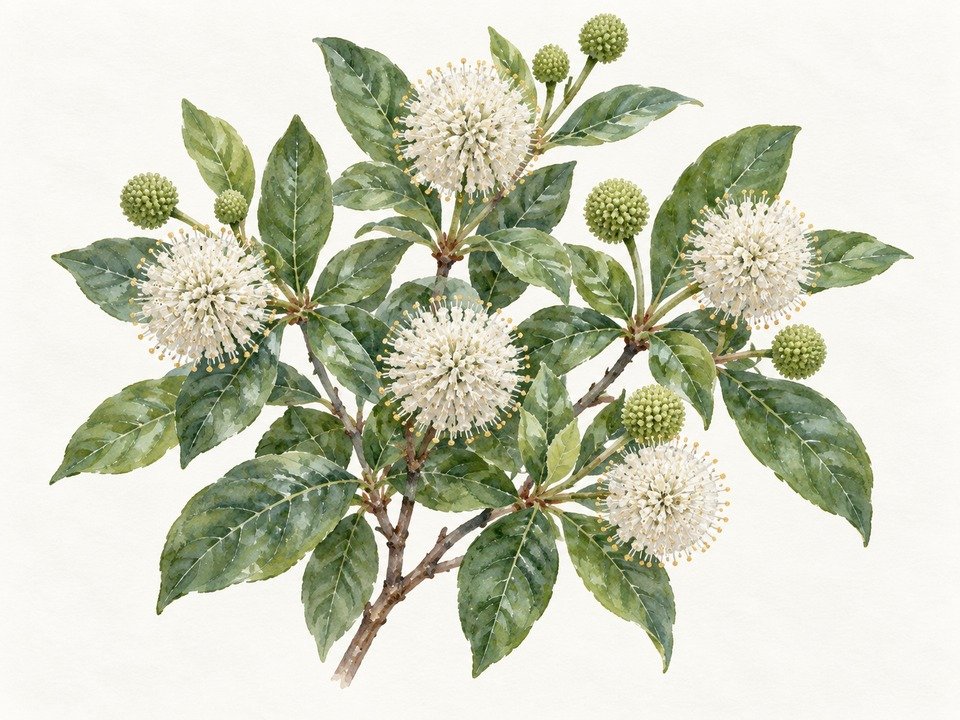
Perfectly round white pincushion flowers in summer, fragrant and swarming with butterflies and bees; round seed balls follow.[3]
When to Plant Bottonbush
Plant Buttonbush in fall or early spring in Central Texas.[3]
If you would like a hand, the Texas Allied Landscape team can plant your Buttonbush and keep it thriving.
Planting
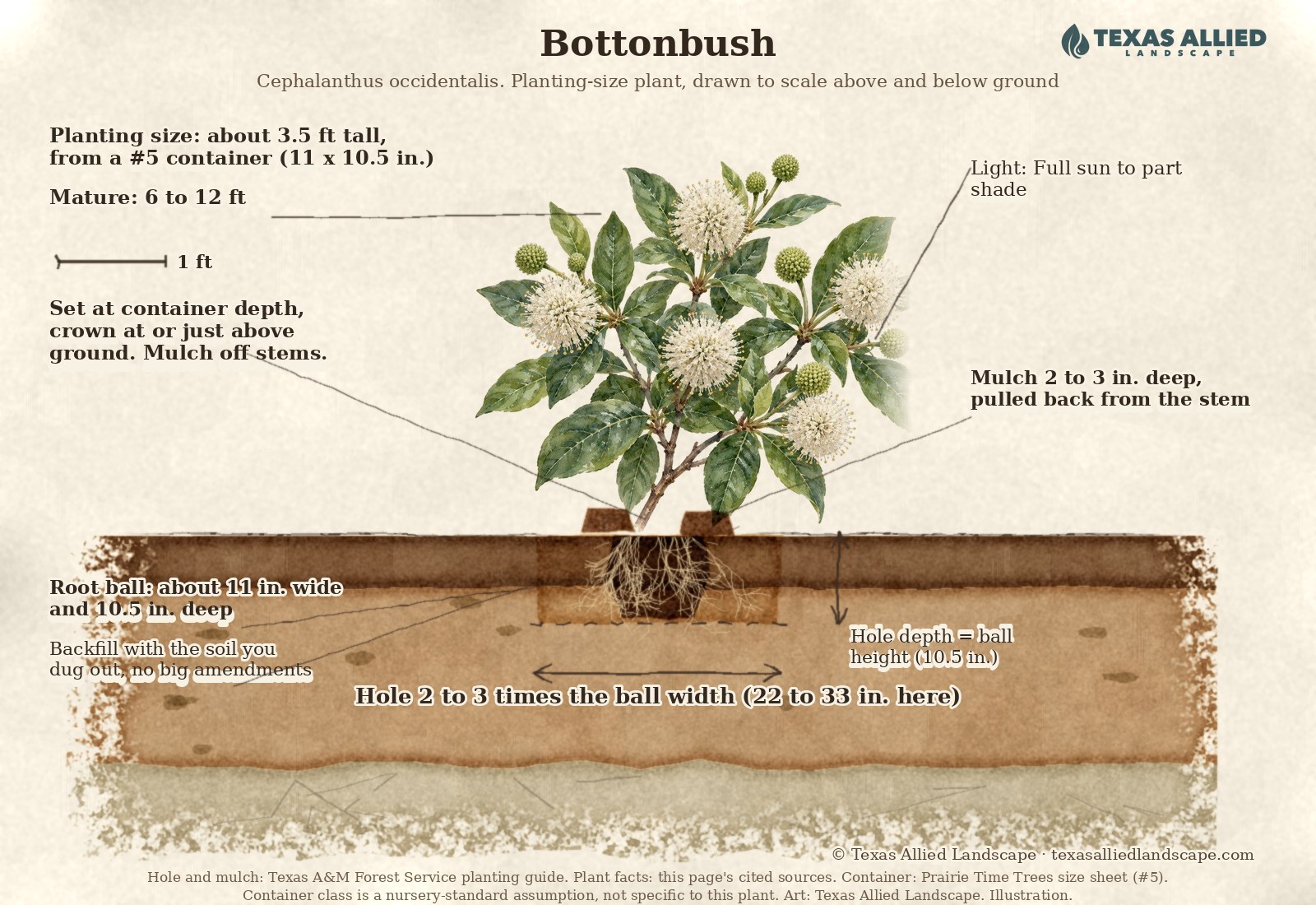
- Dig a hole twice as wide as the pot and no deeper, with sloping sides, and set the plant at the same depth it grew in its pot. Loosen any circling roots before backfilling.[4]
- For a new bed, clear grass and weeds first, roots and all.[4]
- Give it room: 6-12 feet tall and 6-8 feet wide, though it takes a hard late-winter cutback if you want it smaller.[5] Space plants for that full size, not the pot size.[4]
- Site: Full sun to part shade.[1]
- Timing: Plant Buttonbush in fall or early spring in Central Texas.[3]
- Soak it well at planting and keep watering while the roots establish.[4] Once established: Moist to wet ground is its natural home - pond edges, swales, low spots - but it adapts to ordinary garden soil with water.[1]
- Mulch 2 to 4 inches, kept a few inches away from the stems to prevent crown rot. It needs no staking or other support.[4]
Care Instructions for Your Bottonbush
Sunlight
Full sun to part shade.[1]
Soil and drainage
Moist to wet ground is its natural home - pond edges, swales, low spots - but it adapts to ordinary garden soil with water.[1]
Mature height and spread
Pruning
Low - it tolerates hard cutting back in late winter and resprouts vigorously.[1]
Normal seasonal behavior
Perfectly round white pincushion flowers in summer, fragrant and swarming with butterflies and bees; round seed balls follow.[3]
Buttonbush questions
Is buttonbush a Texas native?
Yes - Cephalanthus occidentalis is native to Texas streambanks, ponds and wetlands.[6]
Does buttonbush need wet soil?
It loves it - wet ground is its natural habitat - but it adapts to regular garden soil if it gets water in dry spells.[7]
Is buttonbush good for pollinators?
One of the best - the round fragrant summer blooms draw clouds of butterflies, bees and hummingbirds.[8]
How big does buttonbush get?
6-12 feet tall and 6-8 feet wide, though it takes a hard late-winter cutback if you want it smaller.[5]
Next step: Our horticulturalists can site it where the moisture fits and keep it shaped each year.
Let Texas Allied Landscape care for your Buttonbush
Buttonbush does best with steady, knowledgeable care: the right water, pruning at the right time, and a trained eye for stress. The horticulturists at Texas Allied Landscape care for plants like yours across the San Antonio area, backed by over 40 years of landscape experience.
In these community guides
Sources
- Clemson HGIC, "Common Buttonbush."https://hgic.clemson.edu/factsheet/common-buttonbush/abcdefghijkl
- Texas A&M Plants of Texas Rangelands, "Buttonbush."https://rangeplants.tamu.edu/plant/buttonbush/↑
- Native Plant Society of Texas, "Cephalanthus occidentalis."https://www.npsot.org/posts/native-plant/cephalanthus-occidentalis/abcdef
- Back to basics: Planting perennials, SAWS Garden Style San Antonio.https://www.gardenstylesanantonio.com/garden-articles/back-to-basics-planting-perennials/abcde
- Clemson HGIC, "Common Buttonbush."https://hgic.clemson.edu/factsheet/common-buttonbush/ab
- Native Plant Society of Texas, "Cephalanthus occidentalis."https://www.npsot.org/posts/native-plant/cephalanthus-occidentalis/↑
- Clemson HGIC, "Common Buttonbush."https://hgic.clemson.edu/factsheet/common-buttonbush/↑
- Native Plant Society of Texas, "Cephalanthus occidentalis."https://www.npsot.org/posts/native-plant/cephalanthus-occidentalis/↑