
Property owners
California Fan Palm
- Plant
- California Fan Palm
- Botanical name
- Washingtonia filifera
- Group
- Ornamental trees
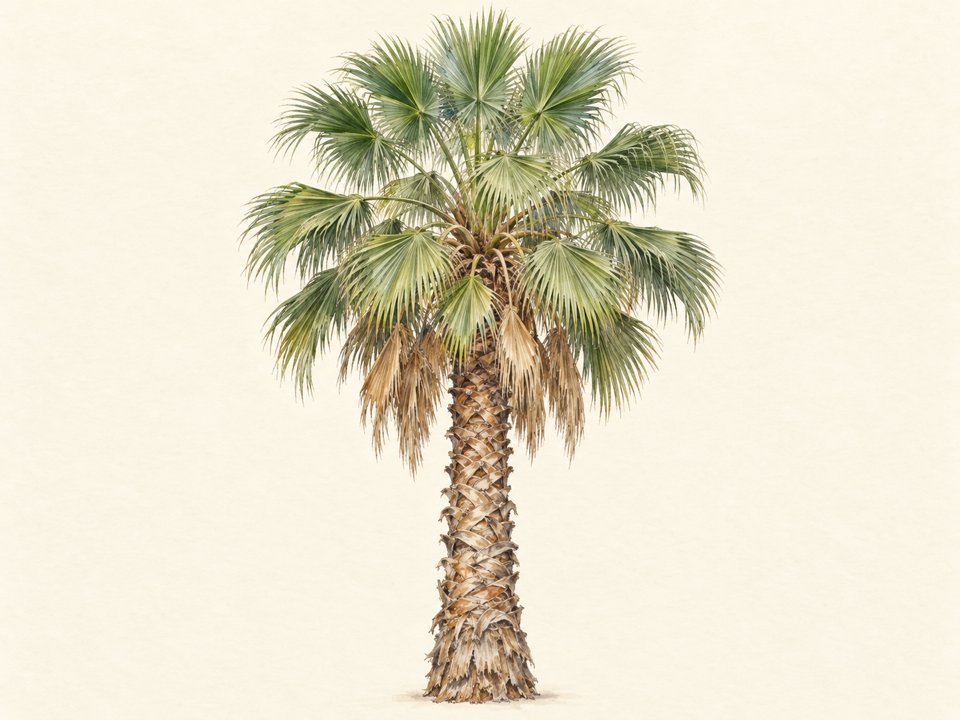
Plant profile for California Fan Palm in San Antonio area landscapes.
On this page
Its botanical name is Washingtonia filifera.
Leer en español
It belongs to the ornamental trees group.
Light
Full sun.[1]
Soil and drainage
Moist, alkaline soils.[1]
Height
Up to about 50 ft tall, occasionally taller.[1]
When to Plant California Fan Palm
Palms are different from trees. They establish best when the soil is warm. In Central Texas, plant California Fan Palm from late spring through summer so new roots grow quickly. Give it steady water its first season.[2]
If you would like a hand, the Texas Allied Landscape team can plant your California Fan Palm and keep it thriving.
Planting
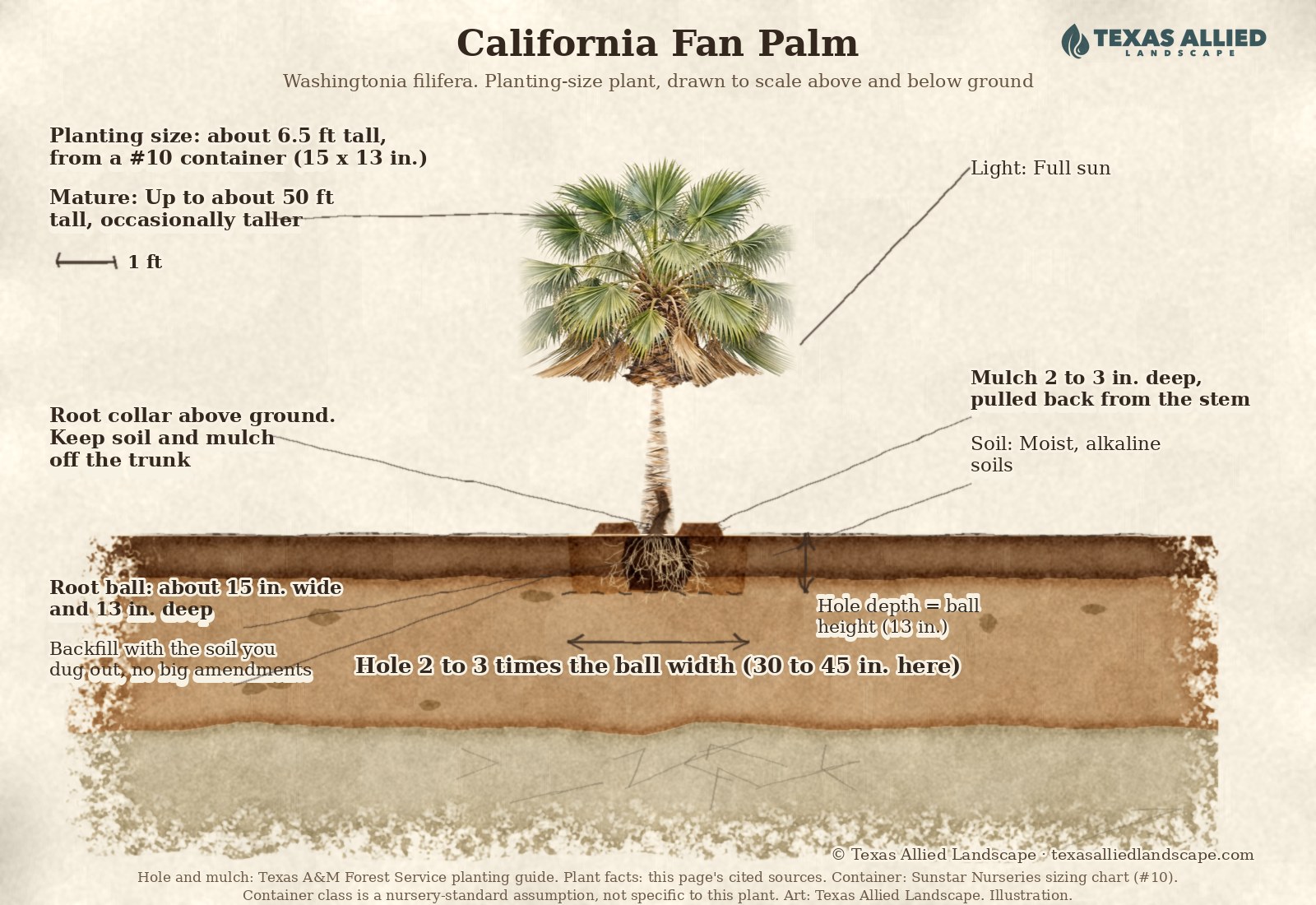
- Dig a hole at least twice as wide as the root ball and no deeper - a square hole keeps the roots from settling too deep while letting them grow out into the surrounding soil.[3]
- Fill the empty hole with water and check the drainage. If it takes longer than 24 hours to drain, choose another spot: roots sitting under water will kill the tree.[3]
- Set the tree with the root collar (the flare just above the roots) level with or slightly above the ground. Carry it by the container or root ball, never the trunk, and take off all wire, twine, containers and bags before backfilling.[3]
- Backfill with the same soil that came out of the hole, without amendments, and settle it with water rather than packing it down.[3]
- Water for at least the first two years, without overwatering: a thorough soaking beats light, frequent watering.[3]
- Mulch 2 to 3 inches deep, out to the drip line and up to but not touching the trunk. Stake only if the tree cannot stand on its own and take stakes off within a year - most trees need no support. Do not fertilize during the first growing season.[3]
Care Instructions for Your California Fan Palm
How to Water a California Fan Palm
Growing in Central Texas
Yes, it grows here. The desert fan palm is among the more cold-hardy large palms. It handles our winters better than the Mexican fan palm it resembles.[4]
Growth and size
It commonly reaches 40 to 50 ft and can reach 80 ft. It is a big skyline palm, not a small-yard plant.[5]
California fan palm questions
How tall does a California fan palm get?
It commonly reaches 40 to 50 ft and can reach 80 ft. It is a big skyline palm, not a small-yard plant.[5]
Is California fan palm cold hardy in Central Texas?
Yes - the desert fan palm is among the more cold-hardy large palms. It handles our winters better than the Mexican fan palm it resembles.[4]
What is the difference between California and Mexican fan palm?
California fan palm is stockier, slower, and much more cold-hardy. Mexican fan palm is skinnier, faster, and more tender. In South and Central Texas both grow. The California type survives hard freezes better.[6]
Should I remove the skirt of dead fronds?
Yes in landscapes - the hanging "petticoat" of dead fronds is a fire and pest hazard in town. It does shelter wildlife in the desert. Cut fronds close, and use sanitized tools.[7]
Next step: Our horticulturalists can clean and skin a fan palm trunk safely on a regular schedule.
In these community guides
Sources
- Washingtonia filifera (California Fan Palm), Lady Bird Johnson Wildflower Center.https://www.wildflower.org/plants/result.php?id_plant=WAFIabc
- PlantAnswers (Texas A&M AgriLife Extension), "Palms for Texas."https://www.plantanswers.com/palms_for_texas.htm↑
- Planting, Texas A&M Forest Service.https://tfsweb.tamu.edu/trees/tree-care/planting/abcdef
- Calscape, "Washingtonia filifera."https://calscape.org/plant/3872/Washingtonia-filifera-(Fan-Palm)ab
- University of Florida IFAS, "Washingtonia filifera."https://ask.ifas.ufl.edu/publication/ST669/pdfab
- Texas A&M AgriLife Extension, Bexar County, "Earth-Kind Horticulture Q&A."https://bexar-tx.tamu.edu/earth-kind-horticulture/2012-march-weekly-q-as/↑
- University of Florida IFAS, "Washingtonia filifera."https://ask.ifas.ufl.edu/publication/ST669/pdf↑