
Property owners
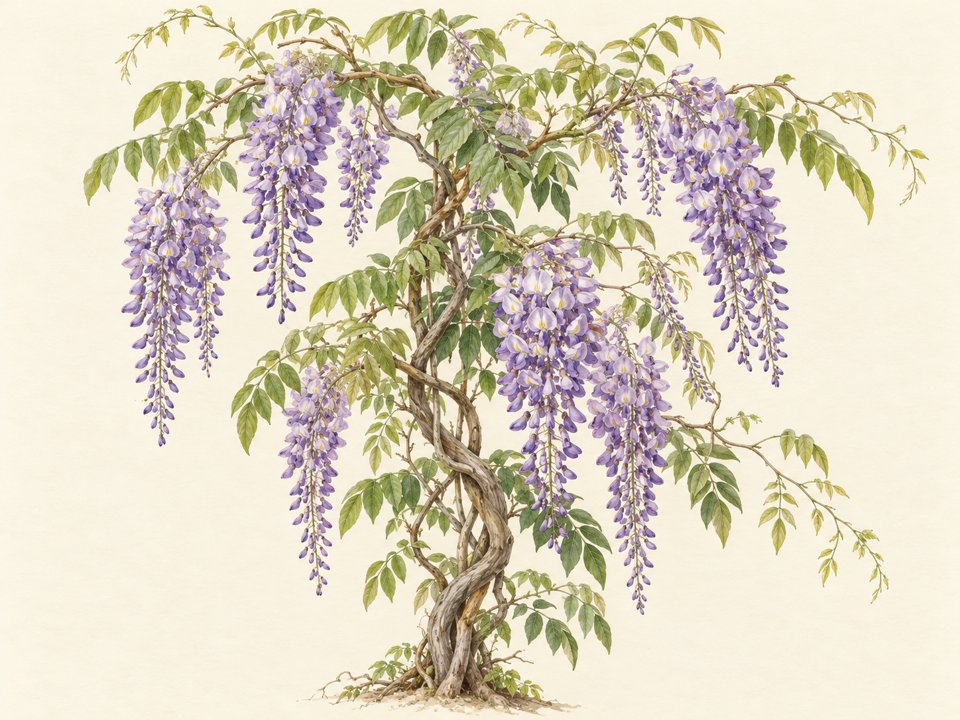
Chinese Wisteria
- Plant
- Chinese Wisteria
- Botanical name
- Wisteria sinensis
- Group
- Vines
Plant profile for Chinese Wisteria in San Antonio area landscapes.
On this page
Its botanical name is Wisteria sinensis.
It belongs to the vines group.
Light
Full sun.[1]
Soil and drainage
Tolerates clay and average soils with good drainage.[1]
Height
A woody vine reaching 10 to 25 ft or more where it can climb.[1]
Planting
- Dig a hole twice as wide as the pot and no deeper, with sloping sides. Set the plant at the same depth it grew in its pot. Loosen any circling roots before backfilling.[2]
- For support, plant it at the base of whatever it should climb. That could be a trellis, fence or arbor. It can take hold from the start.
- For the site, full sun, lean feeding and correct pruning all matter.[3]
- Soak it well at planting and keep watering while the roots establish.[2]
- Mulch 2 to 4 inches, kept a few inches away from the stems to prevent crown rot.[2]
Care Instructions for Your Chinese Wisteria
How to Water a Chinese Wisteria
Fruit and flowers
Young Chinese wisteria can take years to flower. Heavy nitrogen feeding pushes vines instead of blooms. Full sun, lean feeding and correct pruning all matter.[3]
Spread and invasiveness
Yes. Wisteria sinensis is an aggressive Asian vine. It strangles trees and spreads into woodlands. It can take years of work to remove once established.[4]
Growing in Central Texas
Choose American or Texas wisteria (Wisteria frutescens). It has the same lavender cascade look and much better manners. It blooms on new growth, so a hard prune does not cost you flowers.[5]
Chinese wisteria questions
Is Chinese wisteria invasive in Texas?
Yes. Wisteria sinensis is an aggressive Asian vine. It strangles trees and spreads into woodlands. It can take years of work to remove once established.[4]
What is the native alternative to Chinese wisteria?
Choose American or Texas wisteria (Wisteria frutescens). It has the same lavender cascade look and much better manners. It blooms on new growth, so a hard prune does not cost you flowers.[5]
How can I tell Chinese from American wisteria?
Chinese wisteria twines counterclockwise and blooms before the leaves. American wisteria twines clockwise and flowers a bit later on shorter clusters. The surest sign of Chinese is escape. Look for seedlings and runners showing up where they were not planted.[6]
Why won't my wisteria bloom?
Young Chinese wisteria can take years to flower. Heavy nitrogen feeding pushes vines instead of blooms. Full sun, lean feeding and correct pruning all matter.[3]
Next step: Our horticulturalists can assess whether yours needs pruning, patience, or replacement with the native.
In these community guides
Sources
- Wisteria sinensis (Chinese Wisteria), North Carolina Extension Gardener Plant Toolbox.https://plants.ces.ncsu.edu/plants/wisteria-sinensis/abc
- Back to basics: Planting perennials, SAWS Garden Style San Antonio.https://www.gardenstylesanantonio.com/garden-articles/back-to-basics-planting-perennials/abc
- CBS Texas, "Gardening 101: Growing Wisteria."https://www.cbsnews.com/texas/news/gardening-101-growing-wisteria/abc
- Native Plant Society of Texas, "Wisteria sinensis (invasive)."https://www.npsot.org/posts/invasive-plant/wisteria-sinensis/ab
- Travis County Master Gardeners, "All Wisteria Are Not Created Equally."https://travis-tx.tamu.edu/2022/05/10/all-wisteria-are-not-created-equally-by-gayleen-rabakukk/ab
- Travis County Master Gardeners, "All Wisteria Are Not Created Equally."https://travis-tx.tamu.edu/2022/05/10/all-wisteria-are-not-created-equally-by-gayleen-rabakukk/↑