
Property owners
Chitalpa
- Plant
- Chitalpa
- Botanical name
- x Chitalpa tashkentensis
- Group
- Ornamental trees
Sourced light, water, size and care details for Chitalpa.
On this page
Botanical name: x Chitalpa tashkentensis.[1]
Leer en español
Light, soil and water
Full sun. SAWS lists very low to low water use and sandy, well-drained or clay soils.[1]
Size and shape
A deciduous, thornless, fast-growing small tree with a low, spreading canopy. SAWS lists 20 to 35 feet tall and wide. It branches very low and tends to grow sloppy rather than stately, so it needs pruning and training to manage its size and habit.[1]
Flowers
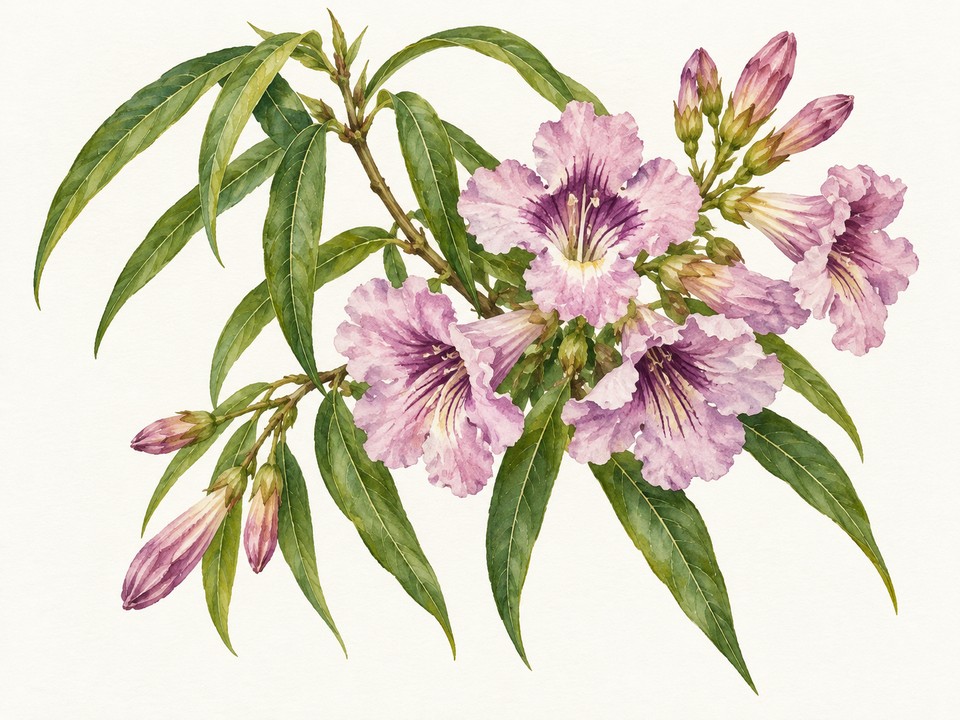
Pale pink trumpet flowers from spring through fall. SAWS tags it as freeze hardy and as attracting pollinators, birds, hummingbirds and butterflies. It is an inter-generic hybrid of Southern Catalpa and Desert Willow.[1]
Maintenance
Remove no more than 25 percent of the canopy in any 5-year cycle. Leaves may get mildew in heavily irrigated settings.[1]
When to Plant Chitalpa
In Central Texas, the best time to plant Chitalpa is fall through late winter, roughly October through February. Cooler weather and fall rains let the roots establish before summer heat arrives.[2]
Container-grown trees can also go in the ground in spring, and even in summer if you can commit to deep, regular watering through the first growing season. Spring and summer planting demand more from you and the tree.
If you would like a hand, the Texas Allied Landscape team can plant your Chitalpa and keep it thriving.
Planting
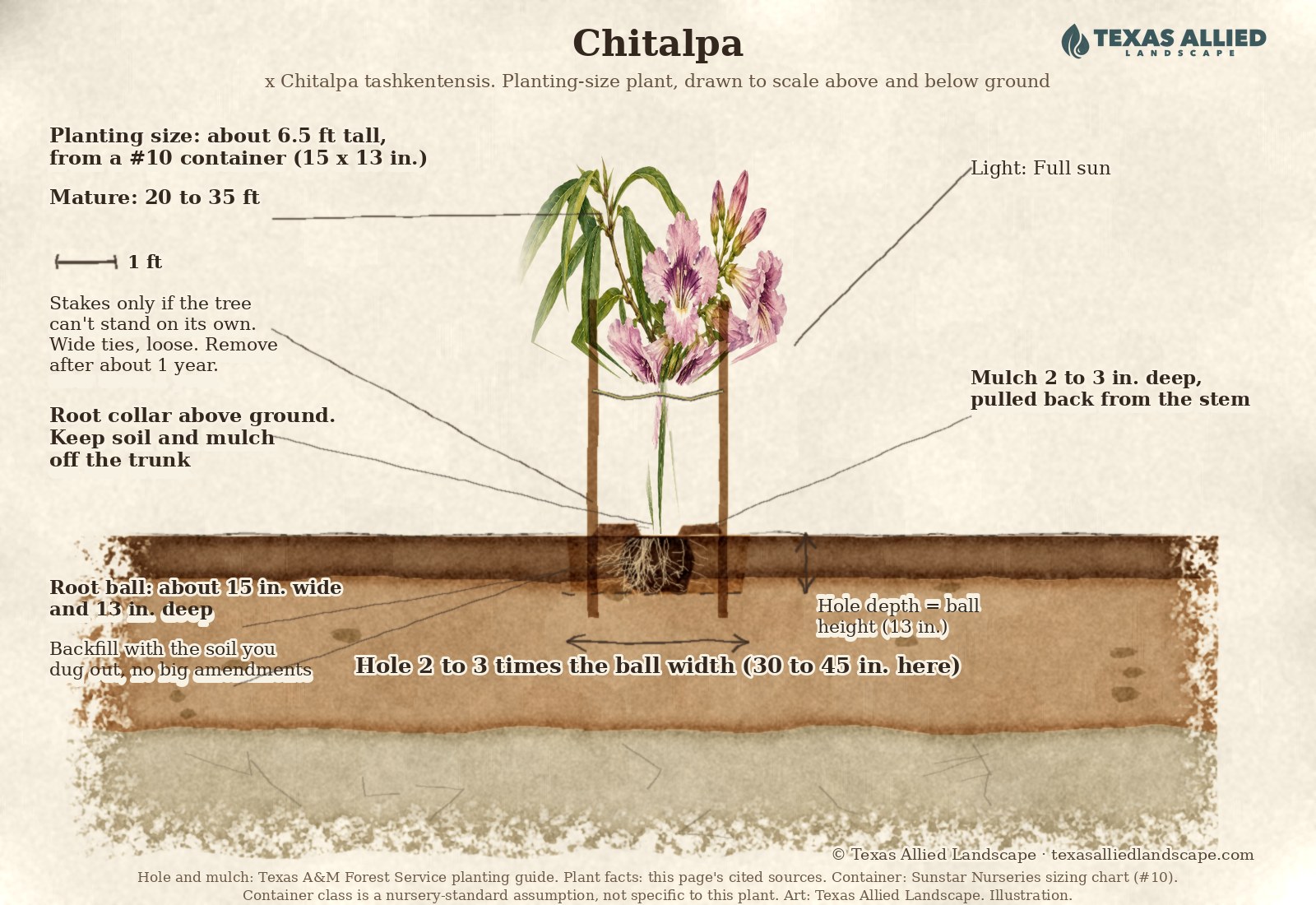
- Dig a hole at least twice as wide as the root ball and no deeper - a square hole keeps the roots from settling too deep while letting them grow out into the surrounding soil.[3]
- Fill the empty hole with water and check the drainage. If it takes longer than 24 hours to drain, choose another spot: roots sitting under water will kill the tree.[3]
- Set the tree with the root collar (the flare just above the roots) level with or slightly above the ground. Carry it by the container or root ball, never the trunk, and take off all wire, twine, containers and bags before backfilling.[3]
- Backfill with the same soil that came out of the hole, without amendments, and settle it with water rather than packing it down.[3]
- Give it room: SAWS lists 20 to 35 feet tall and wide. It branches very low and tends to grow sloppy rather than stately, so it needs pruning and training to manage its size and habit.[1] Give the canopy and roots plenty of vertical and horizontal room.[3]
- Site and soil: Full sun. SAWS lists very low to low water use and sandy, well-drained or clay soils.[1]
- Timing: the best time to plant Chitalpa is fall through late winter, roughly October through February. Cooler weather and fall rains let the roots establish before summer heat arrives.[2]
- Water for at least the first two years, without overwatering: a thorough soaking beats light, frequent watering.[3]
- Mulch 2 to 3 inches deep, out to the drip line and up to but not touching the trunk. Stake only if the tree cannot stand on its own and take stakes off within a year - most trees need no support. Do not fertilize during the first growing season.[3]
Care Instructions for Your Chitalpa
How to Water a Chitalpa
Sunlight, soil and water
Full sun. SAWS lists very low to low water use and sandy, well-drained or clay soils.[1]
Maintenance
Remove no more than 25 percent of the canopy in any 5-year cycle. Leaves may get mildew in heavily irrigated settings.[1]
Flowers
Pale pink trumpet flowers from spring through fall. SAWS tags it as freeze hardy and as attracting pollinators, birds, hummingbirds and butterflies. It is an inter-generic hybrid of Southern Catalpa and Desert Willow.[1]
Chitalpa questions
What is a chitalpa tree?
A hybrid between Southern catalpa and our native desert willow - you get desert willow's drought toughness and orchid-like summer flowers on a fuller, small tree.[4]
Is chitalpa drought tolerant?
Very - it inherits desert willow's dry-country genetics. Full sun, good drainage, and modest water once established.[5]
When does chitalpa bloom?
Summer - clusters of pink, trumpet-shaped flowers through the hot months, when little else blooms.[6]
How big does chitalpa get?
A small tree, 20-25 ft - sized for patios and small yards where a full-size shade tree will not fit.[7]
Next step: Our horticulturalists can structural-prune a young chitalpa so its fast growth forms a strong frame.
Let Texas Allied Landscape care for your Chitalpa
Chitalpa does best with steady, knowledgeable care: the right water, pruning at the right time, and a trained eye for stress. The horticulturists at Texas Allied Landscape care for plants like yours across the San Antonio area, backed by over 40 years of landscape experience.
In these community guides
Sources
- Chitalpa, SAWS Garden Style San Antonio.https://www.gardenstylesanantonio.com/plants/chitalpa/abcdefghij
- October Gardening Checklist, Travis County AgriLife Extension.https://travis-tx.tamu.edu/about-2/horticulture/monthly-gardening-calendar-for-austin-area/october-gardening-checklist-for-austin-and-central-texas/ab
- Planting, Texas A&M Forest Service.https://tfsweb.tamu.edu/trees/tree-care/planting/abcdefg
- Texas Tech Plant Database, "Chitalpa."https://www.depts.ttu.edu/plantresources/Pages/directories/landscape-info-sheets/woody-info/xChitalpa_tashkentensis.php↑
- Lee Ann Torrans, "Chitalpa Tree."https://leeanntorrans.com/chitalpa-tree-morning-cloud/↑
- Leaf Landscape Supply, "Chitalpa Planting and Care for Austin."https://www.leaflandscapesupply.com/plant-nursery/chitalpa-planting-and-care-tips-for-austin-tx-landscapes↑
- Texas Tech Plant Database, "Chitalpa."https://www.depts.ttu.edu/plantresources/Pages/directories/landscape-info-sheets/woody-info/xChitalpa_tashkentensis.php↑