
Property owners
Common Water Hyacinth
- Plant
- Common Water Hyacinth
- Botanical name
- Eichhornia crassipes
- Group
- Prohibited examples
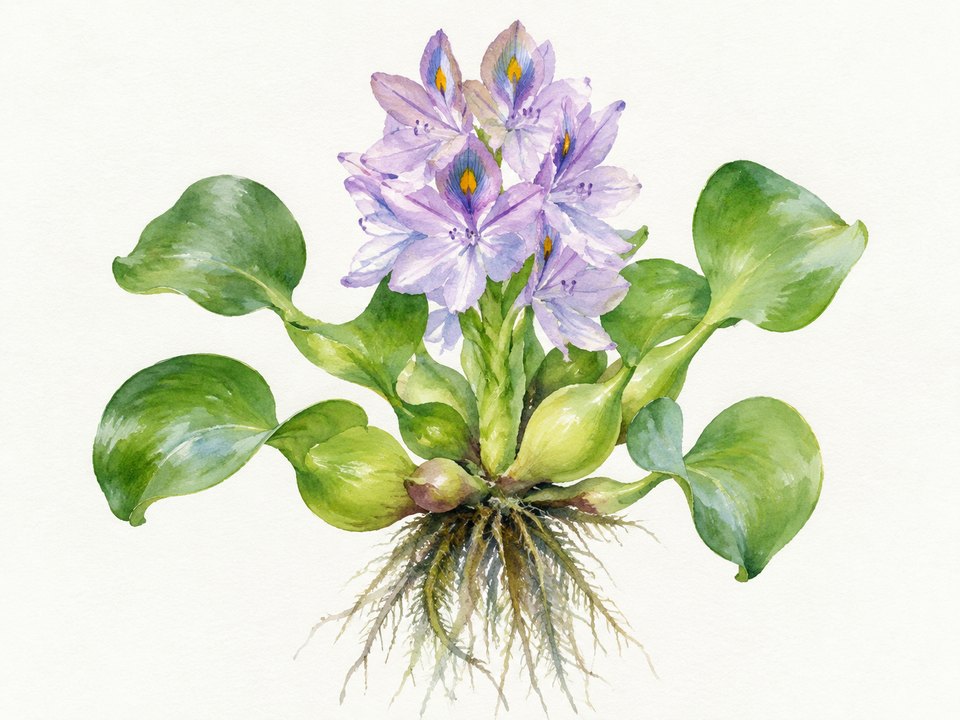
Common Water Hyacinth: growth, foliage, flowers and invasive behavior.
On this page
Its botanical name is Eichhornia crassipes.
Soil and drainage
It floats on open water. Its roots only reach soil during flowering.[1]
Height
Its flower stalks reach about 16 inches above the water.
Spread
It spreads quickly by fragmentation and offshoots. It forms dense mats.
Foliage
It is a perennial. It has thick, shiny, bright-green, kidney-shaped leaves and bulb-like swollen stems.
Seasonal behavior
It has showy lavender flowers in groups of 8 to 15, each with a yellow spot. Caution: water hyacinth is a serious invasive. Its mats lower light and oxygen in the water, which harms fish and native plants. The mats can also clog canals and pumps.
Why Water Hyacinth is a problem here
Common water hyacinth is listed as an invasive species in Texas. It doubles fast and carpets the surface of ponds and slow water. It blocks light and oxygen for everything beneath it. It also escapes easily into creeks and rivers.[1]
What to do instead
Keep it out of natural waterways entirely. Never dump pond plants. If it reaches a pond you manage, remove it before it mats over. The Texas Allied Landscape team can help you plan a fix.
Care Instructions for Your Common Water Hyacinth
How to Water a Common Water Hyacinth
Soil and drainage
It floats on open water. Its roots only reach soil during flowering.[1]
Mature height and spread
Its flower stalks reach about 16 inches above the water. It spreads quickly by fragmentation and offshoots. It forms dense mats.
Normal seasonal behavior
It has showy lavender flowers in groups of 8 to 15, each with a yellow spot. Caution: water hyacinth is a serious invasive. Its mats lower light and oxygen in the water, which harms fish and native plants. The mats can also clog canals and pumps.
Water hyacinth questions
Is water hyacinth invasive in Texas?
Yes. Eichhornia crassipes is one of the worst aquatic invasives in warm climates. It doubles its mat size in weeks and chokes ponds, bayous, and slow water. In Texas it is illegal to possess or transport without a permit.[2]
Can I put water hyacinth in my pond?
It is sold for water gardens because the lavender flowers are pretty. But in Texas it escapes too easily into creeks and stock tanks. Native floaters like water lilies are the safer choice.[3]
Why did my water hyacinths die over winter?
They are tropical. The foliage dies back once water temperatures drop toward the 50s. That is why they are treated as annuals even in mild climates.[4]
How do I get rid of water hyacinth?
Pull every plant and fragment out of the water and dry them on land. Pieces left behind regrow. Mats keep coming back until nothing is left to sprout.[5]
Next step: Our horticulturalists can clear a pond or water feature and set up a watch for regrowth.
In these community guides
Illustration. Illustration based on reference photos of Mountain Springs Ranch. Not a single literal view. Mountain Springs Ranch Landscaping
Plan your Mountain Springs Ranch yard with planting, lawn and irrigation guidance. Get help from the review package…
Sources
- Common water hyacinth (Eichhornia crassipes), Texas Invasives.https://www.texasinvasives.org/plant_database/detail.php?symbol=EICRabc
- Pond Informer, "Water Hyacinth Facts, Care & Planting (Eichhornia crassipes)."https://pondinformer.com/water-hyacinth-eichhornia-crassipes/↑
- Missouri Botanical Garden Plant Finder, "Eichhornia crassipes."https://www.missouribotanicalgarden.org/plantfinder/PlantFinderDetails.aspx?taxonid=285493↑
- Master Gardeners of British Columbia, "Water Hyacinths Die in Winter."https://www.mgabc.org/mgabc2022/article/water-hyacinths-die-winter.html↑
- Gardentopia, "Expert guide to caring for water hyacinth."https://gardentopia.eu/expert-guide-to-caring-for-water-hyacinth/↑