
Property owners
Coral Honeysuckle
- Plant
- Coral Honeysuckle
- Botanical name
- Lonicera sempervirens
- Group
- Vines
Sourced light, water, size and care details for Coral Honeysuckle.
On this page
Its botanical name is Lonicera sempervirens.
It belongs to the vines group.
Light
It grows in full sun to part shade. It gives the most flowers in sun and the lushest foliage in light shade.[1][2]
Soil and drainage
It is adaptable. It grows in rocky, sandy, or clay soils if they drain. It is a Texas native that fits Hill Country ground as-is.[3]
Height
It reaches 10 to 20 ft as a twining vine. It is easily kept shorter with pruning.
Spread
It spreads 3 to 6 ft wide on a trellis or fence.
Foliage
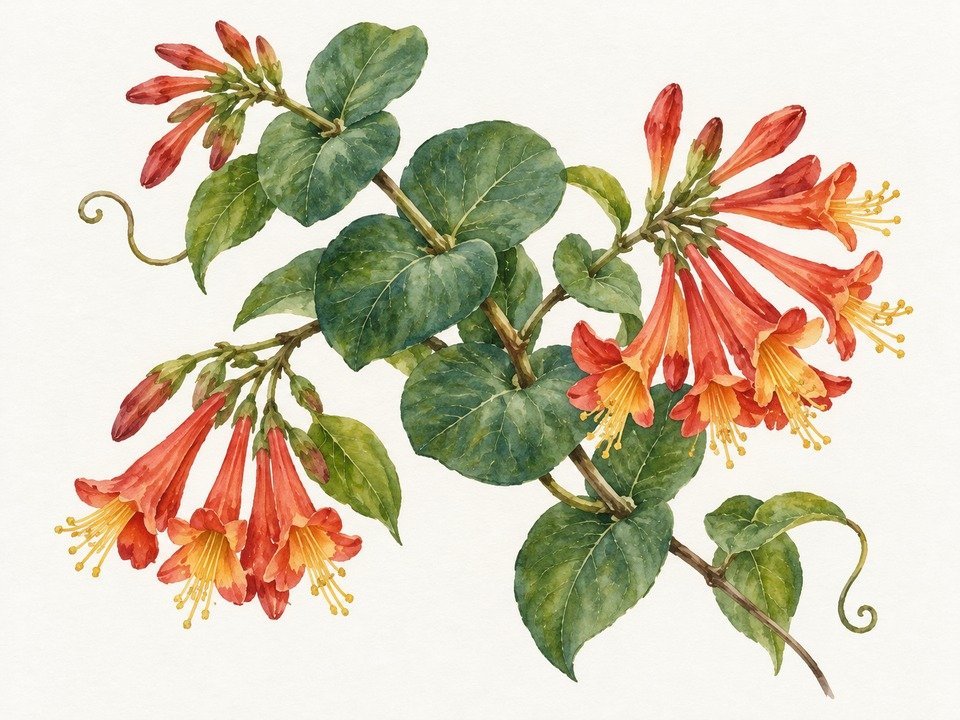
It is semi-evergreen in Central Texas. It has blue-green leaves, with upper pairs fused around the stem.
Water
It needs low to medium water. It handles drought once established but blooms heavier with occasional deep water. If watering ever feels like a guessing game, our horticulturists can care for your Coral Honeysuckle on a schedule that fits your yard.[1]
Pruning
Prune after the spring bloom flush to shape and thin it. It flowers on new growth, so even a hard cutback in late winter is safe.[2]
Seasonal behavior
It has coral-red trumpet flowers from early spring into summer, with repeats to frost. Hummingbirds work it constantly. It has red berries for birds in fall.
When to Plant Coral Honeysuckle
Plant Coral Honeysuckle in fall or early spring in Central Texas. A fall planting grows roots through the cool season. The plant is ready to climb and bloom the next year. Spring planting works too if you water through the first summer.[4]
If you would like a hand, the Texas Allied Landscape team can plant your Coral Honeysuckle and keep it thriving.
Planting
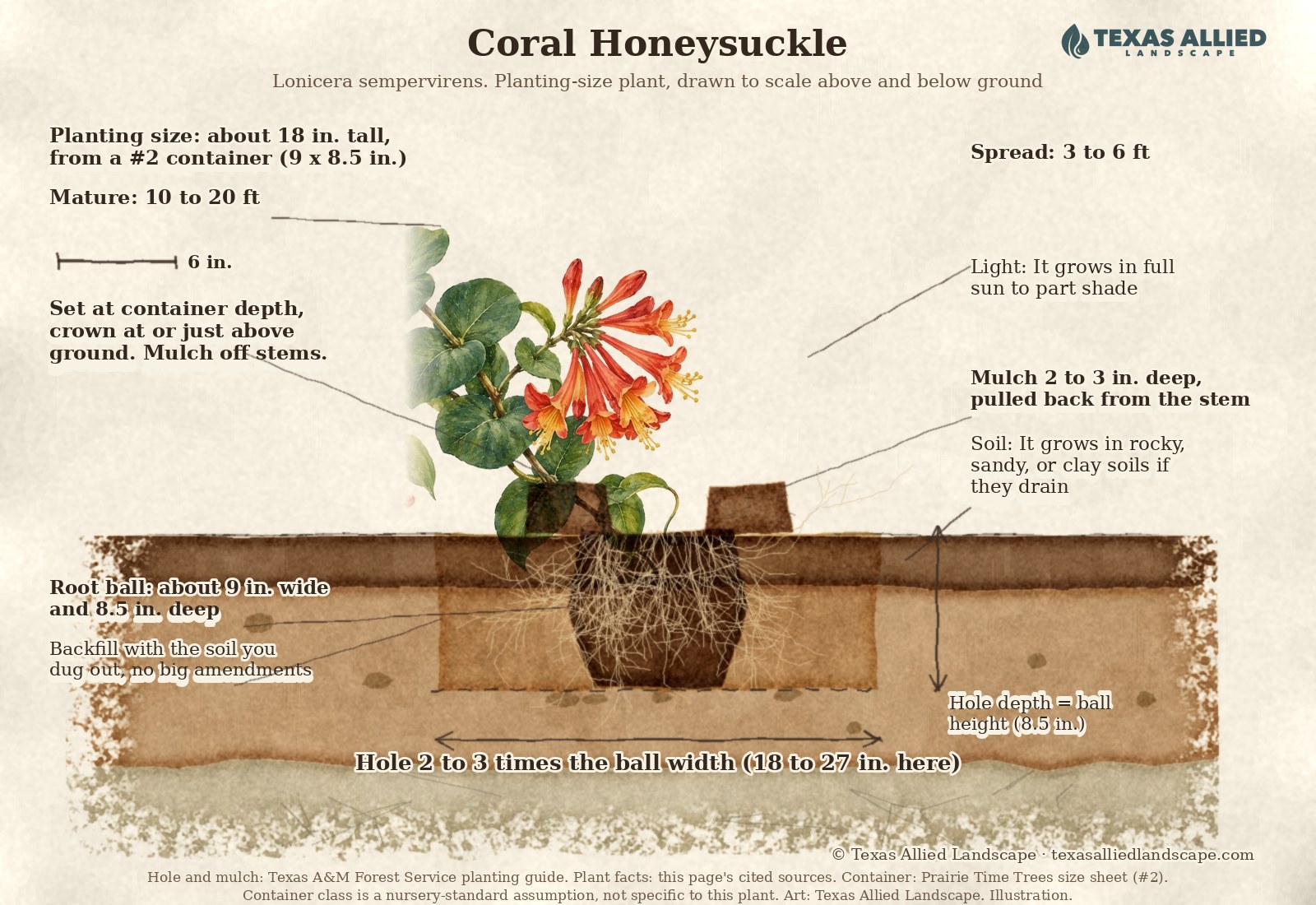
- Dig a hole twice as wide as the pot and no deeper, with sloping sides. Set the plant at the same depth it grew in its pot. Loosen any circling roots before backfilling.[5]
- For support, a fall planting grows roots through the cool season and is ready to climb and bloom the next year. Spring planting works too if you water through the first summer.[4]
- For the site, choose full sun to part shade. It gives the most flowers in sun and the lushest foliage in light shade.[1][2]
- For soil, it is adaptable. It grows in rocky, sandy, or clay soils if they drain. It is a Texas native that fits Hill Country ground as-is.[3]
- For timing, a fall planting grows roots through the cool season and is ready to climb and bloom the next year. Spring planting works too if you water through the first summer.[4]
- Soak it well at planting and keep watering while the roots establish.[5] Once established, it needs low to medium water. It handles drought but blooms heavier with occasional deep water. Prune after the spring bloom flush to shape and thin it. It flowers on new growth, so even a hard cutback in late winter is safe.[2]
- Mulch 2 to 4 inches, kept a few inches away from the stems to prevent crown rot.[5]
Care Instructions for Your Coral Honeysuckle
Sunlight
It grows in full sun to part shade. It gives the most flowers in sun and the lushest foliage in light shade.[1][2]
Soil and drainage
It is adaptable. It grows in rocky, sandy, or clay soils if they drain. It is a Texas native that fits Hill Country ground as-is.[3]
Mature height and spread
It reaches 10 to 20 ft as a twining vine and is easily kept shorter with pruning. It spreads 3 to 6 ft wide on a trellis or fence.
Pruning
Prune after the spring bloom flush to shape and thin; it flowers on new growth, so even a hard cutback in late winter is safe.[2]
Normal seasonal behavior
It has coral-red trumpet flowers from early spring into summer, with repeats to frost. Hummingbirds work it constantly. It has red berries for birds in fall.
Coral honeysuckle questions
Is coral honeysuckle invasive?
No - unlike Japanese honeysuckle (the fragrant white one that strangles fencerows), coral honeysuckle is a well-behaved Texas native. It stays where you plant it.[6]
Do hummingbirds like coral honeysuckle?
It is one of the best hummingbird plants you can grow here. The red trumpets bloom right as hummingbirds arrive in spring.[7]
Why isn't my coral honeysuckle blooming?
The cause is too much shade or too much nitrogen. Give it at least half a day of sun. Skip the lawn fertilizer drifting into its bed.[8]
How do I keep coral honeysuckle on its trellis?
Weave new shoots through the support by hand a few times each season. It twines on its own after that. A light post-bloom trim keeps it from top-flopping.[9]
Next step: Our horticulturalists can train and shape it during regular bed visits.
Let Texas Allied Landscape care for your Coral Honeysuckle
Coral Honeysuckle does best with steady, knowledgeable care: the right water, pruning at the right time, and a trained eye for stress. The horticulturists at Texas Allied Landscape care for plants like yours across the San Antonio area, backed by over 40 years of landscape experience.
In these community guides
Illustration. Illustration based on reference photos of Arbors of Fair Oaks. Not a single literal view. Arbors of Fair Oaks Landscaping
Bring your address, unit and yard ideas. Texas Allied Landscape helps design the planting and irrigation, prepare the…
Sources
- Honeysuckle, Coral, City of Austin Watershed Protection - Grow Green.https://www.austintexas.gov/watershed-protection/plant-guide/honeysuckle-coralabcde
- Lonicera sempervirens, Native Plant Society of Texas.https://www.npsot.org/posts/native-plant/lonicera-sempervirens/abcdef
- Lonicera sempervirens, Lady Bird Johnson Wildflower Center.https://www.wildflower.org/expert/show.php?id=4158abc
- October Gardening Checklist, Travis County AgriLife Extension.https://travis-tx.tamu.edu/about-2/horticulture/monthly-gardening-calendar-for-austin-area/october-gardening-checklist-for-austin-and-central-texas/abc
- Back to basics: Planting perennials, SAWS Garden Style San Antonio.https://www.gardenstylesanantonio.com/garden-articles/back-to-basics-planting-perennials/abc
- Native Plant Society of Texas, "The Dirty Dozen Invasive Plants of North Texas."https://www.npsot.org/posts/the-dirty-dozen-invasive-plants-of-north-texas-2/↑
- Native Plant Society of Texas, "Lonicera sempervirens."https://www.npsot.org/posts/native-plant/lonicera-sempervirens/↑
- City of Austin Grow Green plant guide, "Honeysuckle, Coral."https://www.austintexas.gov/watershed-protection/plant-guide/honeysuckle-coral↑
- Native Garden Guide, "Coral Honeysuckle (Lonicera sempervirens): Texas Vine Care."https://nativegardenguide.com/plants/coral-honeysuckle↑