
Property owners
Creeping Plumbago
- Plant
- Creeping Plumbago
- Botanical name
- Ceratostigma plumbaginoides
- Group
- Ground cover
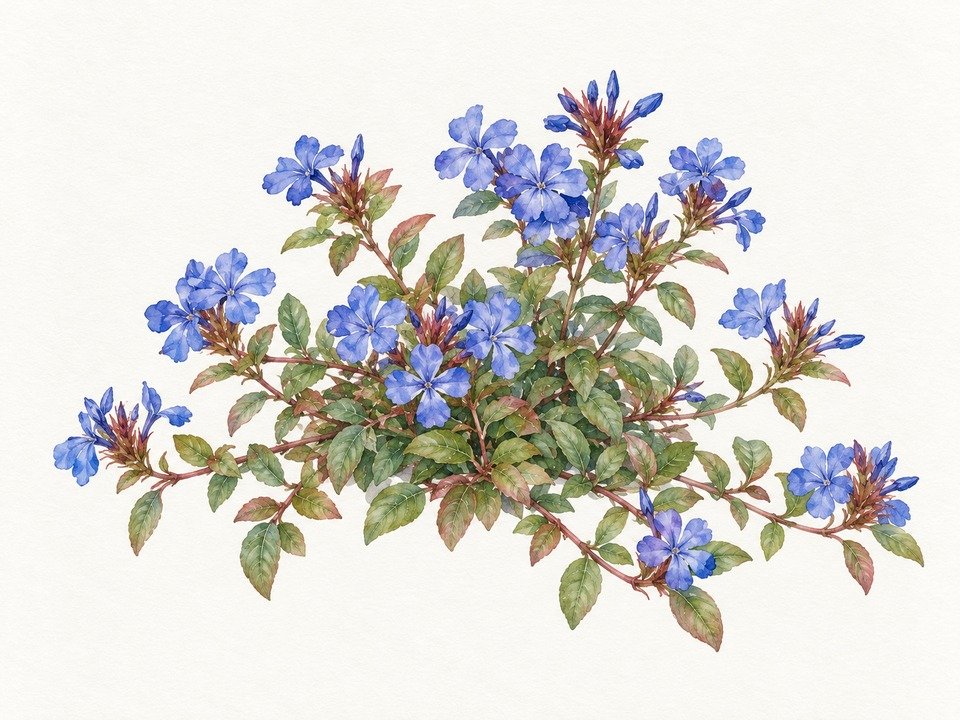
Creeping Plumbago covers ground with gentian-blue bloom just as summer ends.
On this page
Botanical name: Ceratostigma plumbaginoides.
Plant group: Ground cover.
Light
Full sun to part shade; it performs best with morning sun and afternoon shade in hot climates.[1]
Soil and drainage
Sandy or loamy, well-drained soil; it tolerates droughty ground and any pH.[2][1]
Height
About 6-10 inches.[3]
Spread
Spreads by rhizomes into a mat, 12-18 inches per plant and widening steadily - a moderately fast spreader but not considered invasive.[4]
Foliage
Glossy green oval leaves that turn red to purple in fall - often while the blue flowers are still going.[2][4]
Water
Average to low; tolerates droughty soil once established.[1]
Pruning
Cut the dead stems to the ground in late winter; it is very late to wake in spring, so do not assume it died.[3]
Seasonal behavior
True gentian-blue flowers from late summer into fall, against foliage turning red - one of the best late-season groundcovers.[4]
When to Plant Creeping Plumbago
Plant Creeping Plumbago in spring or fall in Central Texas.[4]
If you would like a hand, the Texas Allied Landscape team can plant your Creeping Plumbago and keep it thriving.
Planting
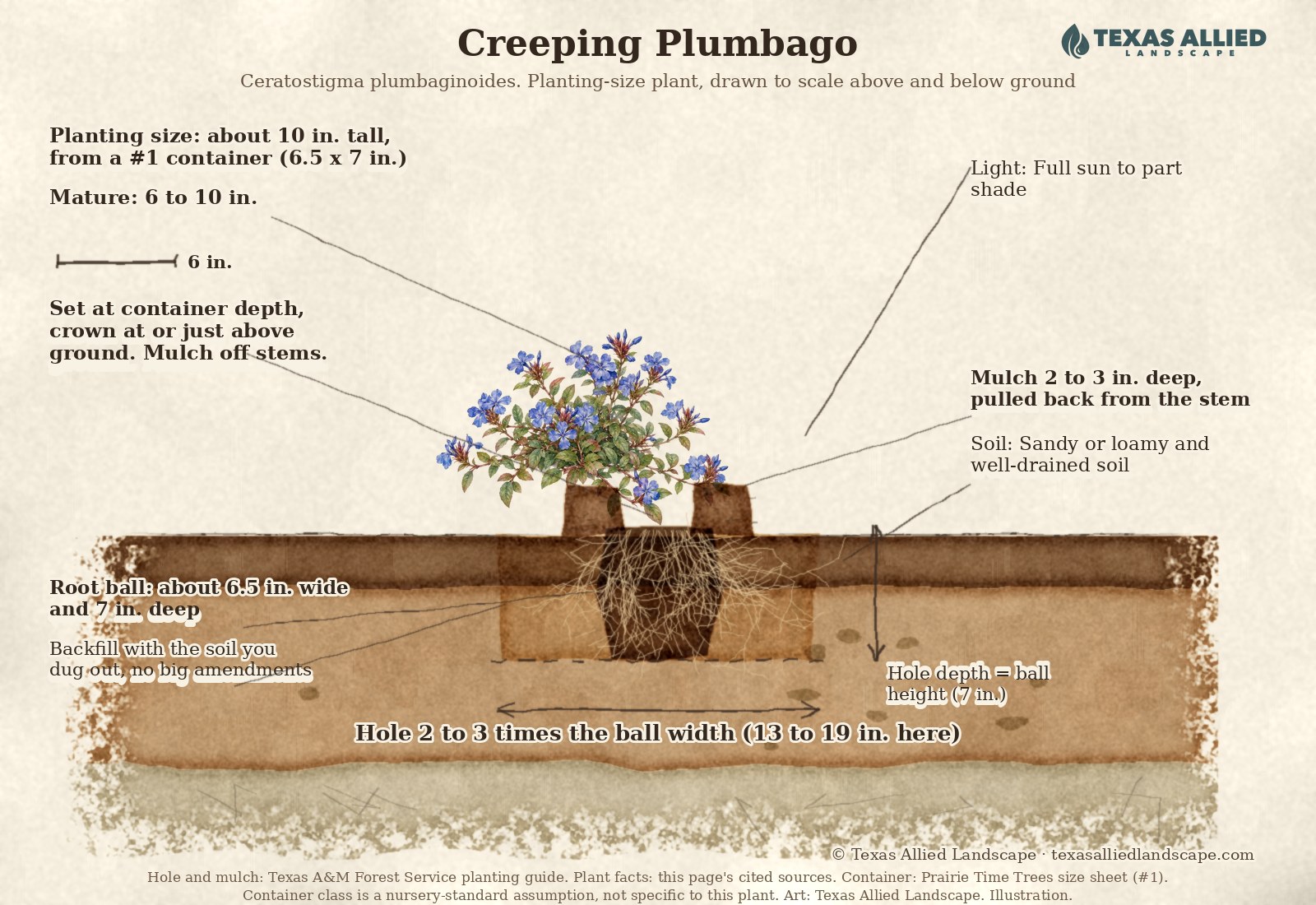
- Dig a hole twice as wide as the pot and no deeper, with sloping sides, and set the plant at the same depth it grew in its pot. Loosen any circling roots before backfilling.[5]
- For a new bed, clear grass and weeds first, roots and all.[5]
- Site: Full sun to part shade; it performs best with morning sun and afternoon shade in hot climates.[1]
- Soil: Sandy or loamy, well-drained soil; it tolerates droughty ground and any pH.[2][1]
- Timing: Plant Creeping Plumbago in spring or fall in Central Texas.[4]
- Soak it well at planting and keep watering while the roots establish.[5]
- Mulch 2 to 4 inches, kept a few inches away from the stems to prevent crown rot. It needs no staking or other support.[5]
Care Instructions for Your Creeping Plumbago
Sunlight
Full sun to part shade; it performs best with morning sun and afternoon shade in hot climates.[1]
Soil and drainage
Sandy or loamy, well-drained soil; it tolerates droughty ground and any pH.[2][1]
Mature height and spread
About 6-10 inches.[3] Spreads by rhizomes into a mat, 12-18 inches per plant and widening steadily - a moderately fast spreader but not considered invasive.[4]
Pruning
Cut the dead stems to the ground in late winter; it is very late to wake in spring, so do not assume it died.[3]
Normal seasonal behavior
True gentian-blue flowers from late summer into fall, against foliage turning red - one of the best late-season groundcovers.[4]
Creeping plumbago questions
Is creeping plumbago invasive?
No - it spreads steadily by rhizomes into a mat but is not considered invasive; it is easy to edge or pull where it oversteps.[6]
When does creeping plumbago bloom?
Late summer through fall - rich gentian-blue flowers at the time of year when little else is starting to bloom.[7]
My creeping plumbago disappeared over winter - is it dead?
Probably not - it dies to the ground and is famously late to re-emerge in spring. Give it until late spring before digging it out.[8]
Next step: Our horticulturalists know which perennials are late risers and can save you from replacing a plant that was just sleeping.
Does creeping plumbago have fall color?
Yes - the leaves turn red to purple in autumn, often while the blue flowers are still open.[9]
Let Texas Allied Landscape care for your Creeping Plumbago
Creeping Plumbago does best with steady, knowledgeable care: the right water, pruning at the right time, and a trained eye for stress. The horticulturists at Texas Allied Landscape care for plants like yours across the San Antonio area, backed by over 40 years of landscape experience.
In these community guides
Sources
- Cornell Home Gardening, "Dwarf Plumbago."http://www.gardening.cornell.edu/homegardening/scenea5d2-2.htmlabcdefgh
- Royal Horticultural Society, "Ceratostigma plumbaginoides."https://www.rhs.org.uk/plants/3410/i-ceratostigma-plumbaginoides-i/detailsabcd
- Bluestone Perennials, "Ceratostigma plumbaginoides."https://www.bluestoneperennials.com/CEPL.htmlabcd
- Clemson Home & Garden Information Center, "Perennial Leadwort."https://hgic.clemson.edu/factsheet/perennial-leadwort/abcdefg
- Back to basics: Planting perennials, SAWS Garden Style San Antonio.https://www.gardenstylesanantonio.com/garden-articles/back-to-basics-planting-perennials/abcd
- Clemson Home & Garden Information Center, "Perennial Leadwort."https://hgic.clemson.edu/factsheet/perennial-leadwort/↑
- Clemson Home & Garden Information Center, "Perennial Leadwort."https://hgic.clemson.edu/factsheet/perennial-leadwort/↑
- Bluestone Perennials, "Ceratostigma plumbaginoides."https://www.bluestoneperennials.com/CEPL.html↑
- Royal Horticultural Society, "Ceratostigma plumbaginoides."https://www.rhs.org.uk/plants/3410/i-ceratostigma-plumbaginoides-i/details↑