
Property owners
Eastern Gama Grass
- Plant
- Eastern Gama Grass
- Botanical name
- Tripsacum dactyloides
- Group
- Ornamental grasses
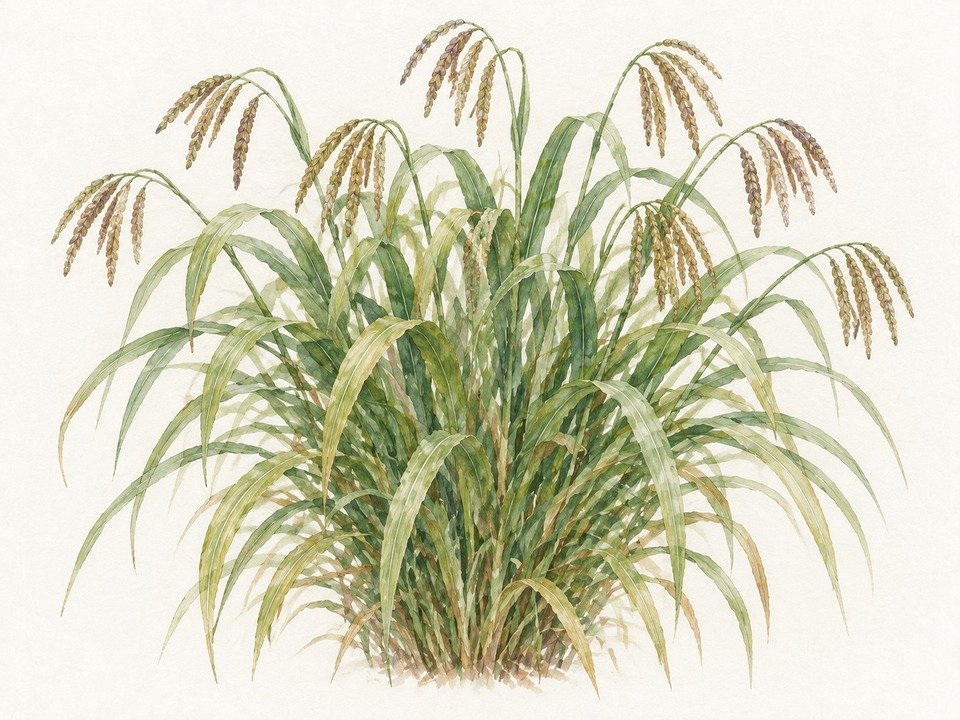
Eastern gama grass is a bold native bunchgrass - corn-like blades to 6 feet and a natural fit for low, moist spots.
On this page
Botanical name: Tripsacum dactyloides.
Plant group: Ornamental grasses.
Light
Full sun to light shade.[1]
Soil and drainage
Adaptable, and unusually tolerant of moist or seasonally wet ground - along swales and low spots where other grasses fade. It also handles ordinary beds once established.[2]
Height
4-8 ft in bloom - one of the biggest native grasses, a corn relative.[2]
Spread
Clumps widen to 3-4 ft; it can self-sow in damp ground.
Foliage
Wide, corn-like green blades in a bold clump; jointed seed spikes in late summer that break into segments at maturity.[1]
Water
Moderate - naturally a grass of moist prairies and creek edges, but established clumps take ordinary Central Texas rainfall.[2]
Pruning
Cut the clump to about 6 inches in late winter before new growth.
Seasonal behavior
Strong green growth spring through summer, seed spikes late summer into fall, dormant tan in winter.[1]
When to Plant Eastern Gama Grass
Plant eastern gama grass in spring through early summer in Central Texas, as soil warms. A warm-season giant, it roots fastest with the whole growing season ahead of it.[2]
If you would like a hand, the Texas Allied Landscape team can plant your Eastern Gama Grass and keep it thriving.
Planting
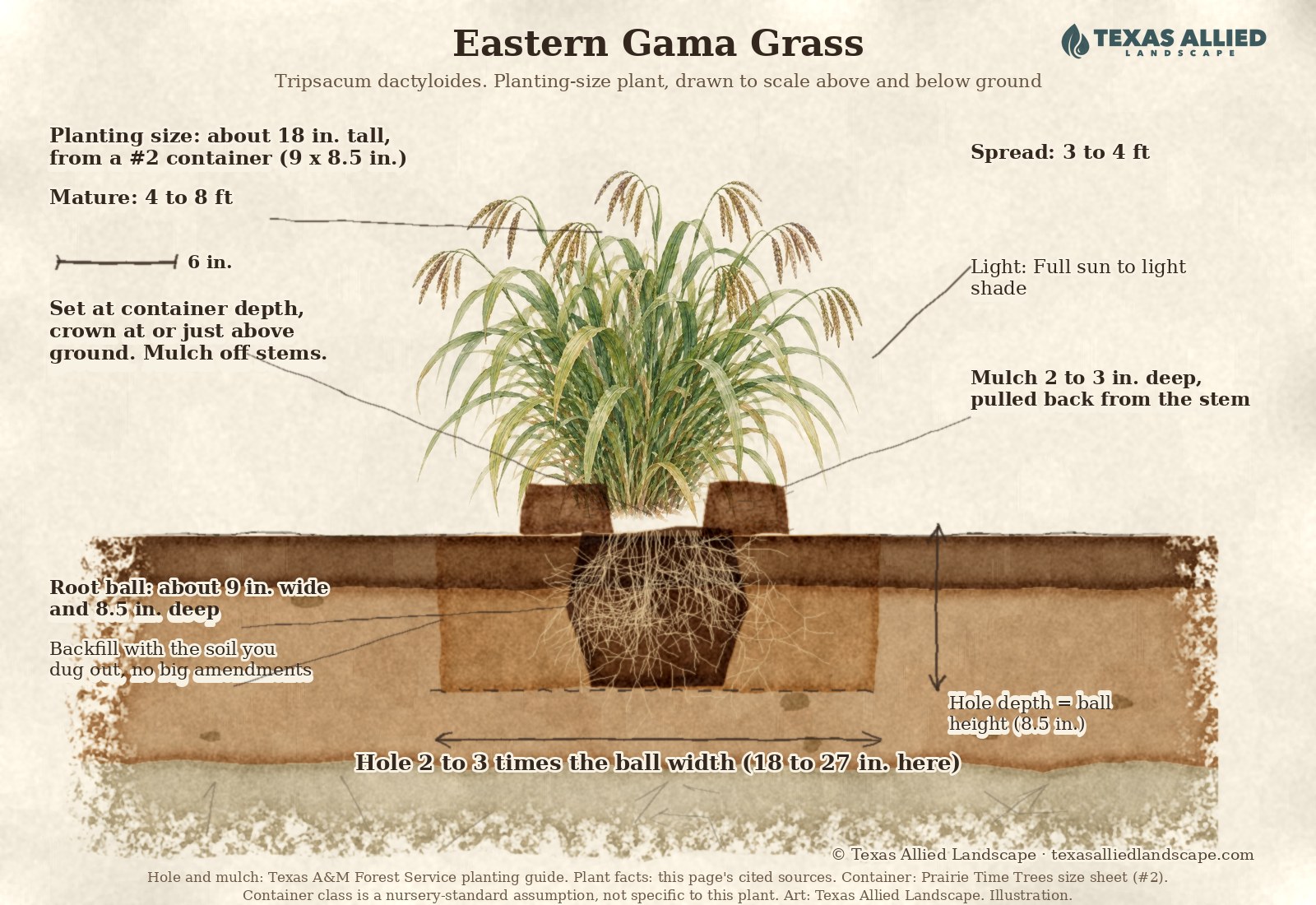
- Dig a hole twice as wide as the pot and no deeper, with sloping sides, and set the plant at the same depth it grew in its pot. Loosen any circling roots before backfilling.[3]
- For a new bed, clear grass and weeds first, roots and all.[3]
- Give it room: Clumps widen to 3-4 ft; it can self-sow in damp ground. Wide, corn-like green blades in a bold clump; jointed seed spikes in late summer that break into segments at maturity.[1] Space plants for that full size, not the pot size.[3]
- Site: Full sun to light shade.[1]
- Timing: Plant eastern gama grass in spring through early summer in Central Texas, as soil warms.
- Soak it well at planting and keep watering while the roots establish.[3] Once established: Full sun and moist to average soil - it likes more water than the dryland grasses, so think low areas, rain gardens and pond edges.[4]
- Mulch 2 to 4 inches, kept a few inches away from the stems to prevent crown rot. It needs no staking or other support.[3]
Care Instructions for Your Eastern Gama Grass
Sunlight
Full sun to light shade.[1]
Soil and drainage
Adaptable, and unusually tolerant of moist or seasonally wet ground - along swales and low spots where other grasses fade. It also handles ordinary beds once established.[2]
Mature height and spread
4-8 ft in bloom - one of the biggest native grasses, a corn relative.[2] Clumps widen to 3-4 ft; it can self-sow in damp ground.
Pruning
Cut the clump to about 6 inches in late winter before new growth.
Normal seasonal behavior
Strong green growth spring through summer, seed spikes late summer into fall, dormant tan in winter.[1]
Eastern gama grass questions
What is eastern gama grass?
Tripsacum dactyloides - a robust native bunchgrass and a wild relative of corn, with thick stems and distinctive seed spikes.[5]
Is gama grass a Texas native?
Yes - it grows naturally along Texas creek margins and moist prairies, and it is prized as a native forage and restoration grass.[6]
Where does gama grass grow best?
Full sun and moist to average soil - it likes more water than the dryland grasses, so think low areas, rain gardens and pond edges.[4]
Is eastern gama grass really related to corn?
Yes - it is one of corn's closest wild relatives, and you can see the family resemblance in the broad leaves and jointed seed spikes.[7]
Next step: Our horticulturalists can use gama grass in a rain garden or low swale where it gets the moisture it wants.
Let Texas Allied Landscape care for your Eastern Gama Grass
Eastern Gama Grass does best with steady, knowledgeable care: the right water, pruning at the right time, and a trained eye for stress. The horticulturists at Texas Allied Landscape care for plants like yours across the San Antonio area, backed by over 40 years of landscape experience.
In these community guides
Sources
- Eastern Gamagrass, Texas SmartScape.https://txsmartscape.com/plant-search/eastern-gamagrassabcdefg
- Eastern gamagrass, Plants of Texas Rangelands, Texas A&M.https://rangeplants.tamu.edu/plant/eastern-gamagrass/abcdefg
- Back to basics: Planting perennials, SAWS Garden Style San Antonio.https://www.gardenstylesanantonio.com/garden-articles/back-to-basics-planting-perennials/abcde
- Native Plant Society of Texas, "Tripsacum dactyloides."https://www.npsot.org/posts/native-plant/tripsacum-dactyloides/ab
- Texas A&M Plants of Texas Rangelands, "Eastern gamagrass."https://rangeplants.tamu.edu/plant/eastern-gamagrass/↑
- Caesar Kleberg Wildlife Research Institute, "Eastern gamagrass."https://www.ckwri.tamuk.edu/plant/eastern-gamagrass↑
- Caesar Kleberg Wildlife Research Institute, "Eastern gamagrass."https://www.ckwri.tamuk.edu/plant/eastern-gamagrass↑