
Property owners
Eurasian Watermilfoil
- Plant
- Eurasian Watermilfoil
- Botanical name
- Myriophyllum spicatum
- Group
- Prohibited examples
Eurasian Watermilfoil: sourced growing conditions, spread, foliage and seasonal behavior.
On this page
Its botanical name is Myriophyllum spicatum.
Soil and drainage
It grows fully submerged in lakes and slow water.[1]
Spread
It spreads mainly by stem fragments. It can develop a land form where water slowly evaporates.
Foliage
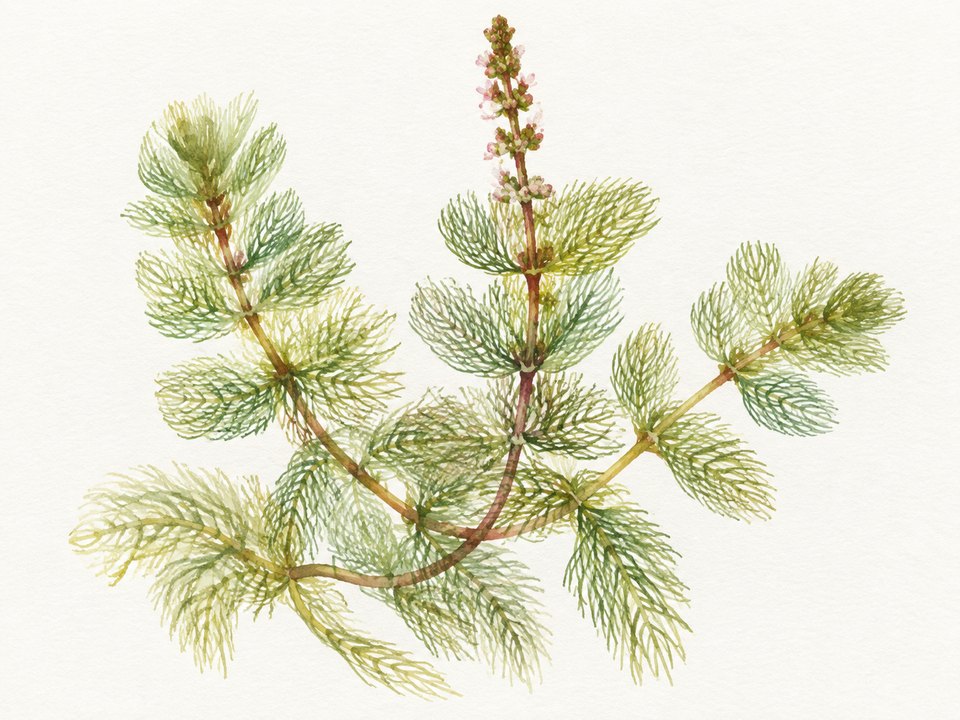
It is a perennial. Its feather-like leaves are arranged in whorls of 4 around the stem. Each leaf has 14 or more leaflet pairs.
Seasonal behavior
Reddish spikes stand a few inches above the water early in the season and submerge after pollination. Its flowers are tiny and pink. Be careful, because it is an invasive aquatic that forms dense mats.
Why Eurasian Watermilfoil is a problem here
Eurasian watermilfoil is listed as an invasive species in Texas. Small stem fragments root and spread easily. They form thick underwater mats that tangle swimmers and boats and push out native aquatic plants.[1][2]
What to do instead
Never plant it or move it between bodies of water. If it shows up in a pond you manage, Texas A&M AquaPlant publishes identification and control guidance, and the Texas Allied Landscape team can help you plan next steps.[2]
Care Instructions for Your Eurasian Watermilfoil
How to Water an Eurasian Watermilfoil
Soil and drainage
It grows fully submerged in lakes and slow water.[1]
Mature height and spread
It spreads mainly by stem fragments. It can develop a land form where water slowly evaporates.
Normal seasonal behavior
Reddish spikes stand a few inches above the water early in the season and submerge after pollination. Its flowers are tiny and pink. Be careful, because it is an invasive aquatic that forms dense mats.
Eurasian watermilfoil questions
Is Eurasian watermilfoil invasive?
Yes. Myriophyllum spicatum is a non-native submerged weed. It forms dense mats and crowds out native pond plants. It also interferes with swimming, fishing, and irrigation intakes.[3]
How does Eurasian watermilfoil spread?
It spreads mostly by fragments. A single stem piece broken off by a boat, trimmer, or current can root and start a new colony. That is how it hops between ponds and lakes.[4]
How do I get rid of Eurasian watermilfoil in my pond?
Texas A&M's AquaPlant program recommends physical removal of small patches. For larger infestations it recommends approved aquatic herbicides. It also recommends cleaning equipment so fragments do not hitchhike.[2]
Next step: Our horticulturalists can help clear a private water feature and keep fragments from re-establishing.
Does Eurasian watermilfoil come back after treatment?
Often, yes. Leftover fragments and root crowns resprout. So managers plan on follow-up treatments and monitoring over more than one season.[5]
In these community guides

Illustration. Illustration based on reference photos of Mountain Springs Ranch. Not a single literal view. Mountain Springs Ranch Landscaping
Plan your Mountain Springs Ranch yard with planting, lawn and irrigation guidance. Get help from the review package…
Sources
- Eurasian watermilfoil (Myriophyllum spicatum), Texas Invasives.https://www.texasinvasives.org/plant_database/detail.php?symbol=MYSP2abc
- Texas A&M AgriLife AquaPlant, "Eurasian Watermilfoil."https://aquaplant.tamu.edu/plant-identification/alphabetical-index/eurasian-watermilfoil/abc
- National Invasive Species Information Center, "Eurasian Watermilfoil."https://www.invasivespeciesinfo.gov/aquatic/plants/eurasian-watermilfoil↑
- Wisconsin DNR, "Eurasian watermilfoil (Myriophyllum spicatum)."https://dnr.wisconsin.gov/topic/Invasives/fact/EurasianWatermilfoil↑
- City of Boulder, "Eurasian Watermilfoil management plan FAQs."https://bouldercolorado.gov/eurasian-watermilfoil-management-plan-faqs↑