
Property owners
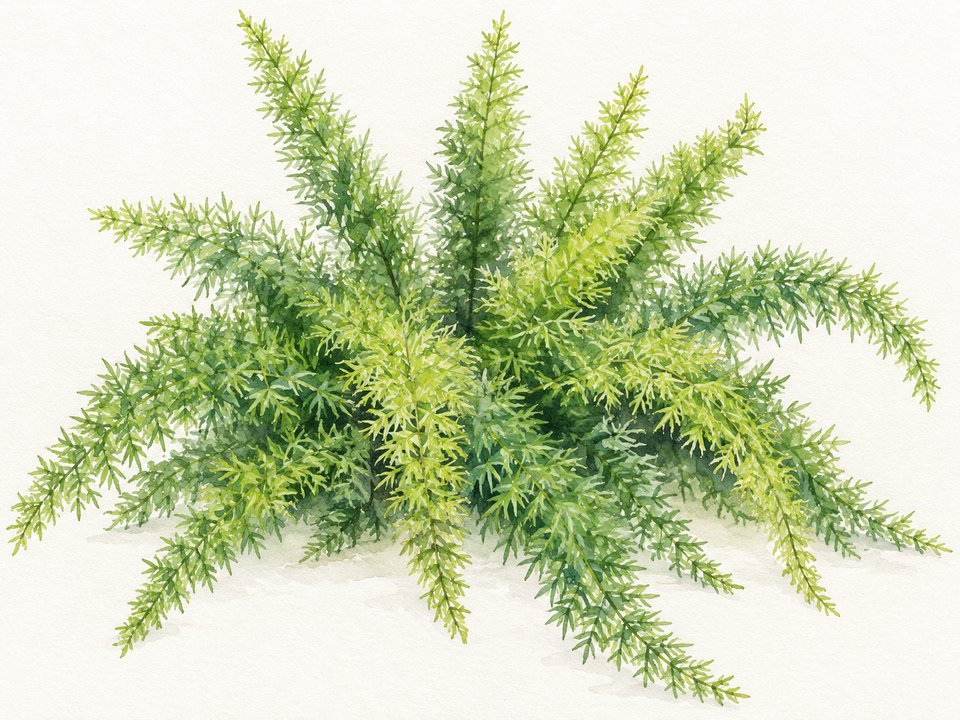
Foxtail Fern
- Plant
- Foxtail Fern
- Botanical name
- Asparagus densiflorus
- Group
- Ground cover
Foxtail Fern (Asparagus densiflorus): light, water, soil, size and care for San Antonio area landscapes.
On this page
Botanical name: Asparagus densiflorus.
Light
Part sun or part shade; protect from afternoon sun.[1]
Soil and drainage
Sandy, well-drained and clay soils.
Height
A maximum of 24 inches.
Spread
18 to 24 inches.
Foliage
Evergreen in the local profile.
Water
Medium Water; may appreciate supplemental summer irrigation. If watering ever feels like a guessing game, our horticulturists can care for your Foxtail Fern on a schedule that fits your yard.
Seasonal behavior
Mounding evergreen perennial with dense needle-like foliage; not a true fern. Another source gives up to 24 inches tall and 18-24 inches wide.
When to Plant Foxtail Fern
Plant Foxtail Fern in spring after the last frost, around mid-March in San Antonio. This fern is frost-tender and needs the warm season to establish; fronds are damaged by freezes.
If you would like a hand, the Texas Allied Landscape team can plant your Foxtail Fern and keep it thriving.
Planting
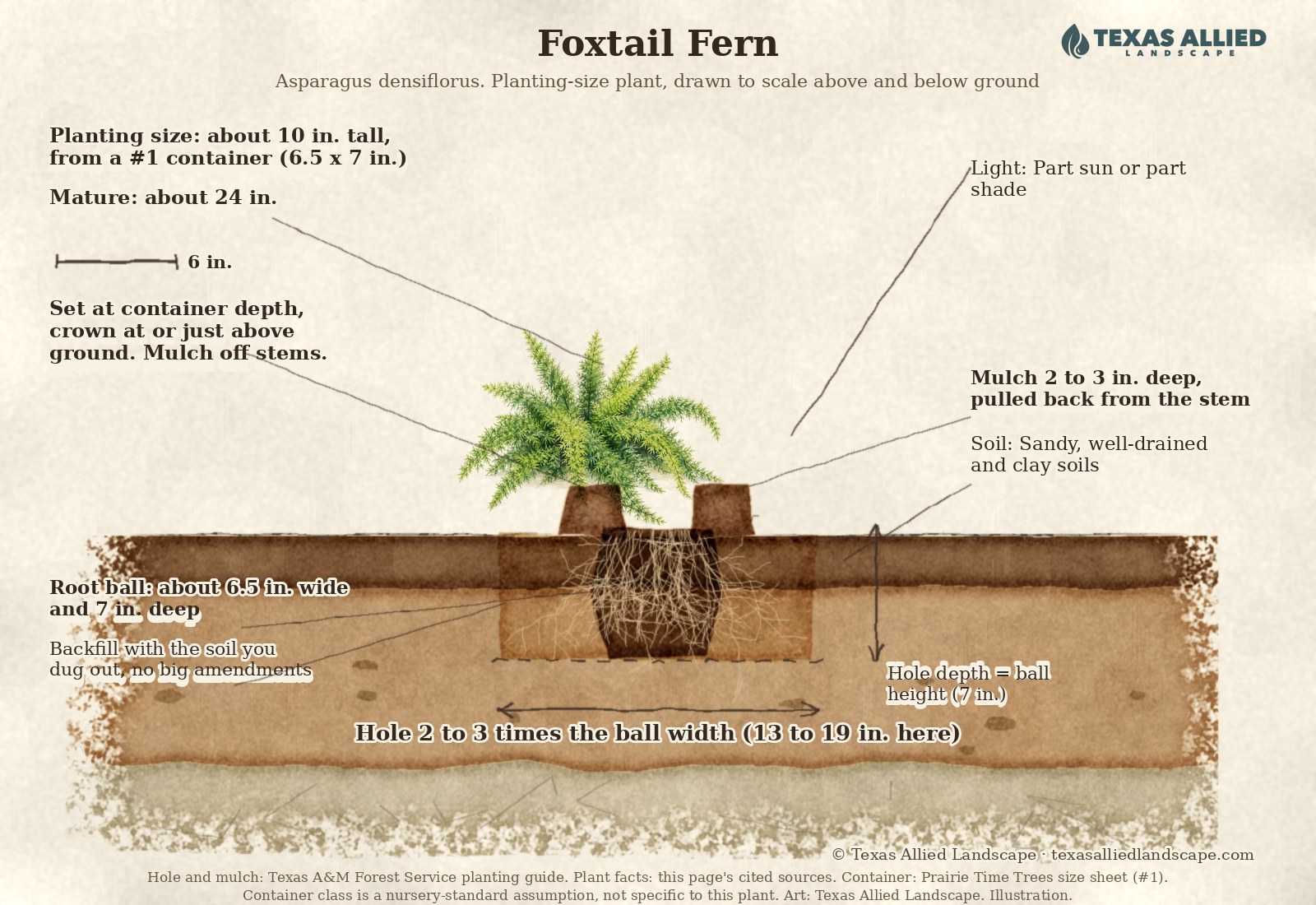
- Dig a hole twice as wide as the pot and no deeper, with sloping sides, and set the plant at the same depth it grew in its pot. Loosen any circling roots before backfilling.[2]
- For a new bed, clear grass and weeds first, roots and all.[2]
- Site: Part sun or part shade; protect from afternoon sun.[1]
- Timing: Plant Foxtail Fern in spring after the last frost, around mid-March in San Antonio.
- Soak it well at planting and keep watering while the roots establish.[2] Once established: It wants bright shade to morning sun and soil that dries between waterings; soggy beds yellow it fast.[3]
- Mulch 2 to 4 inches, kept a few inches away from the stems to prevent crown rot. It needs no staking or other support.[2]
Should foxtail fern get hot afternoon sun?
No - give it part sun or part shade and protect it from hot afternoon sun.
Are foxtail fern berries or sap safe to handle or eat?
Do not eat the berries. The NC State profile includes the Meyersii foxtail form and warns that berries can cause gastrointestinal problems, while sap contact can cause skin irritation. It lists the toxic principle as unknown; the supplied specific sapogenin claim is not retained.[4]
Care Instructions for Your Foxtail Fern
How to Water a Foxtail Fern
Medium Water; may appreciate supplemental summer irrigation.
Sunlight
Part sun or part shade; protect from afternoon sun.[1]
Soil and drainage
Sandy, well-drained and clay soils.
Mature height and spread
A maximum of 24 inches. 18 to 24 inches.
Normal seasonal behavior
Mounding evergreen perennial with dense needle-like foliage; not a true fern. Another source gives up to 24 inches tall and 18-24 inches wide.
Foxtail fern questions
Is foxtail fern a real fern?
No - it is an asparagus relative with plume-like stems, not a true fern. That is why it takes more sun and less water than shade ferns.[5]
Will foxtail fern come back after a freeze?
Usually yes in Central Texas: the plumes burn in a hard freeze but the fleshy roots survive and send up new shoots in spring. Cut the dead stems at the base in late winter.[6]
Why is my foxtail fern turning yellow?
Most often too much water or too little light. It wants bright shade to morning sun and soil that dries between waterings; soggy beds yellow it fast.[3]
Can I divide foxtail fern?
Yes - dig the clump in spring and cut through the root mass with a sharp spade, keeping a few plumes per section. It is also easy to thin by pulling whole stems at the base.[7]
Let Texas Allied Landscape care for your Foxtail Fern
Foxtail Fern does best with steady, knowledgeable care: the right water, pruning at the right time, and a trained eye for stress. The horticulturists at Texas Allied Landscape care for plants like yours across the San Antonio area, backed by over 40 years of landscape experience.
In these community guides

Illustration. Illustration based on reference photos of Johnson Ranch. Not a single literal view. Johnson Ranch Landscaping
Share your Johnson Ranch address, survey and yard ideas. Texas Allied Landscape can help plan planting, irrigation and…
Sources
- Foxtail Fern (Asparagus densiflorus 'Meyersii'), San Antonio Water System - Garden Style San Antonio.https://www.gardenstylesanantonio.com/plants/foxtail-fern/abc
- Back to basics: Planting perennials, Garden Style San Antonio (San Antonio Water System).https://www.gardenstylesanantonio.com/garden-articles/back-to-basics-planting-perennials/abcd
- Mortellaros (Texas nursery), "Asparagus densiflorus 'Meyerii' Fern."https://www.mortellaros.com/plant-name/Asparagus-densiflorus-Meyeriiab
- Asparagus densiflorus Sprengeri Group, NC State Extension.https://plants.ces.ncsu.edu/plants/asparagus-densiflorus-sprengeri-group/↑
- University of Arkansas Extension, "Asparagus densiflorus 'Meyersii,' Foxtail Fern."https://www.uaex.uada.edu/yard-garden/resource-library/plant-week/Asparagus-densiflorus-Meyersii-Foxtail-Fern-06-21-2019.aspx↑
- Texas A&M AgriLife Extension, "Dealing with Freeze Damage on Plants."https://txmg.org/grayson/files/2021/03/Freeze-Damage.pdf↑
- Epic Gardening, "How to Care for Foxtail Ferns in Fall and Winter."https://www.epicgardening.com/foxtail-ferns-fall-winter-care/↑