
Property owners
Grape
- Plant
- Grape
- Botanical name
- Vitis sp.
- Group
- Vines
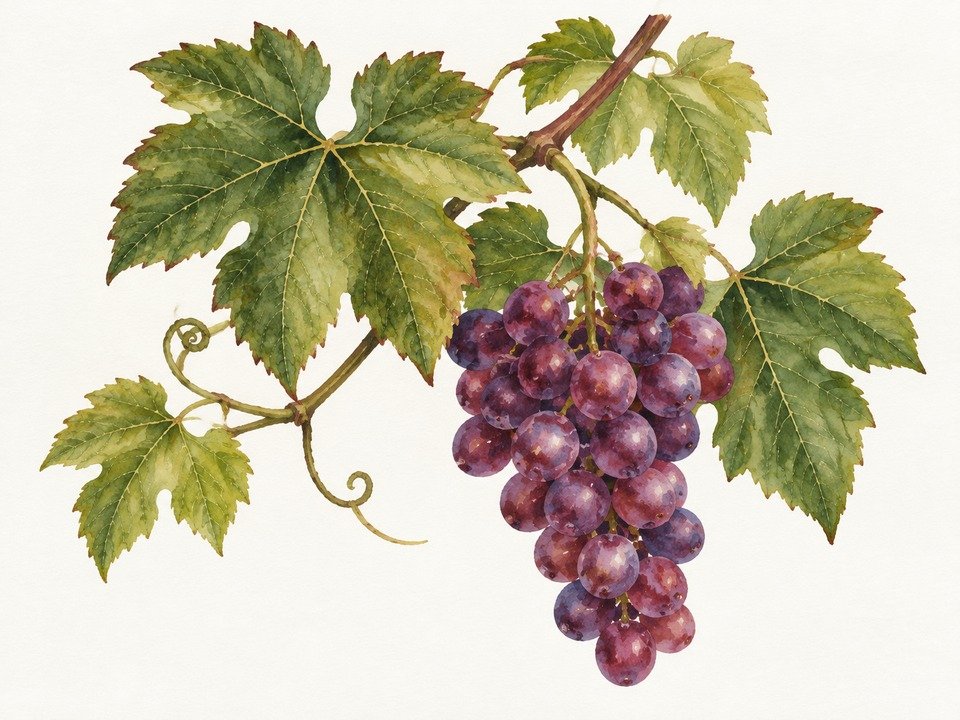
Grapes for Texas arbors: adapted varieties that survive our soils.
On this page
Botanical name: Vitis spp.
Plant group: Vines.
Light
Full sun - fruiting vines need all-day light.[1]
Soil and drainage
Well-drained sandy loam, loamy sand, loam or clay loam, pH 5.8-6.5. In heavy clay, plant in a raised mound of good soil so roots get a strong start.[1][2]
Height
A vine, not a shrub - easily 15-20 feet along an arbor or high wire.[3]
Spread
Vigorous; it needs a sturdy arbor, fence or wire trellis from day one, built to carry real weight.[2]
Foliage
Deciduous, big lobed leaves that shade an arbor in summer and drop in winter to let the sun through.[1]
Water
Moderate and deep; established vines are reasonably tough but fruit needs steady moisture.
Pruning
Hard pruning every late winter while dormant - grapes fruit on new shoots from one-year-old wood, so most of last year's growth comes off.[1]
Seasonal behavior
Leaf-out and rapid growth in spring, fruit ripening mid-July through September, dormant in winter.[1]
For Texas, plant adapted varieties: Champanel and Black Spanish are proven here, and Victoria Red is a table grape worth trying - European wine grapes mostly die of Pierce's disease in our soils.[4][3]
When to Plant Grape
Plant grapes in February or March in Central Texas, while they are dormant.[2]
If you would like a hand, the Texas Allied Landscape team can plant your Grape and keep it thriving.
Planting
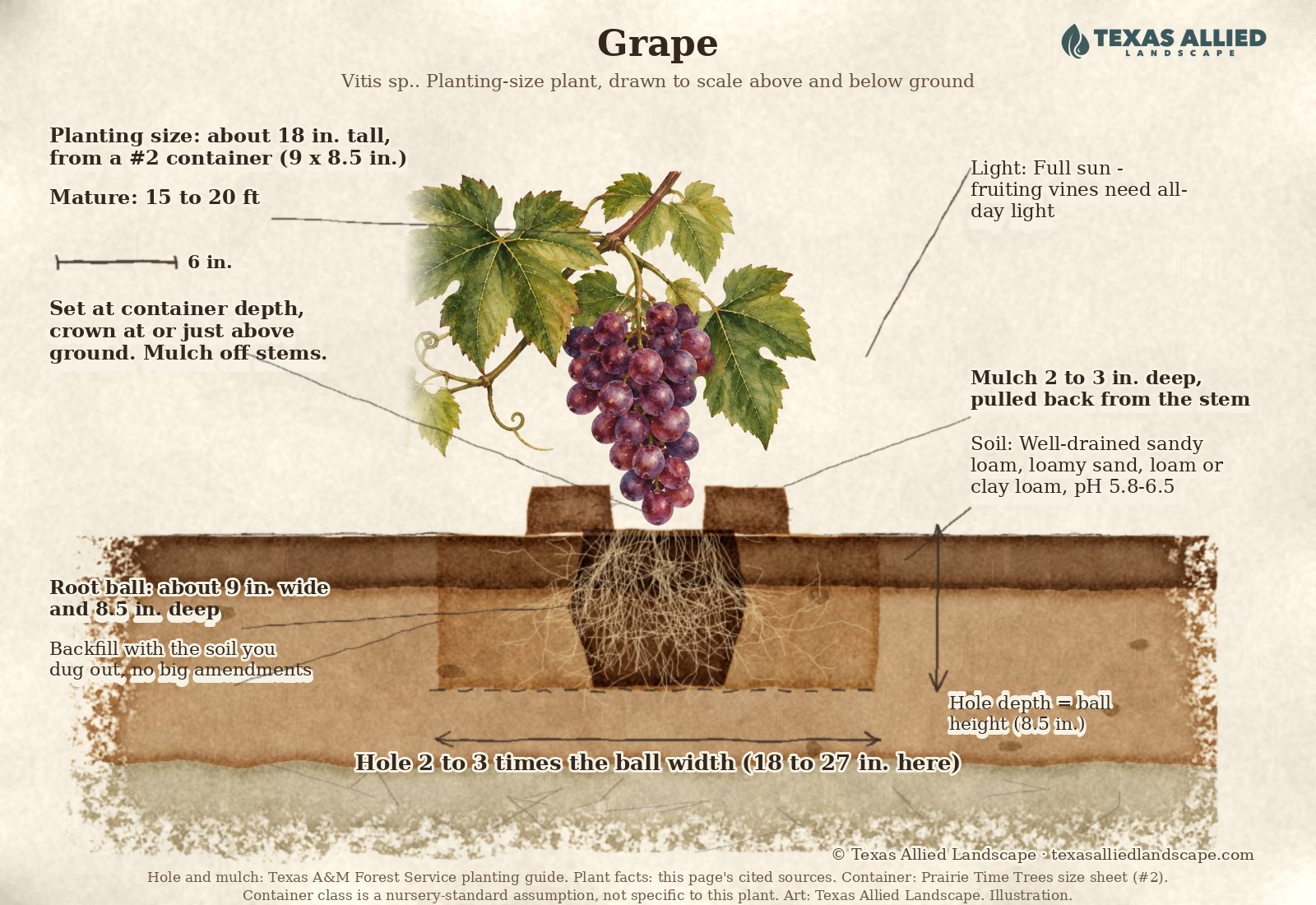
- Dig a hole twice as wide as the pot and no deeper, with sloping sides, and set the plant at the same depth it grew in its pot. Loosen any circling roots before backfilling.[5]
- Support: A vine, not a shrub - easily 15-20 feet along an arbor or high wire.[3]
- Site: Full sun - fruiting vines need all-day light.[1]
- Soil: Well-drained sandy loam, loamy sand, loam or clay loam, pH 5.8-6.5. In heavy clay, plant in a raised mound of good soil so roots get a strong start.[1][2]
- Timing: Plant grapes in February or March in Central Texas, while they are dormant.[2]
- Soak it well at planting and keep watering while the roots establish.[5]
- Mulch 2 to 4 inches, kept a few inches away from the stems to prevent crown rot.[5]
Care Instructions for Your Grape
How to Water a Grape
Moderate and deep; established vines are reasonably tough but fruit needs steady moisture.
Sunlight
Full sun - fruiting vines need all-day light.[1]
Soil and drainage
Well-drained sandy loam, loamy sand, loam or clay loam, pH 5.8-6.5. In heavy clay, plant in a raised mound of good soil so roots get a strong start.[1][2]
Mature height and spread
A vine, not a shrub - easily 15-20 feet along an arbor or high wire.[3] Vigorous; it needs a sturdy arbor, fence or wire trellis from day one, built to carry real weight.[2]
Pruning
Hard pruning every late winter while dormant - grapes fruit on new shoots from one-year-old wood, so most of last year's growth comes off.[1]
Normal seasonal behavior
Leaf-out and rapid growth in spring, fruit ripening mid-July through September, dormant in winter.[1]
For Texas, plant adapted varieties: Champanel and Black Spanish are proven here, and Victoria Red is a table grape worth trying - European wine grapes mostly die of Pierce's disease in our soils.[4][3]
Grape questions
What grapes grow best in Texas?
For home arbors, American bunch grapes and Texas-tough hybrids like Champanel and Black Spanish - European wine grapes mostly die here without serious spray programs.[6]
Why did my grapevine die?
Pierce's disease is the usual killer of susceptible vines in Texas - it is why variety choice matters more here than anywhere. Plant resistant varieties and you skip the heartbreak.[7]
Do grapes need a special trellis?
They need something sturdy - a well-built arbor, fence or wire trellis. A grapevine is a lifetime plant that gets heavy; Texas pioneer T.V. Munson built family arbors that lasted generations.[8]
When do I prune grapes?
Hard in late winter while dormant - grapes fruit on new growth from one-year-old wood, so most of last year's growth comes off. It feels brutal and it is correct.[9]
Next step: Our horticulturalists can do the annual dormant prune that keeps a grapevine productive.
Let Texas Allied Landscape care for your Grape
Grapes do best with steady, knowledgeable care: the right water, pruning at the right time, and a trained eye for stress. The horticulturists at Texas Allied Landscape care for plants like yours across the San Antonio area, backed by over 40 years of landscape experience.
In these community guides
Sources
- Henderson County Master Gardeners, "Grapes - Bunch."https://txmg.org/hendersonmg/plant-library/grapes-bunch/abcdefghijk
- Texas A&M AgriLife, "Grape Arbors."https://aggie-horticulture.tamu.edu/fruit-nut/fact-sheets/grape-arbors/abcdefg
- Texas A&M AgriLife, "Grape Variety Profile: Champanel."https://mytexas.ag.tamu.edu/publications/grape-variety-profile-champanel/abcde
- Ask Extension, "Grapes for San Antonio."https://ask.extension.org/kb/faq.php?id=227758ab
- Back to basics: Planting perennials, SAWS Garden Style San Antonio.https://www.gardenstylesanantonio.com/garden-articles/back-to-basics-planting-perennials/abc
- Henderson County Master Gardeners, "Grapes - Bunch."https://txmg.org/hendersonmg/plant-library/grapes-bunch/↑
- Ask Extension, "Grapes for San Antonio."https://ask.extension.org/kb/faq.php?id=227758↑
- Texas A&M AgriLife, "Grape Arbors."https://aggie-horticulture.tamu.edu/fruit-nut/fact-sheets/grape-arbors/↑
- Henderson County Master Gardeners, "Grapes - Bunch."https://txmg.org/hendersonmg/plant-library/grapes-bunch/↑