
Property owners
Gulf Muhly
- Plant
- Gulf Muhly
- Botanical name
- Muhlenbergia capillaris
- Group
- Low shrubs and perennials
Gulf Muhly (Muhlenbergia capillaris): light, water, soil, size and care for San Antonio area landscapes.
On this page
Its botanical name is Muhlenbergia capillaris.
Light
It grows in sun to part shade. Full sun gives the best bloom.[1][2]
Soil and drainage
It grows in sandy to clayey or rocky well-drained soils. The Wildflower Center notes a low CaCO3 tolerance. Another source suggests 20% compost only in extremely sandy, rocky or clay-laden soils. It adapts to a wide pH range.[3]
Height
It typically grows 1.5 to 3 feet tall, and up to about 5 feet with bloom. Another source lists 3 to 4 feet.
Spread
It spreads about 2 to 3 feet. Another source lists 3 to 4 feet.
Foliage
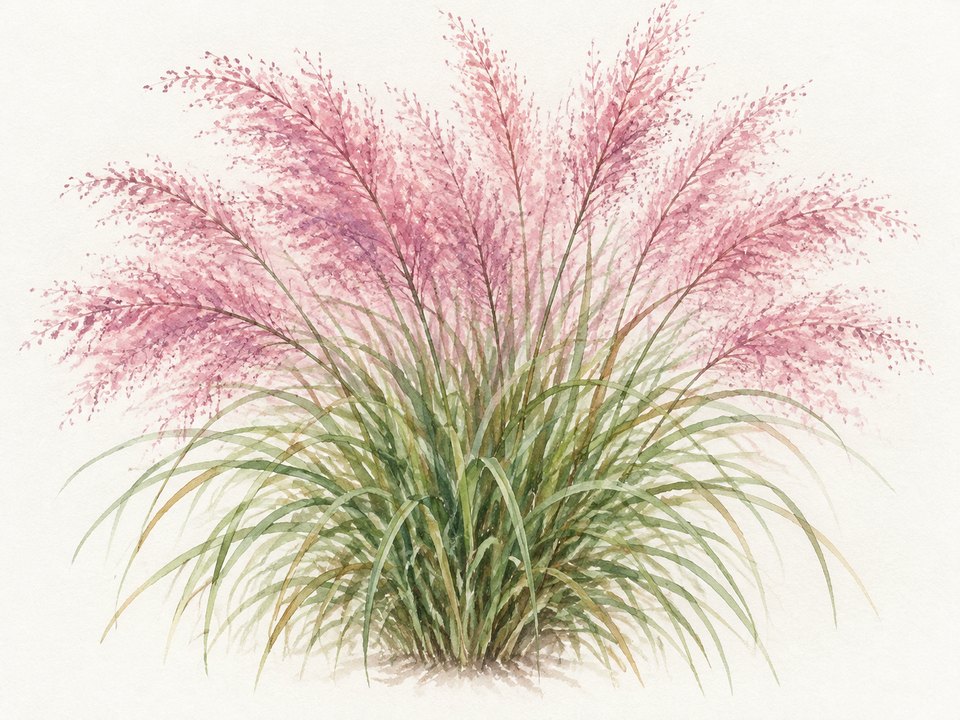
It is a deciduous perennial bunchgrass with wire-like foliage.
Water
It has low water use and is notably drought tolerant. It appreciates some supplemental summer water in exposed locations. If watering ever feels like a guessing game, our horticulturists can care for your Gulf Muhly on a schedule that fits your yard.
Pruning
Cut it back in winter, per the Austin guide.[4]
Seasonal behavior
It puts up an airy pink-to-purple cloud of blooms in fall, from September to October. The cloud reaches about half the plant's height. It is deer resistant and dramatic when massed.
When to Plant Gulf Muhly
Plant Gulf Muhly in fall or early spring in Central Texas. A fall planting establishes roots through the cool season and is ready to grow and bloom the following year. Spring planting works too if you water through the first summer.[5]
If you would like a hand, the Texas Allied Landscape team can plant your Gulf Muhly and keep it thriving.
Planting
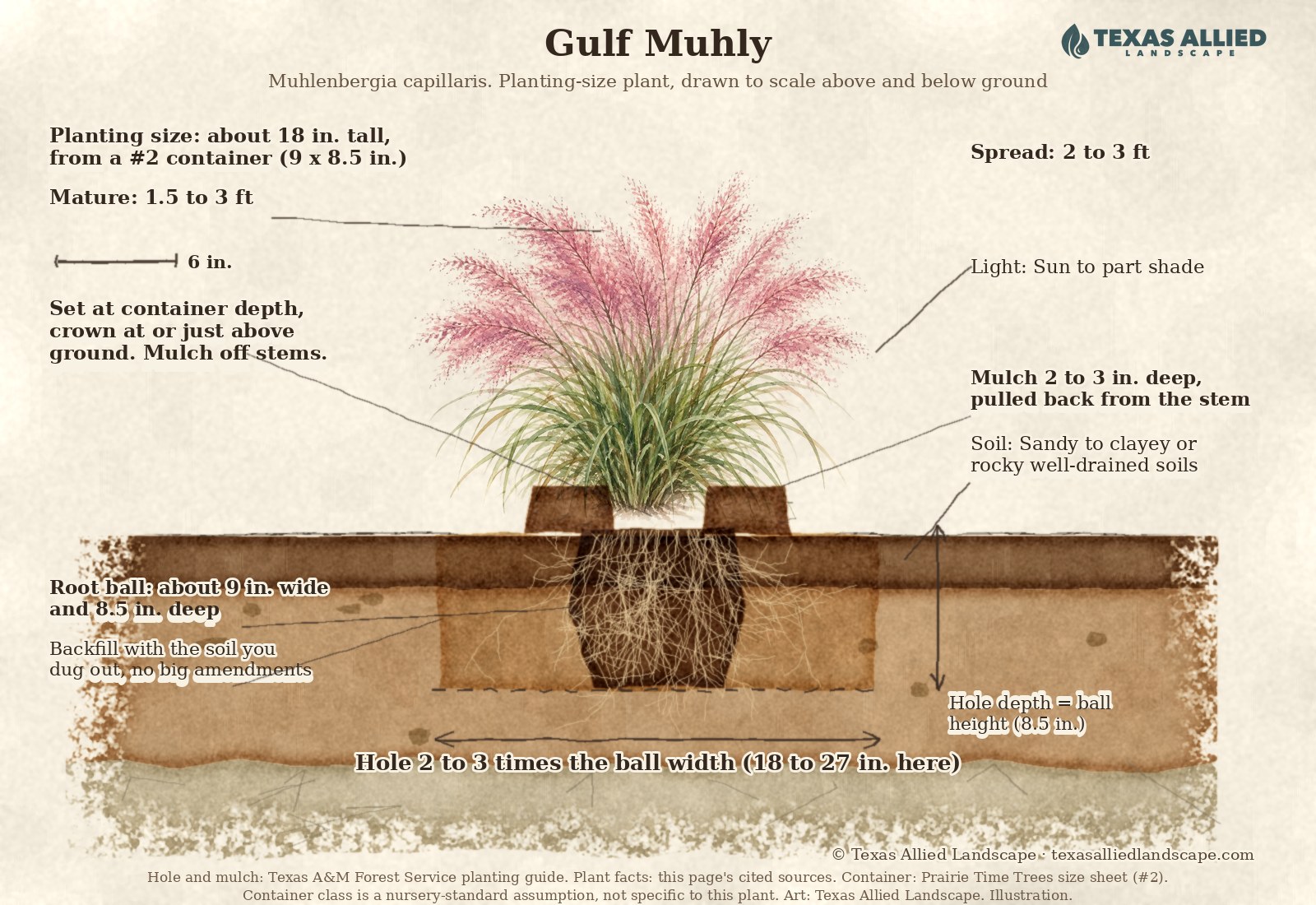
- Dig a hole twice as wide as the pot and no deeper, with sloping sides. Set the plant at the same depth it grew in its pot. Loosen any circling roots before backfilling.[6]
- For a new bed, clear grass and weeds first, roots and all.[6]
- Site: It grows in sun to part shade. Full sun gives the best bloom.[1][2]
- Soil: It grows in sandy to clayey or rocky well-drained soils. The Wildflower Center notes a low CaCO3 tolerance. Another source suggests 20% compost only in extremely sandy, rocky or clay-laden soils. It adapts to a wide pH range.[3]
- Timing: A fall planting establishes roots through the cool season and is ready to grow and bloom the following year. Spring planting works too if you water through the first summer.[5]
- Soak it well at planting and keep watering while the roots establish.[6] Once it is established, it has low water use and is notably drought tolerant. It appreciates some supplemental summer water in exposed locations. Cut it back in winter, per the Austin guide.[4]
- Add 2 to 4 inches of mulch, kept a few inches away from the stems to prevent crown rot. It needs no staking or other support.[6]
Why is my gulf muhly brown and flat in January?
Gulf muhly is a deciduous bunchgrass, so dormant brown foliage in winter is normal. The source's guide says to cut it back in winter. Fresh growth returns in spring.
Why isn't my gulf muhly blooming?
The pink plumes are a fall event, from September to October. Full sun gives the strongest show. A green plant in summer is on schedule, not failing.
Care Instructions for Your Gulf Muhly
How to Water a Gulf Muhly
It has low water use and is notably drought tolerant. It appreciates some supplemental summer water in exposed locations.
Sunlight
It grows in sun to part shade. Full sun gives the best bloom.[1][2]
Soil and drainage
It grows in sandy to clayey or rocky well-drained soils. The Wildflower Center notes a low CaCO3 tolerance. Another source suggests 20% compost only in extremely sandy, rocky or clay-laden soils. It adapts to a wide pH range.[3]
Mature height and spread
It typically grows 1.5 to 3 feet tall, and up to about 5 feet with bloom. Another source lists 3 to 4 feet. It spreads about 2 to 3 feet, though another source lists 3 to 4 feet.
Pruning
Cut it back in winter, per the Austin guide.[4]
Normal seasonal behavior
It puts up an airy pink-to-purple cloud of blooms in fall, from September to October. The cloud reaches about half the plant's height. It is deer resistant and dramatic when massed.
Gulf muhly questions
When should I cut back gulf muhly?
Once a year, in late winter before new growth starts. Cut the whole clump to a few inches tall. The fresh green blades come back in spring, and the pink fall bloom follows on new growth. Do not trim it in pieces through the year. Clumping grasses resent it.[7]
Next step: Our horticulturalists time the annual cut with the rest of your ornamental grasses so the beds never look scalped for long.
Why isn't my muhly grass blooming?
Sun is the first thing to check. Gulf muhly needs most of a day of direct sun to make its pink fall cloud. Rich soil and extra nitrogen grow blades at the expense of flowers. Bloom comes in fall, so a plant that looks plain in spring may still be right on schedule.[8]
Can I divide gulf muhly?
Yes. It is a clumping grass, and a crowded clump can be dug and split in spring as new growth starts. Divisions transplant easily with a season of steady water.[9]
Is gulf muhly native to Texas?
Yes. It is a Gulf Coast and Central Texas native. It is tough enough that Texas A&M named it a Texas Superstar plant for handling heat, drought and poor soils across the state.[10]
Let Texas Allied Landscape care for your Gulf Muhly
Gulf Muhly does best with steady, knowledgeable care. That means the right water, pruning at the right time, and a trained eye for stress. The horticulturists at Texas Allied Landscape care for plants like yours across the San Antonio area. They are backed by over 40 years of landscape experience.
In these community guides
- Art in progress
Esperanza Landscaping
Plan your Esperanza landscape with help on plants, irrigation and the approval package. We check your neighborhood, lot…
- Art in progress
Homestead Landscaping
Share your Homestead address, survey and yard ideas with Texas Allied Landscape. We help prepare a clear plan for…
Illustration. Illustration based on reference photos of Rogers Ranch - Point Bluff and other neighborhoods. Not a single literal view. Rogers Ranch Landscaping
Plan your Rogers Ranch landscape with lawn, tree and irrigation guidance. Get help with the review package, approved…
Illustration. Illustration based on reference photos of Shavano Rogers Ranch - Crosstimber. Not a single literal view. Crosstimber Landscaping
Plan your Crosstimber plants, shade and irrigation. Get help matching your lot rules, preparing the review package and…
Sources
- Muhlenbergia capillaris (Gulf muhly) | Native Plants of North America, Lady Bird Johnson Wildflower Center.https://www.wildflower.org/plants/result.php?id_plant=muca2abc
- Gulf Muhly - Garden Style San Antonio, San Antonio Water System.https://www.gardenstylesanantonio.com/plants/gulf-muhly/abc
- Gulf muhly named new Texas Superstar plant, AgriLife Today, Texas A&M AgriLife Extension Service.https://agrilifetoday.tamu.edu/2022/10/27/gulf-muhly/abc
- Muhly, Gulf | AustinTexas.gov, City of Austin Watershed Protection.https://www.austintexas.gov/watershed-protection/plant-guide/muhly-gulfabc
- October Gardening Checklist, Travis County AgriLife Extension.https://travis-tx.tamu.edu/about-2/horticulture/monthly-gardening-calendar-for-austin-area/october-gardening-checklist-for-austin-and-central-texas/ab
- Back to basics: Planting perennials, SAWS Garden Style San Antonio.https://www.gardenstylesanantonio.com/garden-articles/back-to-basics-planting-perennials/abcd
- Central Texas Gardener, "Clumping Grasses."https://centraltexasgardener.org/resource/clumping-grasses/↑
- Texas A&M AgriLife Today, "Gulf muhly named new Texas Superstar plant."https://agrilifetoday.tamu.edu/2022/10/27/gulf-muhly/↑
- GrowIt BuildIT, "Pink Muhly Grass 101 - Complete Guide."https://growitbuildit.com/muhlenbergia-capillaris-guide-pink-muhly-grass/↑
- Texas A&M AgriLife Today, "Gulf muhly named new Texas Superstar plant."https://agrilifetoday.tamu.edu/2022/10/27/gulf-muhly/↑