
Property owners
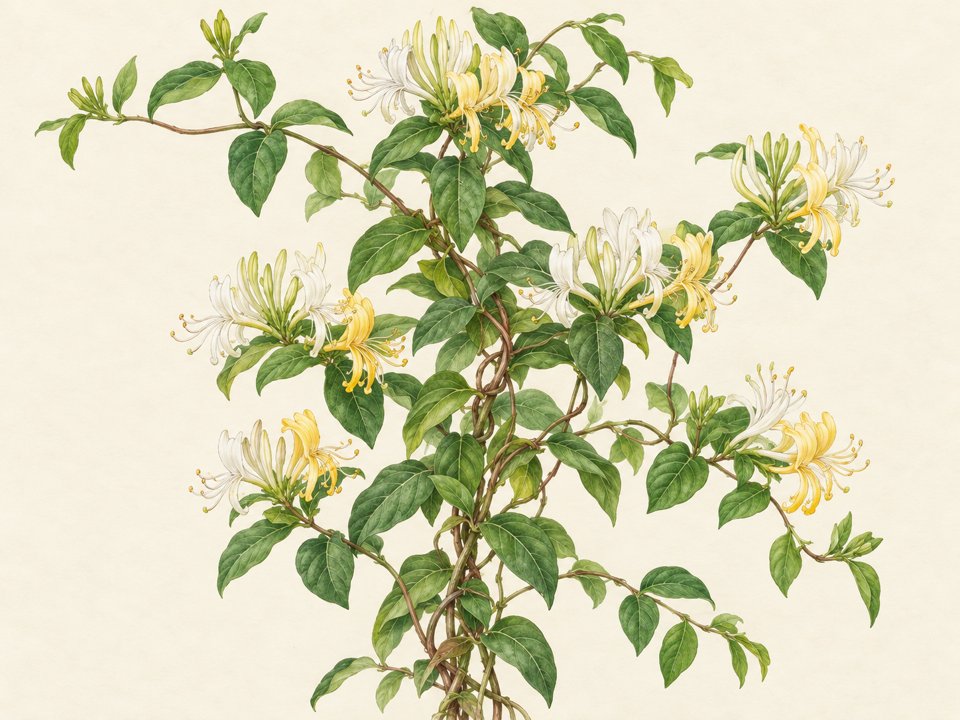
Hall's Honeysuckle
- Plant
- Hall's Honeysuckle
- Botanical name
- Lonicera japonica 'Halliana'
- Cultivar
- 'Halliana'
- Group
- Vines
Plant profile for Hall's Honeysuckle in San Antonio area landscapes.
On this page
Its botanical name is Lonicera japonica 'Halliana'. It belongs to the vines group.
Light
Full sun to part shade.[1]
Height
A rampant twining vine that can reach 16 to 29 ft.[1]
Planting
- Dig a hole twice as wide as the pot and no deeper, with sloping sides, and set the plant at the same depth it grew in its pot. Loosen any circling roots before backfilling.[2]
- For support, plant it at the base of whatever it should climb, such as a trellis, fence, or arbor, so it can take hold from the start.
- Soak it well at planting and keep watering while the roots establish.[2]
- Mulch 2 to 4 inches, kept a few inches away from the stems to prevent crown rot.[2]
Care Instructions for Your Hall's Honeysuckle
How to Water a Hall's Honeysuckle
Spread and invasiveness
Yes. It is a variety of Japanese honeysuckle, one of the most aggressive invasives in Texas. It smothers fences, trees, and woodlands.[3]
Growing in Central Texas
Coral honeysuckle (Lonicera sempervirens) is a good choice. It is a Texas native with red trumpet flowers that hummingbirds love. It is well-mannered on a fence or trellis.[4]
Hall's honeysuckle questions
Is Hall's honeysuckle invasive in Texas?
Yes. It is a variety of Japanese honeysuckle, one of the most aggressive invasives in Texas. It smothers fences, trees, and woodlands.[3]
How do I get rid of Japanese honeysuckle?
Cut vines at the base and dig roots where possible. Treat or repeatedly cut regrowth. It resprouts and layers wherever stems touch soil, so plan on follow-up for a season or two.[5]
Next step: Our horticulturalists can clear a honeysuckle tangle and replant with a well-behaved native vine.
If it is invasive, why do nurseries sell it?
Habit and fragrance keep it on shelves. It grows fast and smells wonderful, which keeps demand alive despite its damage to Texas woodlands. Many nurseries now steer buyers to native coral honeysuckle instead.[6]
What is a good native alternative to Japanese honeysuckle?
Coral honeysuckle (Lonicera sempervirens) is a good choice. It is a Texas native with red trumpet flowers that hummingbirds love. It is well-mannered on a fence or trellis.[4]
In these community guides
Sources
- Lonicera japonica (Japanese Honeysuckle), North Carolina Extension Gardener Plant Toolbox.https://plants.ces.ncsu.edu/plants/lonicera-japonica/ab
- Back to basics: Planting perennials, SAWS Garden Style San Antonio.https://www.gardenstylesanantonio.com/garden-articles/back-to-basics-planting-perennials/abc
- Native Plant Society of Texas, "Japanese Honeysuckle (invasive)."https://www.npsot.org/posts/invasive-plant/lonicera-japonica/ab
- National Invasive Species Information Center, "Japanese Honeysuckle."https://www.invasivespeciesinfo.gov/terrestrial/plants/japanese-honeysuckleab
- Texas Invasive Species Institute, "Japanese Honeysuckle."https://texasinvasives.org/plant_database/detail.php?symbol=LOJA↑
- Native Plant Society of Texas, "Japanese Honeysuckle (invasive)."https://www.npsot.org/posts/invasive-plant/lonicera-japonica/↑