
Property owners
Honeysuckle
- Plant
- Honeysuckle
- Group
- Ground cover
Honeysuckle: this name covers more than one plant, and care depends on which one was installed.
On this page
This plant's name can refer to more than one species. This page shares what is known at the general level. The name can mean different honeysuckles. Coral honeysuckle, a vine, is the one most often profiled for this area. Its sources disagree on water needs. Check which plant was installed before following any care advice.
Light
Sun or part shade, depending on the species.[1]
Soil and drainage
Adaptable to most soil types; most species prefer moist conditions but tolerate drought once established.[1]
Height
5 to 15 ft depending on the species.[1]
When to Plant Honeysuckle
Plant Honeysuckle in fall or early spring in Central Texas. A fall planting grows roots through the cool season. The plant is ready to grow and bloom the next year. Spring planting works too if you water through the first summer.[2]
If you would like a hand, the Texas Allied Landscape team can plant your Honeysuckle and keep it thriving.
Planting
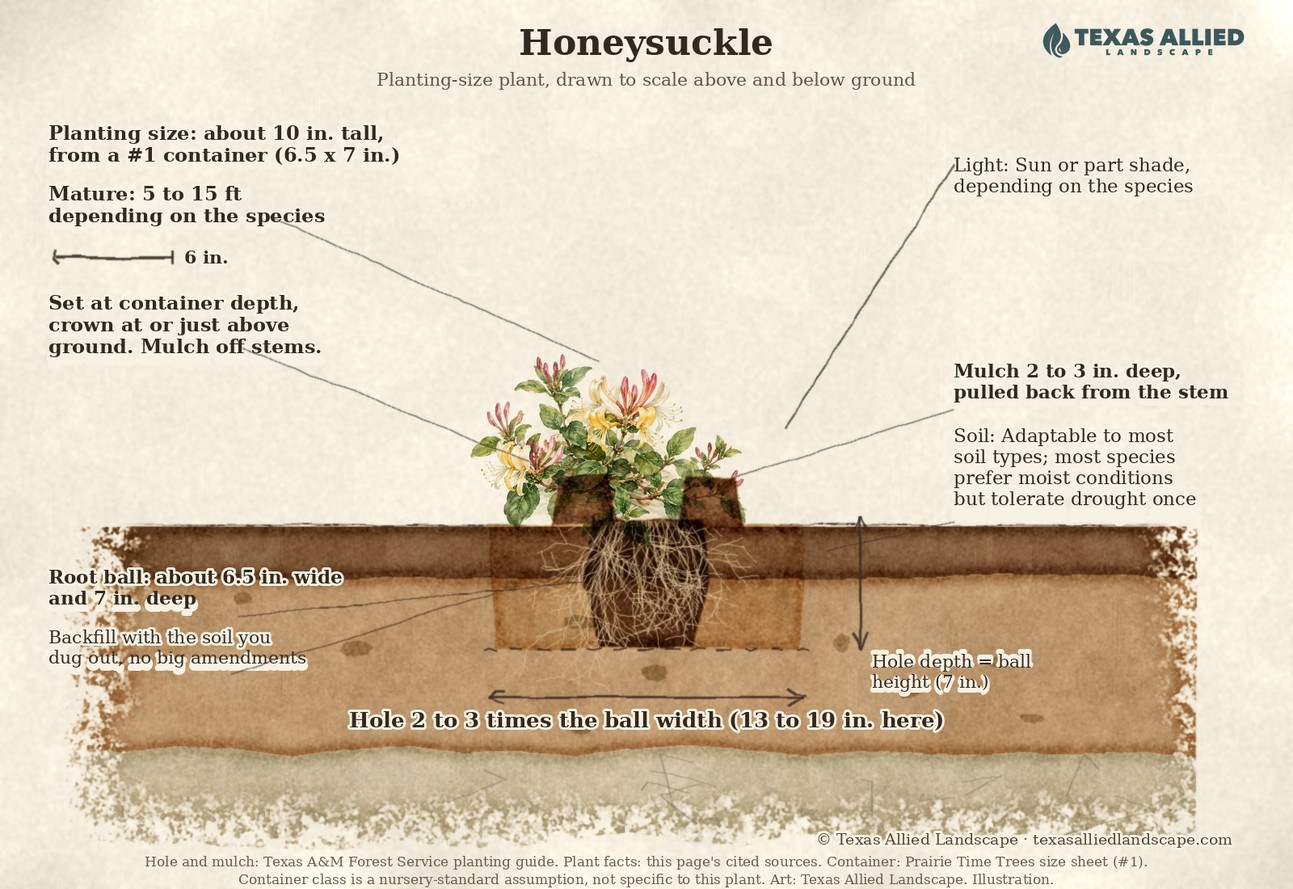
- Dig a hole twice as wide as the pot and no deeper, with sloping sides. Set the plant at the same depth it grew in its pot. Loosen any circling roots before backfilling.[3]
- For a new bed, clear grass and weeds first, roots and all.[3]
- For the site, choose sun to part shade. More sun means more flowers. It stays better behaved than most vines.[4]
- For timing, a fall planting grows roots through the cool season and is ready to grow and bloom the next year. Spring planting works too if you water through the first summer.[2]
- Soak it well at planting and keep watering while the roots establish.[3] Once established, a fall planting grows roots through the cool season and is ready to grow and bloom the next year. Spring planting works too if you water through the first summer.[2]
- Mulch 2 to 4 inches, kept a few inches away from the stems to prevent crown rot. It needs no staking or other support.[3]
Care Instructions for Your Honeysuckle
How to Water a Honeysuckle
Sunlight and soil
It grows in sun to part shade. More sun means more flowers. It stays better behaved than most vines.[4]
Wildlife
It is one of the best plants for wildlife. Its coral-red trumpet flowers run from spring into summer. They are made for hummingbirds.[5]
Spread and invasiveness
No, it does not take over. It twines politely to 10 to 15 feet. It is easy to keep in bounds.[6]
Growing in Central Texas
Yes, it grows well here. Lonicera sempervirens is the good native honeysuckle. It is nothing like the invasive Japanese kind.[7]
Honeysuckle questions
Is coral honeysuckle a Texas native?
Yes - Lonicera sempervirens is the good native honeysuckle. It is nothing like the invasive Japanese kind.[7]
Does coral honeysuckle attract hummingbirds?
It is one of the best. Its coral-red trumpet flowers run from spring into summer. They are made for hummingbirds.[5]
Sun or shade for coral honeysuckle?
It grows in sun to part shade. More sun means more flowers. It stays better behaved than most vines.[4]
Does coral honeysuckle take over like Japanese honeysuckle?
No - it twines politely to 10 to 15 feet. It is easy to keep in bounds.[6]
Next step: Our horticulturalists can train it up a trellis where the hummingbirds will find it.
Let Texas Allied Landscape care for your Honeysuckle
Honeysuckle does best with steady, knowledgeable care: the right water, pruning at the right time, and a trained eye for stress. The horticulturists at Texas Allied Landscape care for plants like yours across the San Antonio area, backed by over 40 years of landscape experience.
In these community guides
- Art in progress
Cordillera Ranch Landscaping
Bring your address, survey and yard ideas. We check the right guideline set, plan planting and irrigation, prepare the…
Sources
- Lonicera (Honeysuckle), North Carolina Extension Gardener Plant Toolbox.https://plants.ces.ncsu.edu/plants/lonicera/abc
- October Gardening Checklist, Travis County AgriLife Extension.https://travis-tx.tamu.edu/about-2/horticulture/monthly-gardening-calendar-for-austin-area/october-gardening-checklist-for-austin-and-central-texas/abc
- Back to basics: Planting perennials, SAWS Garden Style San Antonio.https://www.gardenstylesanantonio.com/garden-articles/back-to-basics-planting-perennials/abcd
- Native Garden Guide, "Coral Honeysuckle."https://nativegardenguide.com/plants/coral-honeysuckleabc
- Lady Bird Johnson Wildflower Center, "Lonicera sempervirens."https://www.wildflower.org/plants/result.php?id_plant=loseab
- City of Austin Watershed Protection plant guide, "Honeysuckle, Coral."https://www.austintexas.gov/watershed-protection/plant-guide/honeysuckle-coralab
- City of Austin Watershed Protection plant guide, "Honeysuckle, Coral."https://www.austintexas.gov/watershed-protection/plant-guide/honeysuckle-coralab