
Property owners
Horsetail
- Plant
- Horsetail
- Botanical name
- Equisetum
- Group
- Ground cover
Plant profile for Horsetail in San Antonio area landscapes.
On this page
Its botanical name is Equisetum.
It belongs to the ground cover group.
Light
Sun to part shade.[1]
Soil and drainage
Wet places - pond margins, swamps, floodplains and ditches; very aggressive, so it is best contained in a pot with no holes.[1]
Height
Up to about 6 ft tall.[1]
When to Plant Horsetail
Plant horsetail in spring in consistently moist ground or in containers. It spreads by rhizomes, so give it room or a root barrier.[2]
If you would like a hand, the Texas Allied Landscape team can plant your horsetail and keep it thriving.
Planting
- Dig a hole twice as wide as the pot and no deeper, with sloping sides, and set the plant at the same depth it grew in its pot. Loosen any circling roots before backfilling.[3]
- For a new bed, clear grass and weeds first, roots and all.[3]
- Soil: Removal takes persistence, not a single fix. It takes repeated digging of rhizomes, smothering mulch, and improving drainage. It re-establishes from tiny rhizome pieces, so expect a multi-season campaign.[4]
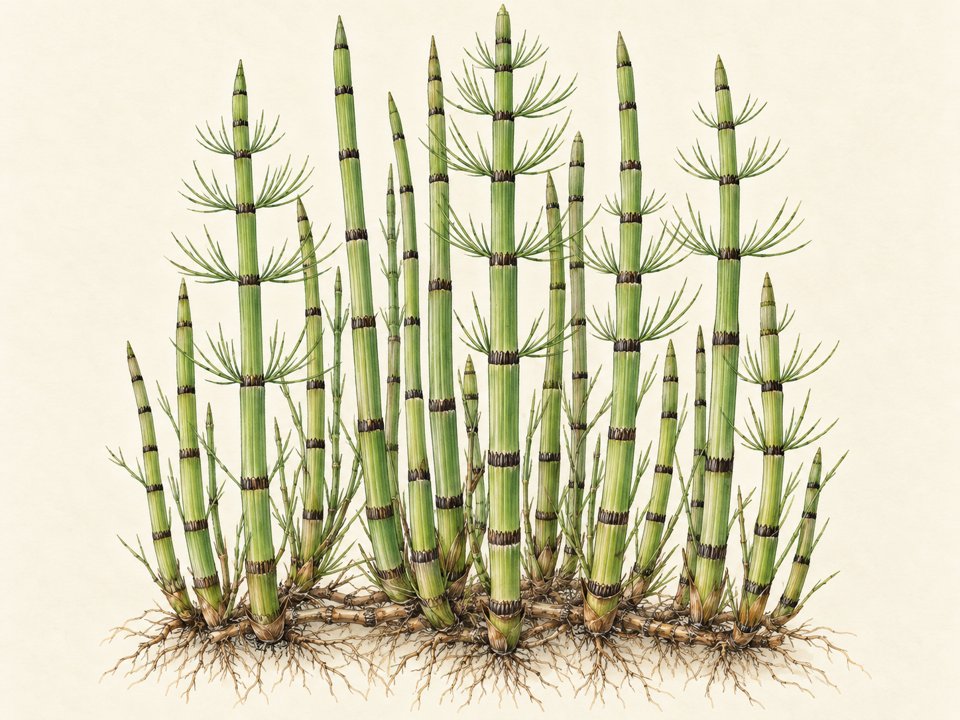
- Soak it well at planting and keep watering while the roots establish.[3] Once it is established, it is striking in the right spot. The upright green tubes give a modern, architectural look in shallow water or a pot, where it can be contained.[5]
- Mulch 2 to 4 inches, kept a few inches away from the stems to prevent crown rot. It needs no staking or other support.[3]
Care Instructions for Your Horsetail
How to Water a Horsetail
Watering
It is striking in the right spot. The upright green tubes give a modern, architectural look in shallow water or a pot, where it can be contained.[5]
Spread and invasiveness
Yes, it spreads. It spreads by deep rhizomes and spores and is famously hard to eradicate. It is best confined to a container or a lined water-garden pocket.[2]
Horsetail questions
Is horsetail invasive?
Yes. It spreads by deep rhizomes and spores and is famously hard to eradicate. It is best confined to a container or a lined water-garden pocket.[2]
How do I get rid of horsetail in a bed?
Removal takes persistence, not a single fix. It takes repeated digging of rhizomes, smothering mulch, and improving drainage. It re-establishes from tiny rhizome pieces, so expect a multi-season campaign.[4]
Next step: Our horticulturalists can take on a horsetail removal with a season-long plan instead of a losing weekend battle.
Is horsetail good for a water garden?
It is striking there. The upright green tubes give a modern, architectural look in shallow water or a pot, where it can be contained.[5]
Is horsetail a fern?
No. It is a living fossil, Equisetum, the last genus of an ancient plant family that predates the dinosaurs. It reproduces by spores like ferns do, but it is its own branch of plant life.[6]
In these community guides
Sources
- Equisetum hyemale (Horsetail / Scouring Rush), Lady Bird Johnson Wildflower Center.https://www.wildflower.org/plants/result.php?id_plant=EQHYAabc
- Texas A&M AgriLife, AquaPlant, "Horsetail management."https://aquaplant.tamu.edu/management-options/horsetail/abc
- Back to basics: Planting perennials, SAWS Garden Style San Antonio.https://www.gardenstylesanantonio.com/garden-articles/back-to-basics-planting-perennials/abcd
- Iowa State Extension, "Equisetum Biology and Management."https://crops.extension.iastate.edu/encyclopedia/equisetum-biology-and-managementab
- Texas A&M AgriLife, AquaPlant, "Horsetail management."https://aquaplant.tamu.edu/management-options/horsetail/abc
- Royal Horticultural Society, "Horsetail."https://www.rhs.org.uk/weeds/horsetail↑