
Property owners
Hybrid Crapemyrtle
- Plant
- Hybrid Crapemyrtle
- Botanical name
- Lagerstroemia fauriei hybrid
- Group
- Ornamental trees
Sourced light, water, size and care details for Hybrid Crapemyrtle.
On this page
Its botanical name is Lagerstroemia indica x fauriei hybrids.
Light
It grows in full sun to part sun. Sun and good air circulation are the best prevention for mildew and aphids.[1]
Height
Hybrid crapemyrtles are the mid-to-large class. They commonly reach 15 to 25 feet at maturity, depending on the variety. Pick one that fits the site.
Foliage
It is deciduous.
Water
It needs low water. Water it weekly for the first growing season, then about twice a month once established. If watering ever feels like a guessing game, our horticulturists can care for your Hybrid Crapemyrtle on a schedule that fits your yard.
Pruning
It needs no special pruning to bloom. Prune only to remove dead, diseased, or crossing branches. Never top a crape myrtle. The proper-pruning guide covers the same technique class.[2]
Seasonal behavior
It has a long summer bloom. The indica x fauriei hybrids were bred for mildew resistance and showy cinnamon-to-tan exfoliating bark. They hold their looks through a Central Texas summer. Crape myrtle bark scale is a newer pest. It can cause considerable damage if not caught early. Check the trunks and branches.[3]
When to Plant Hybrid Crapemyrtle
Plant Hybrid Crapemyrtle in fall or early spring in Central Texas. A fall planting establishes roots through the cool season. It is ready to grow and bloom the following year. Spring planting works too if you water through the first summer.[4]
If you would like a hand, the Texas Allied Landscape team can plant your Hybrid Crapemyrtle and keep it thriving.
Planting
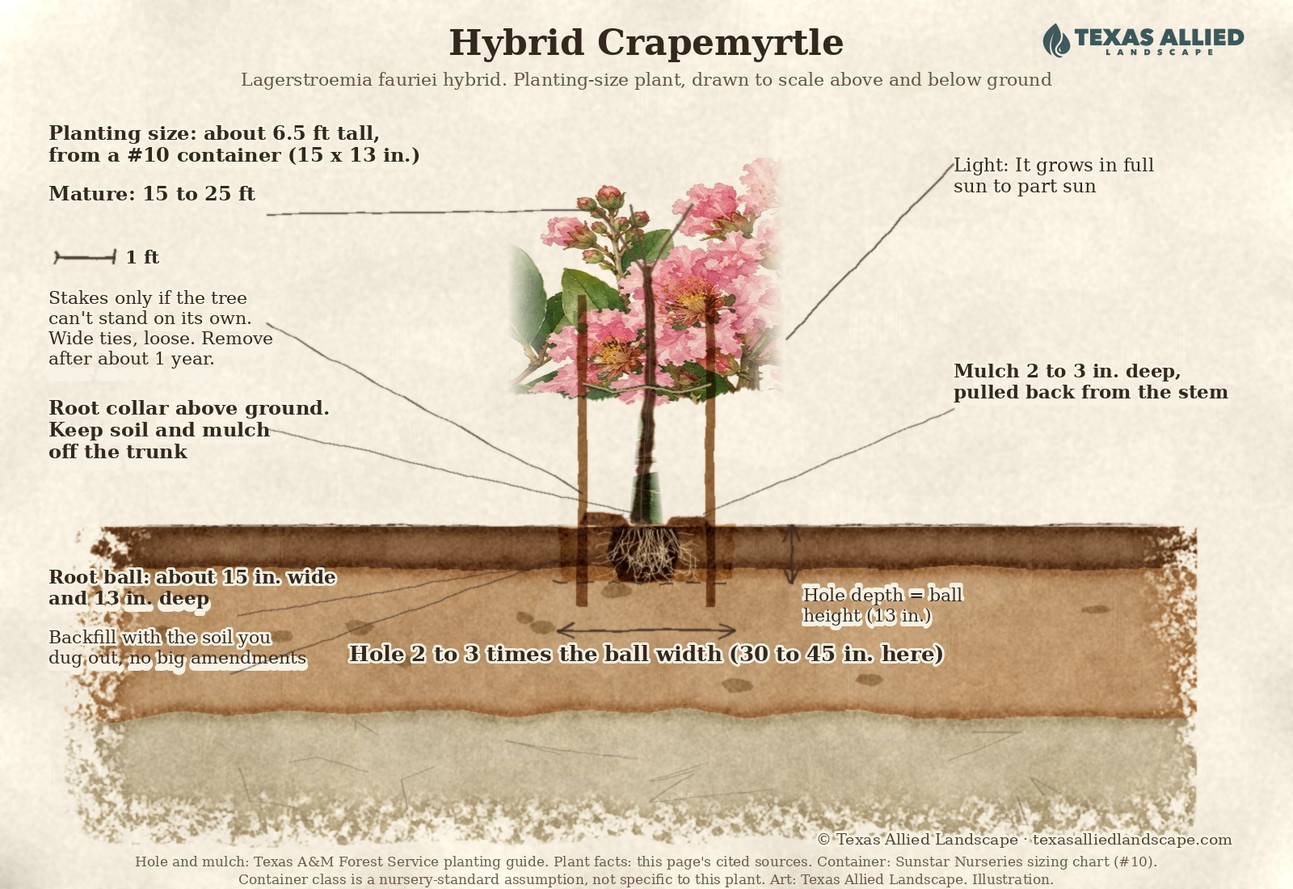
- Dig a hole at least twice as wide as the root ball and no deeper. A square hole keeps the roots from settling too deep. It also lets them grow out into the surrounding soil.[5]
- Fill the empty hole with water and check the drainage. If it takes longer than 24 hours to drain, choose another spot. Roots sitting under water will kill the tree.[5]
- Set it with the root collar (the flare just above the roots) level with or slightly above the ground. Take off all wire, twine, containers and bags before backfilling.[5]
- Backfill with the same soil that came out of the hole. Do not add amendments. Settle it with water rather than packing it down.[5]
- For the site, it grows in full sun to part sun. Sun and good air circulation are the best prevention for mildew and aphids.[1]
- For timing, a fall planting establishes roots through the cool season. It is ready to grow and bloom the following year. Spring planting works too if you water through the first summer.[4]
- Water for at least the first two years, without overwatering. A thorough soaking beats light, frequent watering.[5]
- Mulch 2 to 3 inches deep, out to the drip line and up to but not touching the trunk. Stake only if it cannot stand on its own, and take stakes off within a year. Most need no support. Do not fertilize during the first growing season.[5]
What is crape myrtle bark scale?
It is a new scale pest that can cause considerable damage if not caught early. Mississippi State Extension publication 2938 covers identification and control. Check the trunks and branches if you have or plan to plant crape myrtles.
Care Instructions for Your Hybrid Crapemyrtle
How to Water a Hybrid Crapemyrtle
It needs low water. Water it weekly for the first growing season, then about twice a month once established.
Sunlight
It grows in full sun to part sun. Sun and good air circulation are the best prevention for mildew and aphids.[1]
Mature height and spread
Hybrid crapemyrtles are the mid-to-large class. They commonly reach 15 to 25 feet at maturity, depending on the variety. Pick one that fits the site.
Pruning
It needs no special pruning to bloom. Prune only to remove dead, diseased, or crossing branches. Never top a crape myrtle. The proper-pruning guide covers the same technique class.[2]
Normal seasonal behavior
It has a long summer bloom. The indica x fauriei hybrids were bred for mildew resistance and showy cinnamon-to-tan exfoliating bark. They hold their looks through a Central Texas summer. Crape myrtle bark scale is a newer pest. It can cause considerable damage if not caught early. Check the trunks and branches.[3]
Crape myrtle questions
When should I prune my crape myrtle?
Prune in late winter, while it is leafless. February here is ideal. It blooms on new wood, so winter pruning does not cost you flowers.[6]
What is "crape murder" and how do I avoid it?
It means topping the tree back to bare knuckles every year. That ruins the natural shape and creates weak, whippy regrowth. Prune lightly instead. Remove crossing branches, suckers and seed heads, and let the graceful form be.[7]
How do I pick the right size crape myrtle?
Pick by mature height. Dwarf types stay under 5 ft. Semi-dwarfs reach 5-12 ft, and tree forms reach 20-30 ft. Matching the variety to the space is what lets you stop pruning hard.[8]
Why won't my crape myrtle bloom?
The cause is almost always too much shade. It needs full sun for a heavy bloom show. Over-fertilizing with nitrogen also pushes leaves at the expense of flowers.[9]
Next step: Our horticulturalists can check sun, feeding and pruning history and get a stubborn crape myrtle blooming again.
Let Texas Allied Landscape care for your Hybrid Crapemyrtle
Hybrid Crapemyrtle does best with steady, knowledgeable care. That means the right water, pruning at the right time, and a trained eye for stress. The horticulturists at Texas Allied Landscape care for plants like yours across the San Antonio area. They bring over 40 years of landscape experience.
In these community guides

Illustration. Illustration based on reference photos of Shavano Rogers Ranch - Crosstimber. Not a single literal view. Crosstimber Landscaping
Plan your Crosstimber plants, shade and irrigation. Get help matching your lot rules, preparing the review package and…

Illustration. Illustration based on reference photos of Rogers Ranch - Point Bluff and other neighborhoods. Not a single literal view. Rogers Ranch Landscaping
Plan your Rogers Ranch landscape with lawn, tree and irrigation guidance. Get help with the review package, approved…
Sources
- Crape Myrtle, San Antonio Water System - Garden Style San Antonio.https://www.gardenstylesanantonio.com/plants/crape-myrtle/abc
- Follow Proper Pruning Techniques, Texas A&M AgriLife Extension Earth-Kind Landscaping.https://aggie-horticulture.tamu.edu/earthkind/landscape/proper-pruning-techniques/ab
- 3 Things to Know About Crape Myrtles, Mississippi State University Extension / Texas A&M AgriLife Collaborative Pest Alerts.https://extension.msstate.edu/blogs/extension-for-real-life/3-things-know-about-crape-myrtlesab
- October Gardening Checklist, Travis County AgriLife Extension.https://travis-tx.tamu.edu/about-2/horticulture/monthly-gardening-calendar-for-austin-and-central-texas/ab
- Planting, Texas A&M Forest Service.https://tfsweb.tamu.edu/trees/tree-care/planting/abcdef
- Lady Bird Johnson Wildflower Center, Mr. Smarty Plants, "When to trim crape myrtle."https://www.wildflower.org/expert/show.php?frontpage=true&id=1980↑
- Plant Answers, "Crapemyrtle - the best landscape plant for Texas."https://www.plantanswers.com/crapemyrtle.htm↑
- Texas Master Gardeners, Victoria County, "Gardeners' Dirt: Crape myrtles."https://txmg.org/victoria/2025-oct-18-gardeners-dirt/↑
- City of Austin Grow Green plant guide, "Crape Myrtle."https://www.austintexas.gov/watershed-protection/plant-guide/crape-myrtle↑