
Property owners
Indian Ricegrass
- Plant
- Indian Ricegrass
- Botanical name
- Oryzopsis hymenoides
- Group
- Ornamental grasses
Indian ricegrass is a delicate native bunchgrass for the driest, rockiest corners - hair-fine blades and a blond seed haze.
On this page
Botanical name: Oryzopsis hymenoides.
Plant group: Ornamental grasses.
Light
Full sun.[1]
Soil and drainage
Sandy or rocky, sharply drained soil - a dryland bunchgrass that rots in wet clay. It is at home on thin, sloping ground.[2]
Height
1-2 ft in bloom.[3]
Spread
Compact bunch, a foot or so wide; it self-sows lightly in open sandy spots.
Foliage
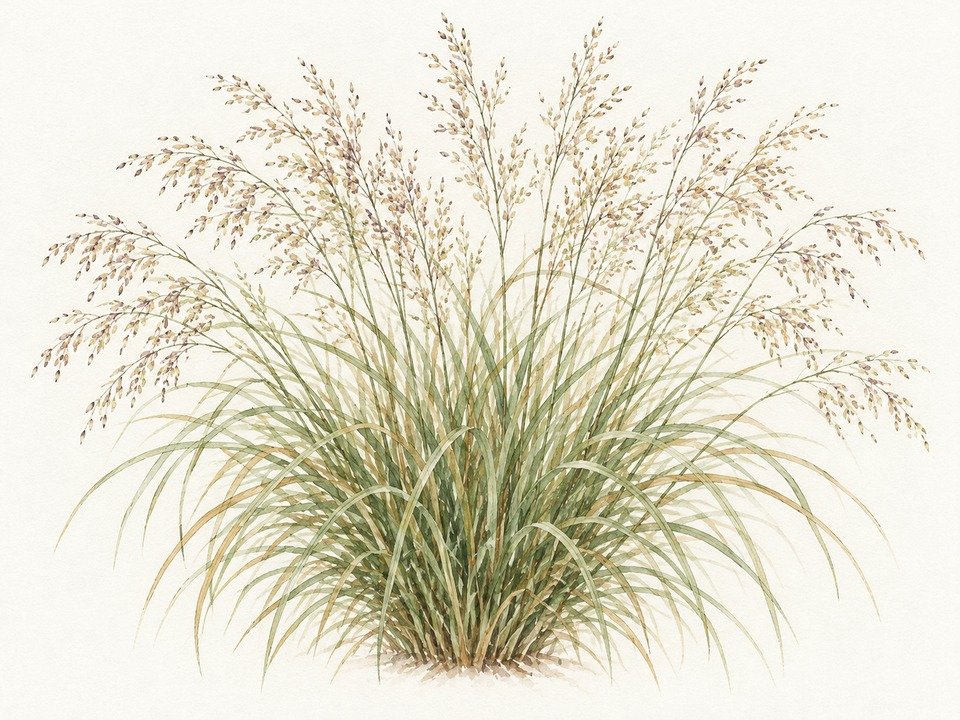
Very fine, hair-like green blades in a soft tuft, topped in late spring by delicate open panicles that dry to a blond haze.[2]
Water
Very low - one of the most drought-tolerant native grasses. Water to establish, then little or none.[3]
Pruning
Rake or comb out old growth in late winter; a light shear refreshes the tuft.
Seasonal behavior
Green in spring, airy bloom in late spring to summer, blond seed heads into fall, dormant in winter.[1]
When to Plant Indian Ricegrass
Plant indian ricegrass in fall through early spring in Central Texas. Cool-season planting lets this dryland bunchgrass root before summer heat.[2]
If you would like a hand, the Texas Allied Landscape team can plant your Indian Ricegrass and keep it thriving.
Planting
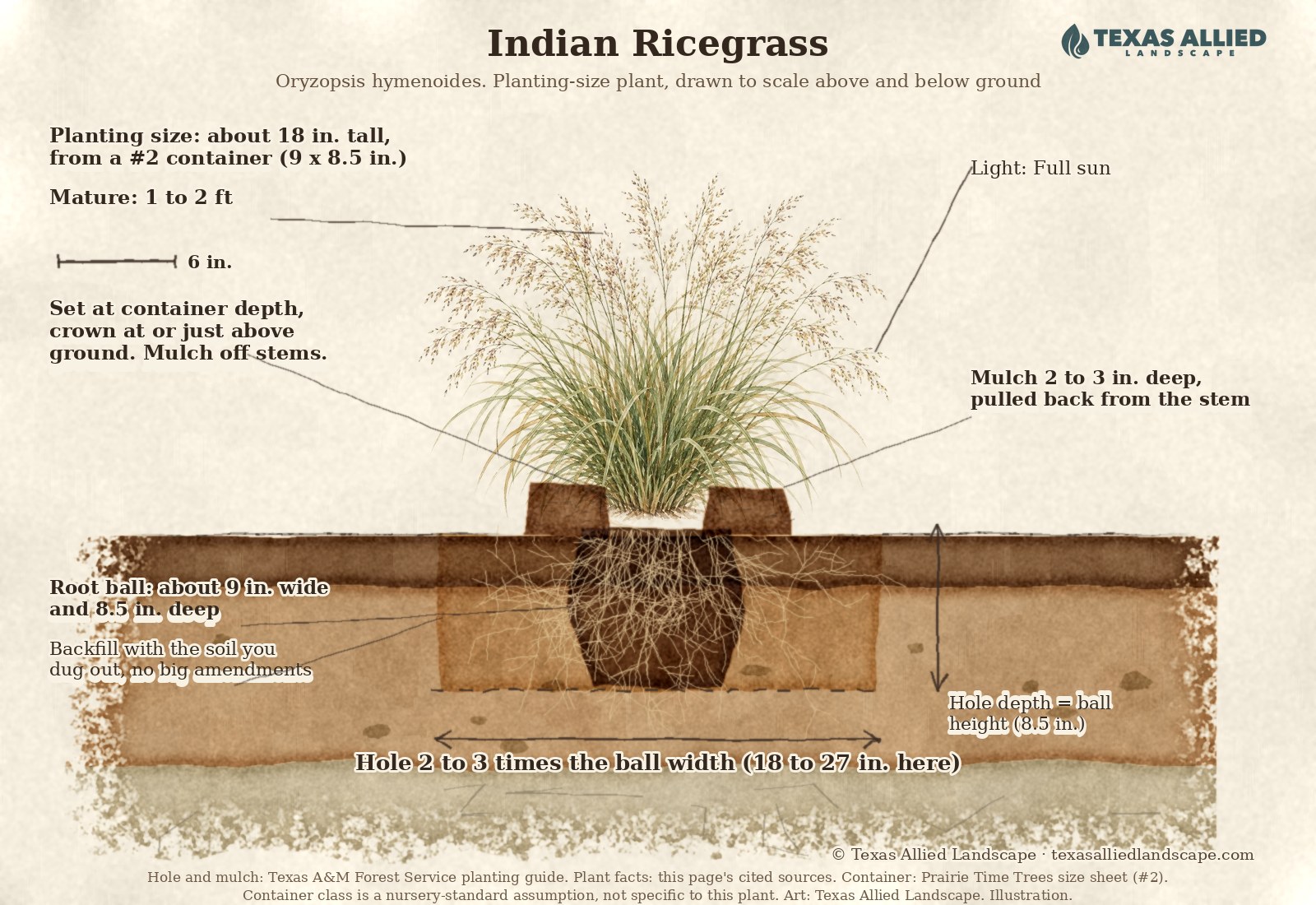
- Dig a hole twice as wide as the pot and no deeper, with sloping sides, and set the plant at the same depth it grew in its pot. Loosen any circling roots before backfilling.[4]
- For a new bed, clear grass and weeds first, roots and all.[4]
- Site: Full sun.[1]
- Soil: Sandy or rocky, sharply drained soil - a dryland bunchgrass that rots in wet clay. It is at home on thin, sloping ground.[2]
- Timing: Cool-season planting lets this dryland bunchgrass root before summer heat.[2]
- Soak it well at planting and keep watering while the roots establish.[4] Once established: Water to establish, then little or none.[3]
- Mulch 2 to 4 inches, kept a few inches away from the stems to prevent crown rot. It needs no staking or other support.[4]
Care Instructions for Your Indian Ricegrass
Sunlight
Full sun.[1]
Soil and drainage
Sandy or rocky, sharply drained soil - a dryland bunchgrass that rots in wet clay. It is at home on thin, sloping ground.[2]
Mature height and spread
1-2 ft in bloom.[3] Compact bunch, a foot or so wide; it self-sows lightly in open sandy spots.
Pruning
Rake or comb out old growth in late winter; a light shear refreshes the tuft.
Normal seasonal behavior
Green in spring, airy bloom in late spring to summer, blond seed heads into fall, dormant in winter.[1]
Indian ricegrass questions
What is Indian ricegrass?
Achnatherum hymenoides - a beautiful native bunchgrass of the western US including West Texas, with delicate airy seed heads and nutritious rice-like seeds.[5]
Why is it called ricegrass?
The seeds were an important food grain for Native peoples of the West, ground like rice - and birds still love them.[6]
Where does Indian ricegrass grow best?
Full sun on dry, sandy, well-drained soil - it is one of the most drought-tolerant native grasses, thriving where others fail.[7]
Can I find Indian ricegrass for my garden?
Seed is sold by native grass suppliers - it is mostly a seed-grown plant rather than a nursery pot, so plan to sow it in a prepared bed.[8]
Next step: Our horticulturalists can source and sow native grass seed for a low-water meadow bed.
Let Texas Allied Landscape care for your Indian Ricegrass
Indian Ricegrass does best with steady, knowledgeable care: the right water, pruning at the right time, and a trained eye for stress. The horticulturists at Texas Allied Landscape care for plants like yours across the San Antonio area, backed by over 40 years of landscape experience.
In these community guides
Sources
- Achnatherum hymenoides (Oryzopsis hymenoides), Native Plant Society of Texas.https://www.npsot.org/posts/native-plant/achnatherum-hymenoides/abcde
- Plant Guide for Indian Ricegrass, USDA NRCS.https://www.nrcs.usda.gov/plantmaterials/idpmcpg11641.pdfabcdef
- Indian Ricegrass, Utah State University Extension.https://extension.usu.edu/rangeplants/grasses-and-grasslikes/indian-ricegrassabcde
- Back to basics: Planting perennials, SAWS Garden Style San Antonio.https://www.gardenstylesanantonio.com/garden-articles/back-to-basics-planting-perennials/abcd
- Native Plant Society of Texas, "Achnatherum hymenoides."https://www.npsot.org/posts/native-plant/achnatherum-hymenoides/↑
- USDA NRCS, "Indian Ricegrass Plant Guide."https://www.nrcs.usda.gov/plantmaterials/idpmcpg11641.pdf↑
- USDA NRCS, "Indian Ricegrass Plant Guide."https://www.nrcs.usda.gov/plantmaterials/idpmcpg11641.pdf↑
- Lady Bird Johnson Wildflower Center, Mr. Smarty Plants, "Sources for Texas natives."https://www.wildflower.org/expert/show.php?frontpage=true&id=8904↑