
Property owners
Japanese Persimmon
- Plant
- Japanese Persimmon
- Botanical name
- Diospyros kaki
- Group
- Ornamental trees
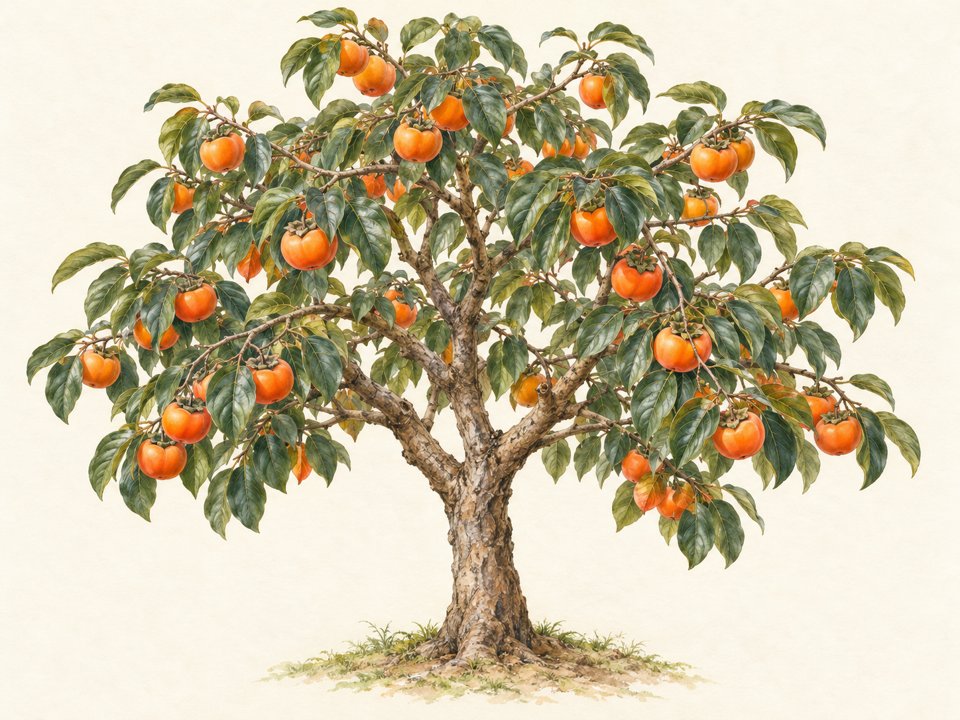
Plant profile for Japanese Persimmon in San Antonio area landscapes.
On this page
Its botanical name is Diospyros kaki.
It belongs to the ornamental trees group.
Light
Full sun.[1]
Soil and drainage
Loamy, moist but well-drained soil with a pH of 6.0 to 6.5 is best.[1]
Height
20 to 30 ft tall and 15 to 25 ft wide.[1]
When to Plant Japanese Persimmon
In the San Antonio area, October and November are the best months to plant trees and shrubs. Roots keep growing through our mild winters. A fall-planted Japanese Persimmon is established before summer heat. Spring planting also works. Try to avoid planting in peak summer.[2]
If you would like a hand, the Texas Allied Landscape team can plant your Japanese Persimmon and keep it thriving.
Planting
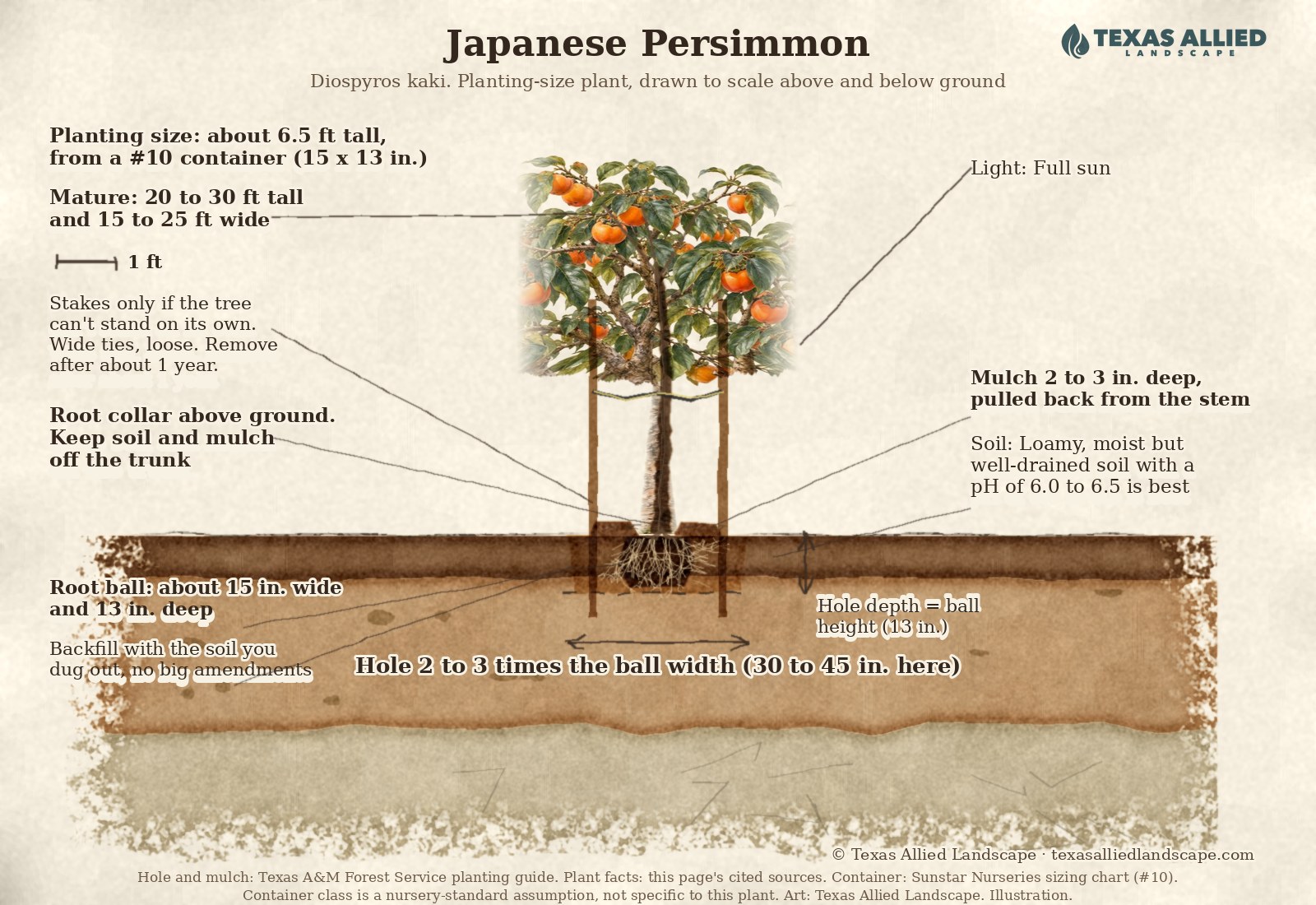
- Dig a hole at least twice as wide as the root ball and no deeper. A square hole keeps the roots from settling too deep. It also lets them grow out into the surrounding soil.[3]
- Fill the empty hole with water and check the drainage. If it takes longer than 24 hours to drain, choose another spot. Roots sitting under water will kill the tree.[3]
- Set the tree with the root collar (the flare just above the roots) level with or slightly above the ground. Carry it by the container or root ball, never the trunk. Take off all wire, twine, containers and bags before backfilling.[3]
- Backfill with the same soil that came out of the hole. Do not add amendments. Settle it with water rather than packing it down.[3]
- Water for at least the first two years, without overwatering. A thorough soaking beats light, frequent watering.[3]
- Mulch 2 to 3 inches deep, out to the drip line and up to but not touching the trunk. Stake only if the tree cannot stand on its own, and take stakes off within a year. Most trees need no support. Do not fertilize during the first growing season.[3]
Care Instructions for Your Japanese Persimmon
How to Water a Japanese Persimmon
Growing in Central Texas
Very well. They are small, easy trees adapted to most of Texas. The oriental persimmon was just named a Texas Superstar plant.[4]
Fruit and flowers
You have an astringent variety. Those must go jelly-soft before eating. Non-astringent types like Fuyu can be eaten crisp like an apple.[5]
Japanese persimmon questions
Do Japanese persimmons grow well in Texas?
Very well. They are small, easy trees adapted to most of Texas. The oriental persimmon was just named a Texas Superstar plant.[4]
Why is my persimmon fruit mouth-puckering?
You have an astringent variety. Those must go jelly-soft before eating. Non-astringent types like Fuyu can be eaten crisp like an apple.[5]
Does a persimmon tree need a pollinator?
Most common varieties set fruit on their own, without a second tree. That is one more reason they are an easy home orchard pick.[6]
When are persimmons ripe in Texas?
In fall. The bright orange fruit ripens roughly October into November. It hangs ornamentally after the leaves drop.[7]
Next step: Our horticulturalists can prune your persimmon each winter to keep the fruit within reach.
In these community guides
Sources
- Diospyros kaki (Japanese Persimmon), North Carolina Extension Gardener Plant Toolbox.https://plants.ces.ncsu.edu/plants/diospyros-kaki/abc
- SAWS, "Autumn is for planting trees."https://www.saws.org/autumn-is-for-planting-trees/↑
- Planting, Texas A&M Forest Service.https://tfsweb.tamu.edu/trees/tree-care/planting/abcdef
- AgriLife Today, "Persimmon named newest Texas Superstar plant."https://agrilifetoday.tamu.edu/2026/10/19/persimmon-named-newest-texas-superstar-plant/ab
- Texas A&M AgriLife, "Persimmons: Path to the Plate."https://mytexas.ag.tamu.edu/publications/persimmons-path-to-the-plate/ab
- Brazos County Master Gardeners, "Persimmon for a Fruitful Fall."https://txmg.org/brazos/persimmon-for-a-fruitful-fall/↑
- Texas A&M AgriLife, "Persimmons: Path to the Plate."https://mytexas.ag.tamu.edu/publications/persimmons-path-to-the-plate/↑