
Property owners
Jerusalem Sage
- Plant
- Jerusalem Sage
- Botanical name
- Phlomis fruticosa
- Group
- Large shrubs
Jerusalem Sage (Phlomis fruticosa): light, water, soil, size and care for San Antonio area landscapes.
On this page
Its botanical name is Phlomis fruticosa.
Light
It grows in sun or partial shade. A touch of afternoon shade can help.[1]
Soil and drainage
It grows in sandy, well-drained or clay categories.
Height
It is a 2 to 4 foot plant.[2]
Spread
It spreads to a maximum of 3 feet.
Foliage
It is evergreen in the local profile.
Water
Occasional supplemental summer water may be needed in sunny sites. If watering ever feels like a guessing game, our horticulturists can care for your Jerusalem Sage on a schedule that fits your yard.
Pruning
Groom it periodically. Spent stalks may be removed after spring or left for interest.
Seasonal behavior
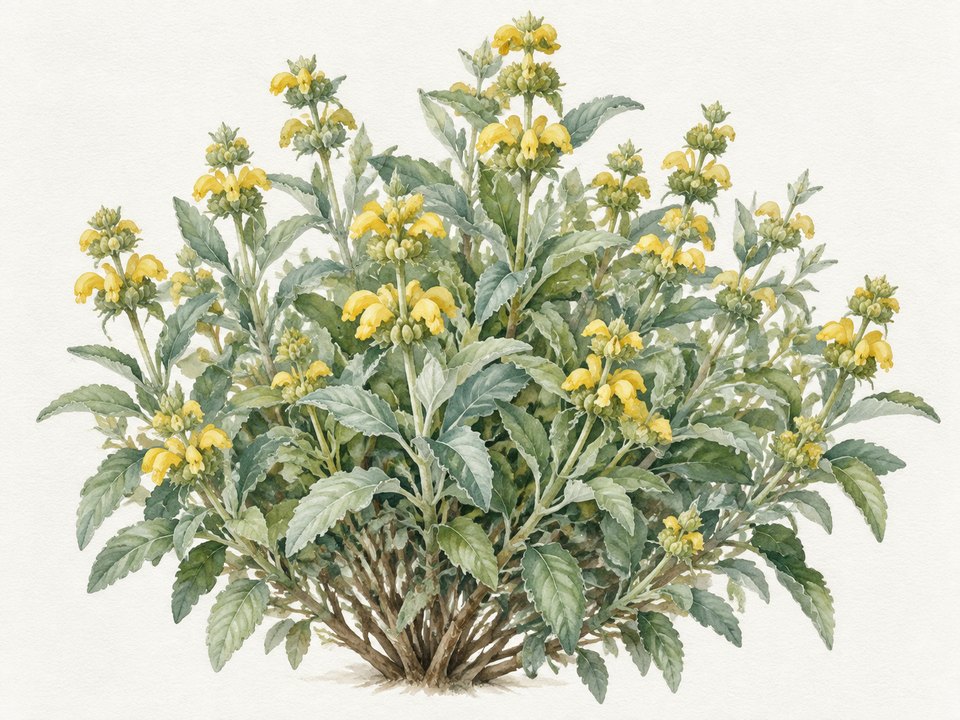
It has evergreen woolly gray foliage and yellow late-spring flowers.
When to Plant Jerusalem Sage
Fall, October through November, and late winter into early spring are the best times to plant Jerusalem Sage in Central Texas. Cooler months give the roots time to establish before summer heat.[3]
Container-grown shrubs can go in at other times if you keep up with watering, but avoid planting in the peak of summer.
If you would like a hand, the Texas Allied Landscape team can plant your Jerusalem Sage and keep it thriving.
Planting
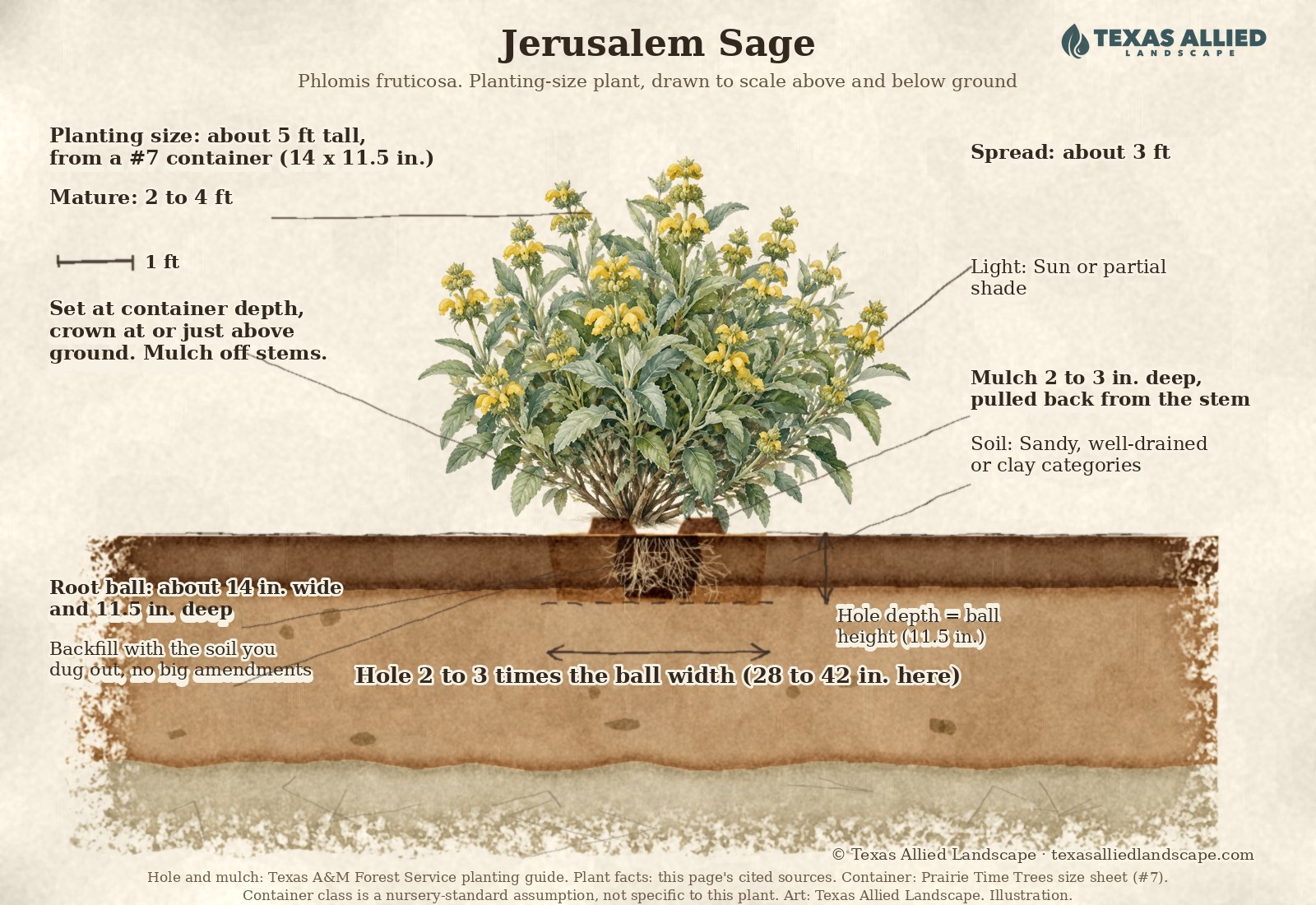
- Dig a hole at least twice as wide as the root ball and no deeper, so the roots can grow out into the surrounding soil.[4]
- Fill the empty hole with water and check the drainage. If it takes longer than 24 hours to drain, choose another spot. Roots sitting under water will kill the plant.[4]
- Set it with the root collar (where the stems meet the roots) level with the ground. Take off the container and any twine or bags before backfilling.[4]
- Backfill with the same soil that came out of the hole, without amendments. Settle the soil with water rather than packing it down.[4]
- Site and soil: It grows in sun or partial shade, and a touch of afternoon shade can help.[1] It grows in sandy, well-drained or clay categories. It is a 2 to 4 foot plant.[2]
- Timing: Fall, October through November, and late winter into early spring are the best times to plant Jerusalem Sage in Central Texas.
- Water it regularly through the first growing season while the roots establish. Do not overwater. A thorough soaking beats light, frequent watering.[4]
- Mulch 2 to 3 inches deep, up to but not touching the stems. It needs no staking or other support. Do not fertilize during the first growing season.[4]
Do I have to remove Jerusalem sage flower stalks?
No compulsory deadheading program is supported by the SAWS profile. It says spent stalks may be removed after spring or left for year-round interest; periodic grooming is enough in its maintenance account.
Care Instructions for Your Jerusalem Sage
How to Water a Jerusalem Sage
Occasional supplemental summer water may be needed in sunny sites.
Sunlight
It grows in sun or partial shade. A touch of afternoon shade can help.[1]
Soil and drainage
It grows in sandy, well-drained or clay categories.
Mature height and spread
It is a 2 to 4 foot plant.[2] It spreads to a maximum of 3 feet.
Pruning
Groom it periodically. Spent stalks may be removed after spring or left for interest.
Normal seasonal behavior
It has evergreen woolly gray foliage and yellow late-spring flowers.
Jerusalem sage questions
Is Jerusalem sage a real sage?
No. Phlomis fruticosa is in the mint family, but it is not a Salvia. It is a Mediterranean shrub that loves our climate.[5]
When does Jerusalem sage bloom?
It blooms from spring into summer. Whorls of yellow hooded flowers open above the gray-green woolly leaves.[6]
How do I prune Jerusalem sage?
Deadhead the flower stalks after bloom and shear lightly in late winter. That keeps it from getting leggy.[7]
Next step: Our horticulturalists can keep it sheared into a tidy mound.
Is Jerusalem sage drought tolerant?
Very. It has woolly gray leaves and Mediterranean roots, and it rots if overwatered.[8]
Let Texas Allied Landscape care for your Jerusalem Sage
Jerusalem Sage does best with steady, knowledgeable care. That means the right water, pruning at the right time, and a trained eye for stress. The horticulturists at Texas Allied Landscape care for plants like yours across the San Antonio area. They are backed by over 40 years of landscape experience.
In these community guides
Illustration. Illustration based on reference photos of Rogers Ranch - Point Bluff and other neighborhoods. Not a single literal view. Rogers Ranch Landscaping
Plan your Rogers Ranch landscape with lawn, tree and irrigation guidance. Get help with the review package, approved…
Illustration. Illustration based on reference photos of Shavano Rogers Ranch - Crosstimber. Not a single literal view. Crosstimber Landscaping
Plan your Crosstimber plants, shade and irrigation. Get help matching your lot rules, preparing the review package and…
Sources
- Jerusalem Sage, San Antonio Water System - Garden Style San Antonio.https://www.gardenstylesanantonio.com/plants/jerusalem-sage/abc
- Phlomis fruticosa, NC State Extension.https://plants.ces.ncsu.edu/plants/phlomis-fruticosa/abc
- October Gardening Checklist, Travis County AgriLife Extension.https://travis-tx.tamu.edu/about-2/horticulture/monthly-gardening-calendar-for-austin-area/october-gardening-checklist-for-austin-and-central-texas/↑
- Planting, Texas A&M Forest Service.https://tfsweb.tamu.edu/trees/tree-care/planting/abcdef
- Central Texas Gardener, "Jerusalem Sage."https://centraltexasgardener.org/resource/jerusalem-sage/↑
- Bexar County Master Gardeners, "Jerusalem Sage."https://bcmgtx.org/2025/07/09/jerusalem-sage/↑
- City of Austin Grow Green plant guide, "Sage, Jerusalem."https://www.austintexas.gov/department/grow-green/plant-guide/sage-jerusalem↑
- City of Austin Grow Green plant guide, "Sage, Jerusalem."https://www.austintexas.gov/department/grow-green/plant-guide/sage-jerusalem↑