
Property owners
Jerusalem Thorn
- Plant
- Jerusalem Thorn
- Botanical name
- Parkinsonia aculeata
- Group
- Ornamental trees
Plant profile for Jerusalem Thorn in San Antonio area landscapes.
On this page
Its botanical name is Parkinsonia aculeata.
It belongs to the ornamental trees group.
Light
Full sun.[1]
Soil and drainage
Well-drained soils of any type - sands, loams, clays, caliche - and it tolerates poor soils, salinity and occasional flooding. Protect from north winds in cold spots.[1]
Height
Up to about 40 ft tall, usually much shorter.[1]
When to Plant Jerusalem Thorn
In the San Antonio area, October and November are the best months to plant trees and shrubs. Roots keep growing through our mild winters. A fall-planted Jerusalem Thorn is established before summer heat. Spring planting also works. Try to avoid planting in peak summer.[2]
If you would like a hand, the Texas Allied Landscape team can plant your Jerusalem Thorn and keep it thriving.
Planting
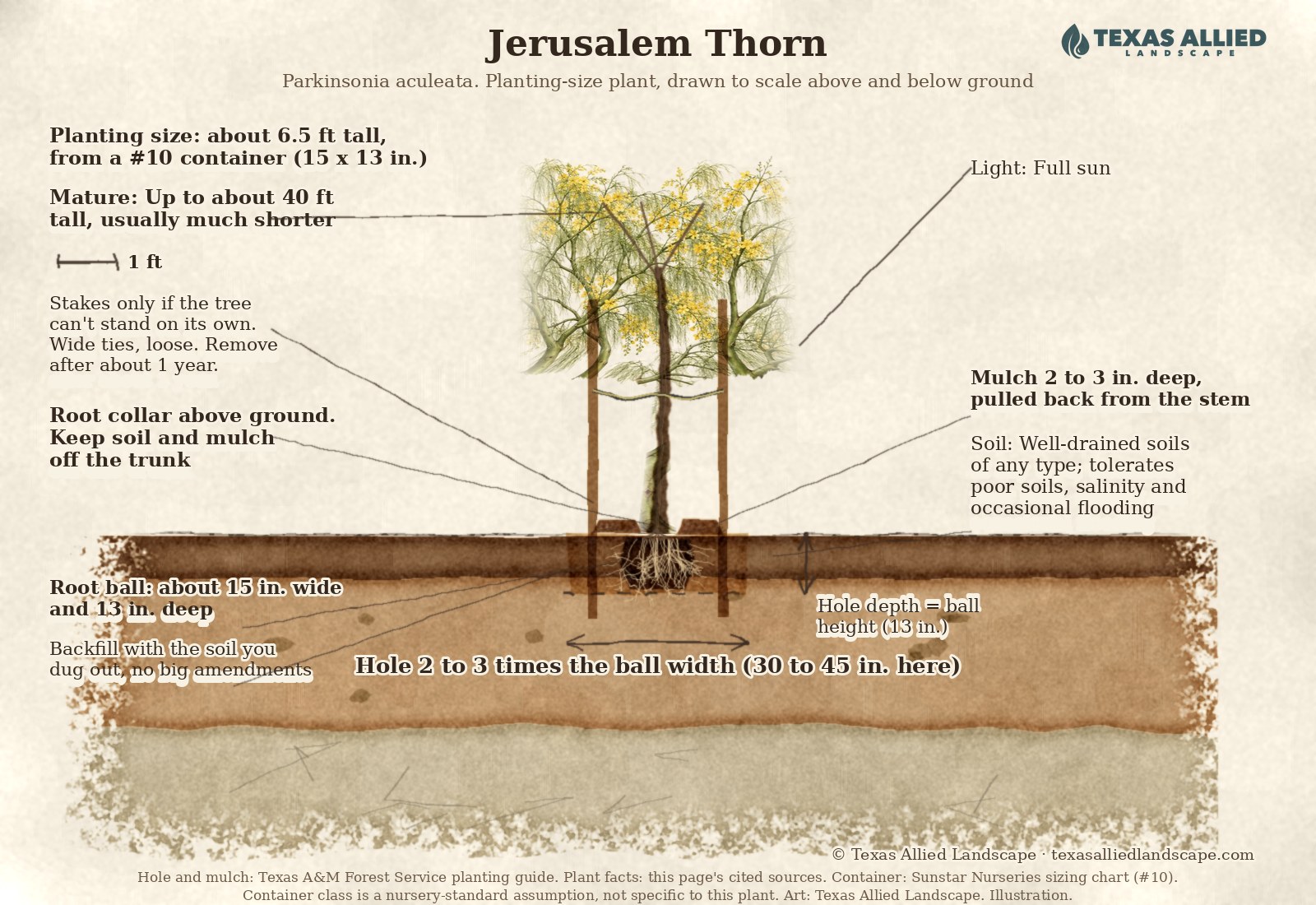
- Dig a hole at least twice as wide as the root ball and no deeper - a square hole keeps the roots from settling too deep while letting them grow out into the surrounding soil.[3]
- Fill the empty hole with water and check the drainage. If it takes longer than 24 hours to drain, choose another spot: roots sitting under water will kill the tree.[3]
- Set the tree with the root collar (the flare just above the roots) level with or slightly above the ground. Carry it by the container or root ball, never the trunk, and take off all wire, twine, containers and bags before backfilling.[3]
- Backfill with the same soil that came out of the hole, without amendments, and settle it with water rather than packing it down.[3]
- Water for at least the first two years, without overwatering: a thorough soaking beats light, frequent watering.[3]
- Mulch 2 to 3 inches deep, out to the drip line and up to but not touching the trunk. Stake only if the tree cannot stand on its own and take stakes off within a year - most trees need no support. Do not fertilize during the first growing season.[3]
Care Instructions for Your Jerusalem Thorn
How to Water a Jerusalem Thorn
Watering
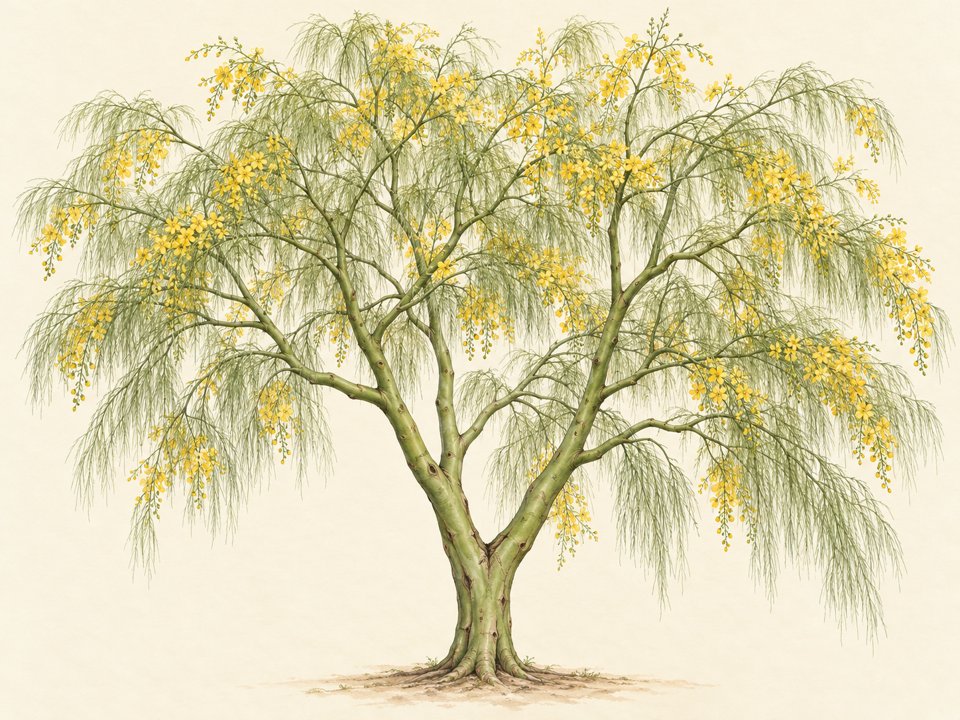
It needs almost none once established. It is a drought native with yellow flower clusters through the hot months. Overwatering makes it leggy and weak.[4]
Growing in Central Texas
Yes, it grows here. Parkinsonia aculeata is native to South and West Texas. It can seed in aggressively outside its home range.[5]
Jerusalem thorn questions
Is Jerusalem thorn (retama) a Texas native?
Yes - Parkinsonia aculeata is native to South and West Texas. It can seed in aggressively outside its home range.[5]
Why is the bark on my retama green?
That is normal and is the tree's trick. The green bark photosynthesizes. That lets the tree drop its tiny leaves in drought and keep growing.[6]
Does Jerusalem thorn have thorns?
Yes - the name is literal. It has sharp thorns at the leaf bases. Plant it away from paths, pools, and play areas.[7]
How much water does retama need?
It needs almost none once established. It is a drought native with yellow flower clusters through the hot months. Overwatering makes it leggy and weak.[4]
Next step: Our horticulturalists can help you place it where its thorns and self-seeding are virtues, not headaches.
In these community guides
Sources
- Parkinsonia aculeata (Jerusalem Thorn), Lady Bird Johnson Wildflower Center.https://www.wildflower.org/plants/result.php?id_plant=PAAC3abc
- SAWS, "Autumn is for planting trees."https://www.saws.org/autumn-is-for-planting-trees/↑
- Planting, Texas A&M Forest Service.https://tfsweb.tamu.edu/trees/tree-care/planting/abcdef
- City of Austin Grow Green plant guide, "Retama."https://www.austintexas.gov/watershed-protection/plant-guide/retamaab
- Lady Bird Johnson Wildflower Center, Mr. Smarty Plants, "Is Jerusalem thorn native?"https://www.wildflower.org/expert/show.php?frontpage=true&id=4356ab
- Lady Bird Johnson Wildflower Center, "Parkinsonia aculeata."https://www.wildflower.org/plants/result.php?id_plant=paac3↑
- City of Austin Grow Green plant guide, "Retama."https://www.austintexas.gov/watershed-protection/plant-guide/retama↑