
Property owners
Lamb's Ear
- Plant
- Lamb's Ear
- Botanical name
- Stachys byzantina
- Group
- Ground cover
Lamb's Ear (Stachys byzantina): light, water, soil, size and care for San Antonio area landscapes.
On this page
Its botanical name is Stachys byzantina.
Light
It wants full sun. Light afternoon shade is helpful in hot summer climates. Too much shade can inhibit leaf drying.[1]
Soil and drainage
It wants average, dry to medium, well-drained soil.
Height
Henderson describes a 4 to 6 inch foliage mat, flower stems around 10 to 15 inches, and a broader 9 to 18 inch characteristics range.
Spread
Henderson lists 12 to 18 inches. Spreading stems can extend the planting.
Foliage
It is evergreen in warm climates. The leaves can deteriorate in harsh winters.
Water
It is generally drought tolerant. Avoid overwatering. If watering ever feels like a guessing game, our horticulturists can care for your Lamb's Ear on a schedule that fits your yard.
Pruning
Remove damaged leaves as needed. Removing flower stems is optional for a foliage-focused groundcover. Divide when necessary.
Seasonal behavior
It is evergreen in warm climates, but the foliage deteriorates in harsh winters. Humidity and wet foliage can cause summer decline. Creeping stems can spread aggressively.
When to Plant Lamb's Ear
Plant Lamb's Ear in fall or early spring in Central Texas. A fall planting establishes roots through the cool season and is ready to grow and bloom the following year. Spring planting works too if you water through the first summer.[2]
If you would like a hand, the Texas Allied Landscape team can plant your Lamb's Ear and keep it thriving.
Planting
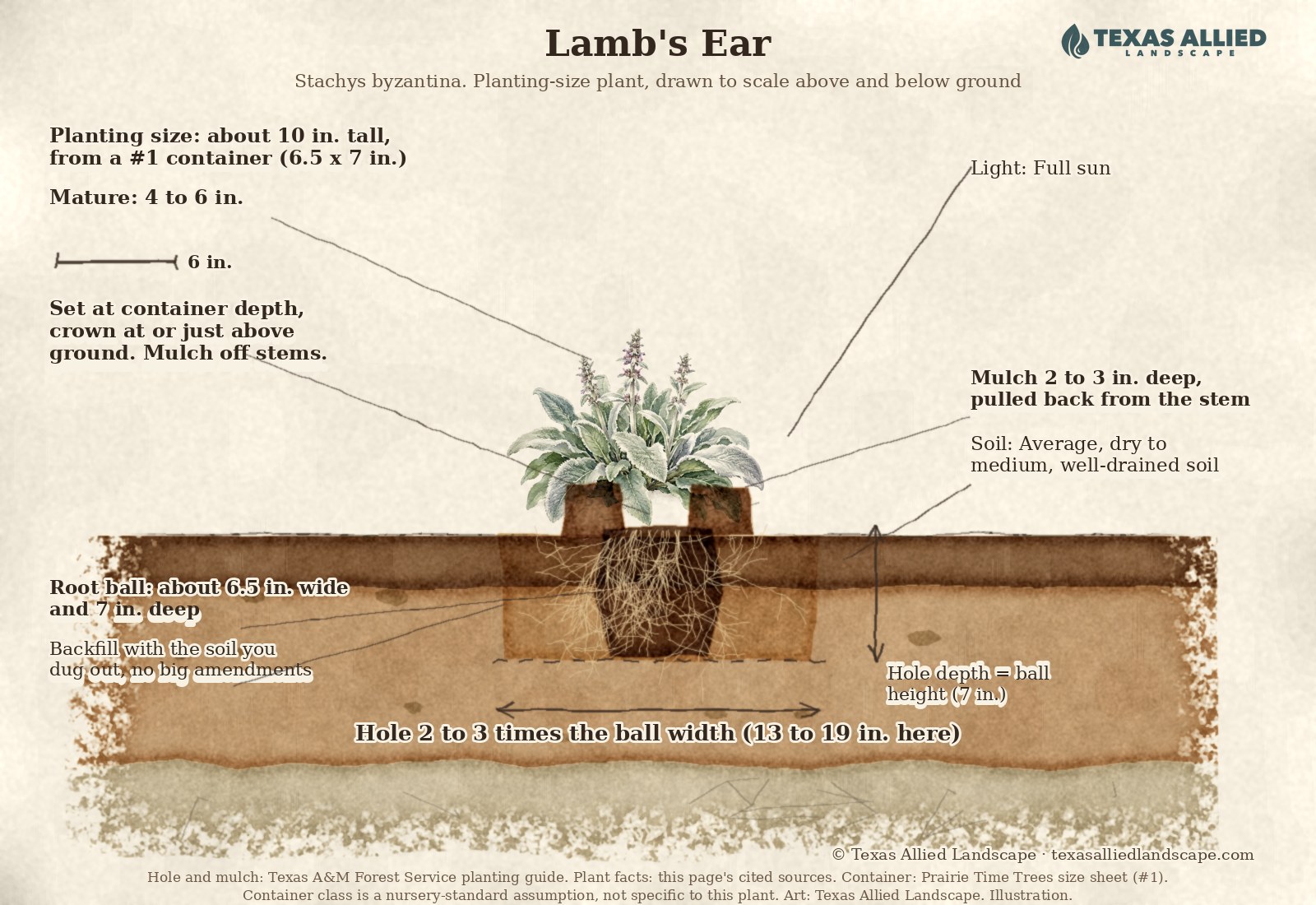
- Dig a hole twice as wide as the pot and no deeper, with sloping sides. Set the plant at the same depth it grew in its pot. Loosen any circling roots before backfilling.[3]
- For a new bed, clear grass and weeds first, roots and all.[3]
- Give it room. For a sunny, dry edge, yes. The silver rosettes spread into a soft mat kids love to touch.[4] Space plants for that full size, not the pot size.[3]
- Site: It wants full sun. Light afternoon shade is helpful in hot summer climates. Too much shade can inhibit leaf drying.[1]
- Timing: A fall planting establishes roots through the cool season and is ready to grow and bloom the following year. Spring planting works too if you water through the first summer.[2]
- Soak it well at planting and keep watering while the roots establish.[3] Once it is established, a fall planting is ready to grow and bloom the following year. Spring planting works too if you water through the first summer.[2]
- Mulch 2 to 4 inches, kept a few inches away from the stems to prevent crown rot. It needs no staking or other support.[3]
Should I remove all the flower stems from lambs ear?
That is your choice. Removing the flower stems keeps it foliage-only. Otherwise just remove damaged leaves as needed and divide crowded clumps.
Care Instructions for Your Lamb's Ear
How to Water a Lamb's Ear
It is generally drought tolerant. Avoid overwatering.
Sunlight
It wants full sun. Light afternoon shade is helpful in hot summer climates. Too much shade can inhibit leaf drying.[1]
Soil and drainage
It wants average, dry to medium, well-drained soil.
Mature height and spread
Henderson describes a 4 to 6 inch foliage mat, flower stems around 10 to 15 inches, and a broader 9 to 18 inch characteristics range. Henderson lists 12 to 18 inches, and spreading stems can extend the planting.
Pruning
Remove damaged leaves as needed. Removing flower stems is optional for a foliage-focused groundcover. Divide when necessary.
Normal seasonal behavior
It is evergreen in warm climates, but the foliage deteriorates in harsh winters. Humidity and wet foliage can cause summer decline. Creeping stems can spread aggressively.
Lamb's ear questions
Does lamb's ear grow in Texas?
Yes, with care. It rots in heat plus humidity plus wet soil, so give it morning sun, sharp drainage and light water.[5]
Why did my lamb's ear melt out in summer?
Heat and humidity rot the fuzzy leaves, especially with overhead watering. Plant it dry and airy, and expect it to thin in August.[6]
Is lamb's ear a good ground cover?
For a sunny, dry edge, yes. The silver rosettes spread into a soft mat kids love to touch.[4]
Should I cut off lamb's ear flowers?
That is your call. The purple spikes attract bees, but many gardeners cut them to keep the foliage show tidy.[7]
Next step: Our horticulturalists can keep it tidy and divide tired clumps.
Let Texas Allied Landscape care for your Lamb's Ear
Lamb's Ear does best with steady, knowledgeable care. That means the right water, pruning at the right time, and a trained eye for stress. The horticulturists at Texas Allied Landscape care for plants like yours across the San Antonio area. They are backed by over 40 years of landscape experience.
In these community guides

Illustration. Illustration based on reference photos of Johnson Ranch. Not a single literal view. Johnson Ranch Landscaping
Share your Johnson Ranch address, survey and yard ideas. Texas Allied Landscape can help plan planting, irrigation and…
Sources
- Lamb's Ear (Stachys byzantina), Texas Master Gardener Program - Texas A&M AgriLife Extension.https://txmg.org/hendersonmg/plant-library/lambs-ear/abc
- October Gardening Checklist, Travis County AgriLife Extension.https://travis-tx.tamu.edu/about-2/horticulture/monthly-gardening-calendar-for-austin-area/october-gardening-checklist-for-austin-and-central-texas/abc
- Back to basics: Planting perennials, Garden Style San Antonio (San Antonio Water System).https://www.gardenstylesanantonio.com/garden-articles/back-to-basics-planting-perennials/abcde
- Texas Tech Plant Resources, "Stachys byzantina."https://www.depts.ttu.edu/plantresources/Pages/directories/landscape-info-sheets/herbaceous-info/Stachys_byzantina.phpab
- Texas Master Gardeners, "Lamb's Ear."https://txmg.org/hendersonmg/plant-library/lambs-ear/↑
- NC State Extension, "Stachys byzantina."https://plants.ces.ncsu.edu/plants/stachys-byzantina/↑
- NC State Extension, "Stachys byzantina."https://plants.ces.ncsu.edu/plants/stachys-byzantina/↑