
Property owners
Lavender
- Plant
- Lavender
- Botanical name
- Lavandula
- Group
- Low shrubs and perennials
Plant profile for Lavender in San Antonio area landscapes.
On this page
Botanical name: Lavandula.
Plant group: Low shrubs and perennials.
Light
Full sun.[1]
Soil and drainage
Perfectly drained, preferably dry, neutral to alkaline soil; dislikes wet feet and dies out in heavy clay.[1]
Height
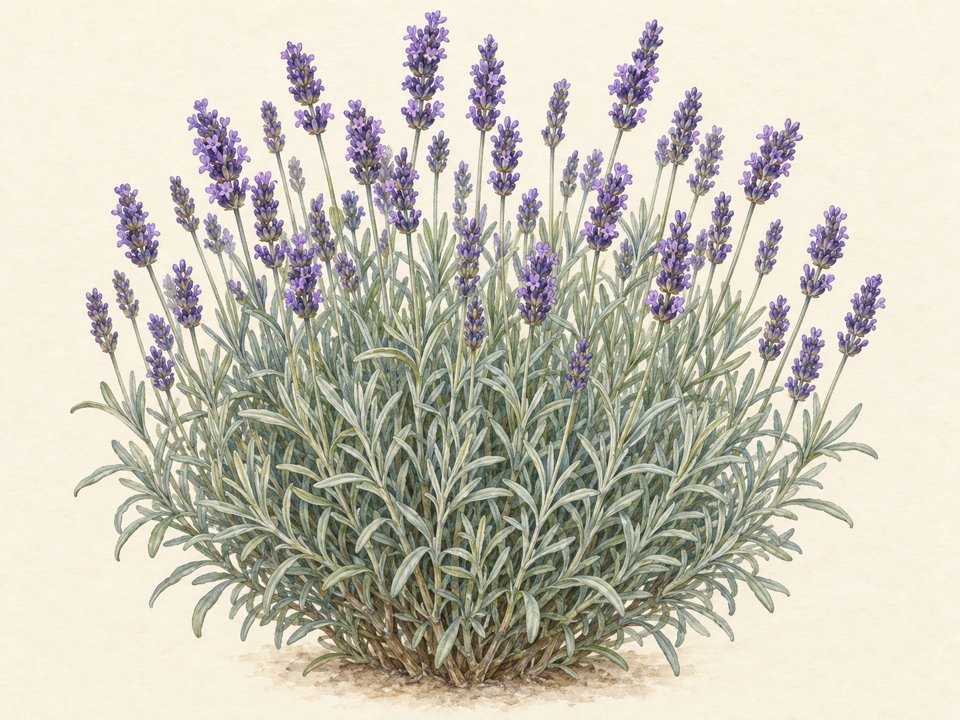
1 to 2 ft tall and 2 to 3 ft wide, a broadly mounded dwarf shrub.[1]
When to Plant Lavender
Plant lavender in spring; warm soil and sharp drainage give it the best start in Central Texas, where winter wet is the bigger risk than cold.[2]
If you would like a hand, the Texas Allied Landscape team can plant your lavender and keep it thriving.
Planting
- Dig a hole at least twice as wide as the root ball and no deeper, so the roots can grow out into the surrounding soil.[3]
- Fill the empty hole with water and check the drainage. If it takes longer than 24 hours to drain, choose another spot: roots sitting under water will kill the plant.[3]
- Set it with the root collar (where the stems meet the roots) level with the ground, and take off the container and any twine or bags before backfilling.[3]
- Backfill with the same soil that came out of the hole, without amendments, and settle it with water rather than packing it down.[3]
- Soil: Our limestone hills suit it; humidity and wet clay are what kill it.[2]
- Water regularly through the first growing season while roots establish, without overwatering: a thorough soaking beats light, frequent watering.[3] Once established: Plant it high, in gravelly soil, and water sparingly once established.[4]
- Mulch 2 to 3 inches deep, up to but not touching the stems. It needs no staking or other support. Do not fertilize during the first growing season.[3]
Care Instructions for Your Lavender
How to Water a Lavender
Growing in Central Texas
Yes, with the right variety and site - it wants blazing sun, lean alkaline soil and sharp drainage. Our limestone hills suit it; humidity and wet clay are what kill it.[2]
Pruning and mowing
Shear lightly after each bloom flush, and shape it in early spring - never cut into the old woody stems, which do not resprout.[5]
Pests, disease, and problems
Nine times out of ten it is wet feet - lavender rots fast in soil that stays moist. Plant it high, in gravelly soil, and water sparingly once established.[4]
Lavender questions
Can lavender grow in Central Texas?
Yes, with the right variety and site - it wants blazing sun, lean alkaline soil and sharp drainage. Our limestone hills suit it; humidity and wet clay are what kill it.[2]
Which lavender is best for Texas?
Spanish and French lavenders (L. stoechas, L. dentata) handle our heat and humidity better than English lavender. Ask for heat-tolerant varieties at the nursery.[6]
Why did my lavender die over summer?
Nine times out of ten it is wet feet - lavender rots fast in soil that stays moist. Plant it high, in gravelly soil, and water sparingly once established.[4]
Next step: Our horticulturalists can rebuild the bed with the drainage lavender demands.
When do I prune lavender?
Shear lightly after each bloom flush, and shape it in early spring - never cut into the old woody stems, which do not resprout.[5]
In these community guides
Sources
- Lavandula angustifolia (English Lavender), North Carolina Extension Gardener Plant Toolbox.https://plants.ces.ncsu.edu/plants/lavandula-angustifolia/abc
- Bell County Master Gardeners, "Lavender in Central Texas."https://txmg.org/bell/files/2010/03/Lavendar-in-Central-Texas-May2011.pdfabcd
- Planting, Texas A&M Forest Service.https://tfsweb.tamu.edu/trees/tree-care/planting/abcdef
- Richters Herbs, "Lavender in Pipe Creek, Texas."https://www.richters.com/questions-and-answers/05-20020130-1abc
- Backbone Valley Nursery, "Lavender Demystified."https://backbonevalleynursery.com/lavender-demystified/ab
- Backbone Valley Nursery, "Lavender Demystified."https://backbonevalleynursery.com/lavender-demystified/↑