
Property owners
Montezuma Cypress
- Plant
- Montezuma Cypress
- Botanical name
- Taxodium mucronatum
- Group
- Shade trees
Montezuma Cypress care: light, soil, water, mature size and cold exposure for Taxodium mucronatum.
On this page
Its botanical name is Taxodium mucronatum. NC State lists this plant under Taxodium distichum var. mexicanum and includes Taxodium mucronatum among its earlier names.[1][2]
Light and room to grow
It grows in sun to partial shade. Allow for a large tree. The NC State profile describes typical growth of 36 to 72 feet tall and 20 to 40 feet wide.[1]
Soil and water
The tree prefers moist, well-drained soil but tolerates a wide range of conditions, including flooding. Texas A&M's tree selector gives moderate water needs and lists tolerance of poorly drained sites. Drought tolerance does not mean a newly planted tree can be left without establishment care.[1][2]
Foliage and cold
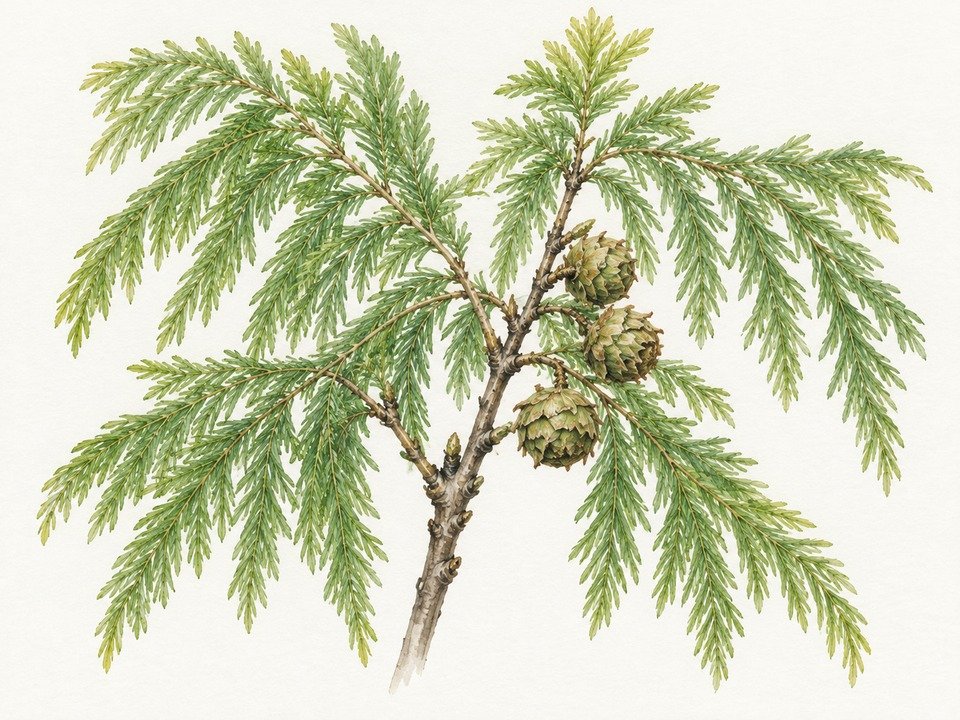
Texas A&M describes fine, feathery foliage. It notes that the tree becomes deciduous north of San Antonio. NC State warns of possible winter damage from Central Texas northward. Match the site to local cold exposure.[2][1]
Placement and upkeep
Give the trunk base and spreading crown room. The tree bears cones. Texas A&M notes some insect pests and fruit drop as maintenance considerations.[2]
When to Plant Montezuma Cypress
In the San Antonio area, October and November are the best months to plant trees and shrubs. Roots keep growing through our mild winters. So a fall-planted Montezuma Cypress is established before summer heat. Spring planting also works. Try to avoid planting in peak summer.[3]
If you would like a hand, the Texas Allied Landscape team can plant your Montezuma Cypress and keep it thriving.
Planting
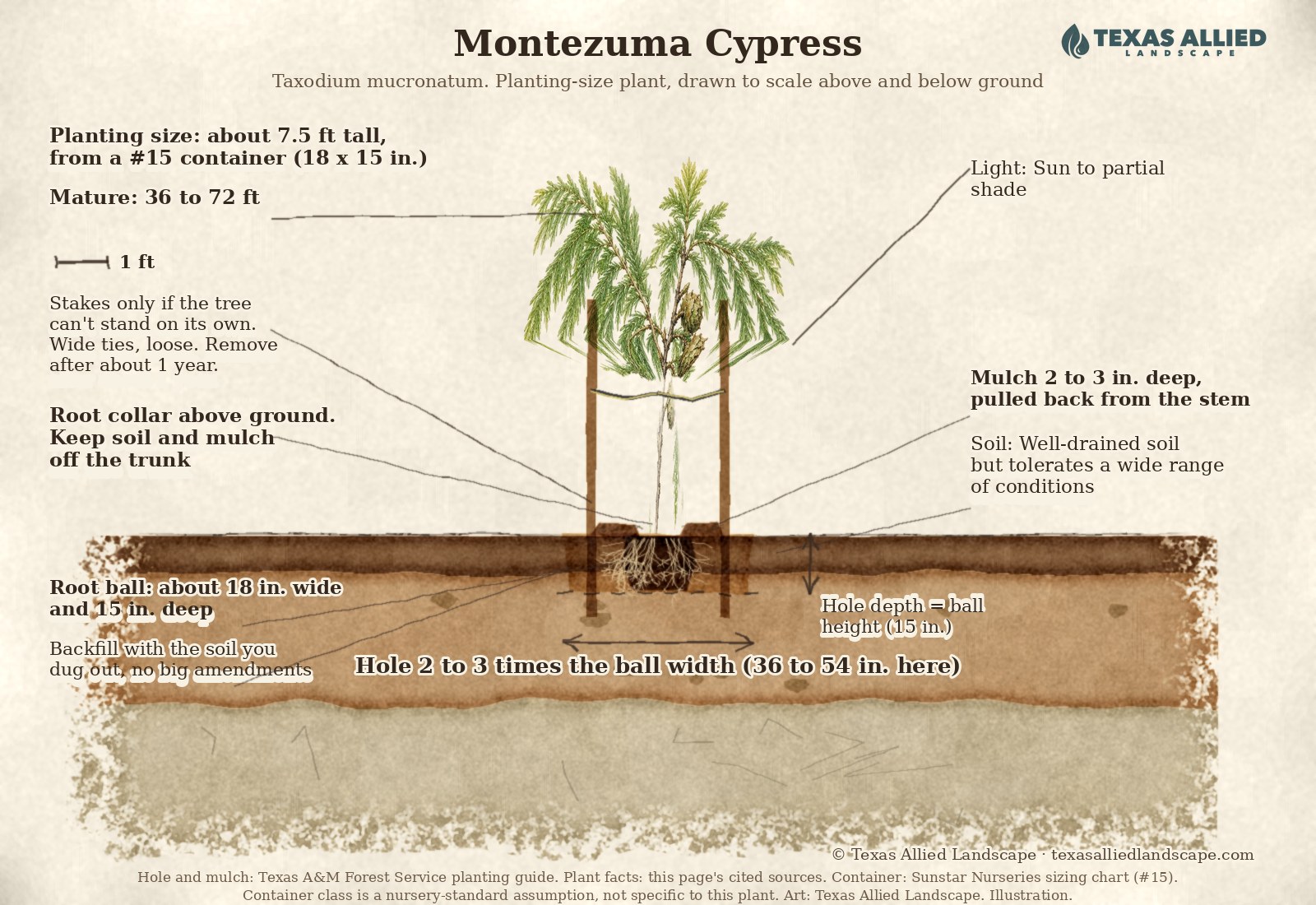
- Dig a hole at least twice as wide as the root ball and no deeper. A square hole keeps the roots from settling too deep. It also lets them grow out into the surrounding soil.[4]
- Fill the empty hole with water and check the drainage. If it takes longer than 24 hours to drain, choose another spot. Roots sitting under water will kill the tree.[4]
- Set the tree with the root collar (the flare just above the roots) level with or slightly above the ground. Carry it by the container or root ball, never the trunk. Take off all wire, twine, containers and bags before backfilling.[4]
- Backfill with the same soil that came out of the hole, without amendments. Settle it with water rather than packing it down.[4]
- Give it room: Allow for a large tree. The NC State profile describes typical growth of 36 to 72 feet tall and 20 to 40 feet wide.[1] Give the canopy and roots plenty of vertical and horizontal room.[4]
- Site: It grows in sun to partial shade. Allow for a large tree. The NC State profile describes typical growth of 36 to 72 feet tall and 20 to 40 feet wide.[1]
- Water it for at least the first two years. Do not overwater. A thorough soaking beats light, frequent watering.[4] Once established: Texas A&M's tree selector gives moderate water needs and lists tolerance of poorly drained sites. Drought tolerance does not mean a newly planted tree can be left without establishment care.[1][2]
- Mulch 2 to 3 inches deep, out to the drip line and up to but not touching the trunk. Stake it only if the tree cannot stand on its own. Take stakes off within a year. Most trees need no support. Do not fertilize during the first growing season.[4]
Care Instructions for Your Montezuma Cypress
How to Water a Montezuma Cypress
Watering
It is a river tree. Along the Guadalupe and other Hill Country rivers it drinks deeply. In a landscape, give it regular deep water, especially while young and in drought.[5]
Growth and size
Knees are rare in landscape settings. They show up mainly on trees standing in water or saturated soil. Montezuma produces fewer than bald cypress to begin with.[6]
Montezuma cypress questions
Is Montezuma cypress evergreen?
It is nearly evergreen in Central Texas. Unlike its bald cypress cousin, it holds most of its fine green foliage through mild winters. It browns and sheds lightly.[7]
How big does Montezuma cypress get?
It gets huge. It reaches 60-100 ft tall with a trunk that can span several feet across. It needs a big, open site. It is not a small-yard tree.[8]
How much water does a Montezuma cypress need?
It is a river tree. Along the Guadalupe and other Hill Country rivers it drinks deeply. In a landscape, give it regular deep water, especially while young and in drought.[5]
Does Montezuma cypress grow knees like bald cypress?
Knees are rare in landscape settings. They show up mainly on trees standing in water or saturated soil. Montezuma produces fewer than bald cypress to begin with.[6]
Next step: Not sure your site fits a tree this big? Our horticulturalists can assess the space and soil before you plant.
In these community guides
Sources
- NC State Extension: Taxodium distichum var. mexicanum .https://plants.ces.ncsu.edu/plants/taxodium-distichum-var-mexicanum/abcdefg
- Texas A&M Texas Tree Selector: Montezuma Baldcypress .https://texastreeplanting.tamu.edu/display_onetree.aspx?tid=96abcde
- SAWS, "Autumn is for planting trees."https://www.saws.org/autumn-is-for-planting-trees/↑
- Planting, Texas A&M Forest Service.https://tfsweb.tamu.edu/trees/tree-care/planting/abcdefg
- Lady Bird Johnson Wildflower Center, Mr. Smarty Plants, "Watering a Montezuma Cypress."https://www.wildflower.org/expert/show.php?frontpage=true&id=9590ab
- Texas A&M Forest Service, Trees of Texas, "Montezuma Baldcypress."https://texastreeid.tfs.tamu.edu/content/TreeDetails/?id=122ab
- Central Texas Gardener, "Montezuma Cypress."https://centraltexasgardener.org/resource/montezuma-cypress/↑
- City of Austin Grow Green plant guide, "Cypress, Montezuma."https://www.austintexas.gov/department/grow-green/plant-guide/cypress-montezuma↑