
Property owners
Nellie R. Stevens Holly
- Plant
- Nellie R. Stevens Holly
- Botanical name
- Ilex x 'Nellie R. Stevens'
- Cultivar
- 'Nellie R. Stevens'
- Group
- Medium shrubs and perennials
Nellie R. Stevens Holly care: light, drainage, mature size, winter pruning and berry production.
On this page
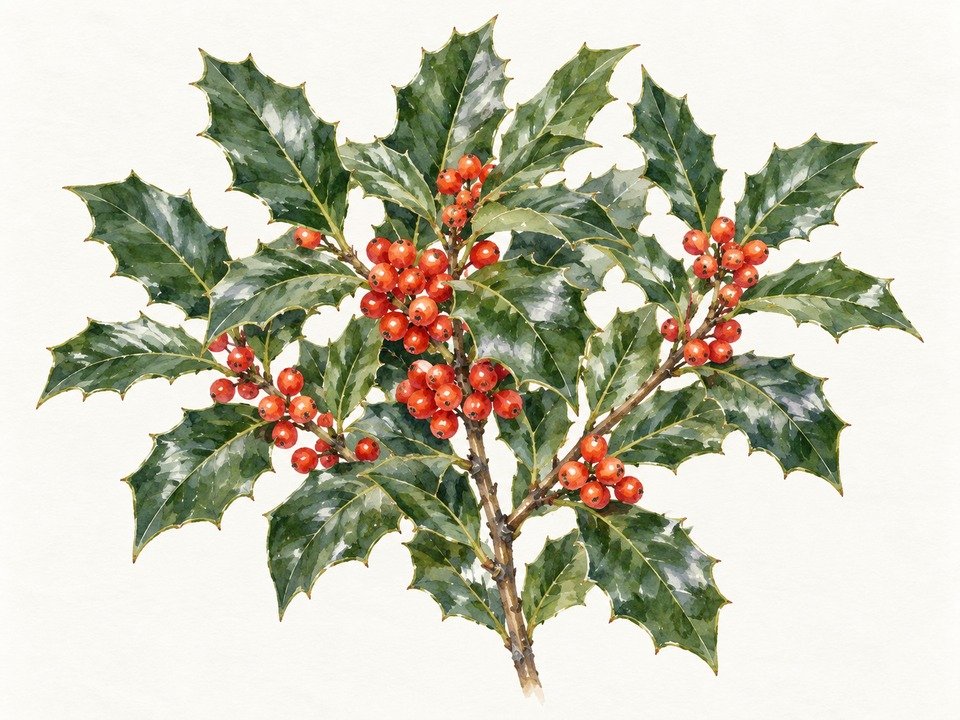
Botanical name: Ilex 'Nellie R. Stevens', a hybrid of Ilex aquifolium and Ilex cornuta. This evergreen holly is a large shrub or small tree, not a dwarf foundation plant.[1]
Light and soil
Full sun to partial shade, with some protection from strong afternoon sun where leaf scorch is a concern. Rich, acidic, well-drained soil is preferred. It tolerates several soil types, including heavy clay, but avoid wet sites.[1]
Size and spacing
Allow about 15 to 30 feet of height and 8 to 25 feet of width at maturity. Its dense, prickly foliage suits a screen or barrier where there is enough room.[1]
Water and heat
The source describes better heat and drought tolerance than many other hollies. Good drainage remains important; do not place it where irrigation leaves the root zone wet.[1]
Pruning and berries
Prune to shape in winter. Lower branches can be removed to train it as a small tree. This female cultivar can bear some fruit without a male pollinizer; compatible male hollies can improve fruiting. Spring flowers attract pollinators and the red fruits attract birds.[1]
When to Plant Nellie R. Stevens Holly
In the San Antonio area, October and November are the best months to plant trees and shrubs: roots keep growing through our mild winters, so a fall-planted Nellie R. Stevens Holly is established before summer heat. Spring planting also works; try to avoid planting in peak summer.[2]
If you would like a hand, the Texas Allied Landscape team can plant your Nellie R. Stevens Holly and keep it thriving.
Planting
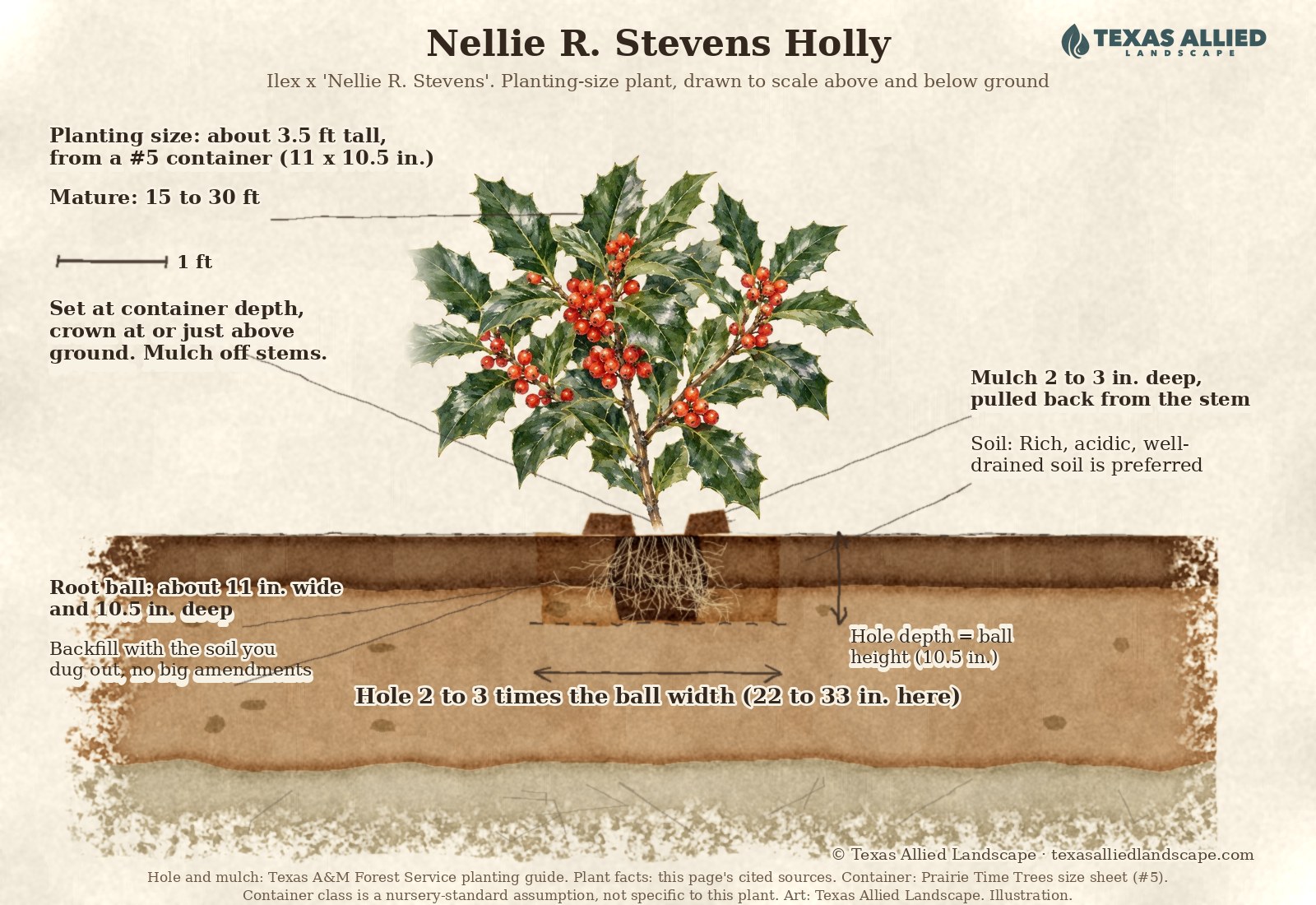
- Dig a hole at least twice as wide as the root ball and no deeper, so the roots can grow out into the surrounding soil.[3]
- Fill the empty hole with water and check the drainage. If it takes longer than 24 hours to drain, choose another spot: roots sitting under water will kill the plant.[3]
- Set it with the root collar (where the stems meet the roots) level with the ground, and take off the container and any twine or bags before backfilling.[3]
- Backfill with the same soil that came out of the hole, without amendments, and settle it with water rather than packing it down.[3]
- Give it room: Big - plan on 15-25 ft tall and 8-12 ft wide at maturity, though it takes shearing well. Give it room or commit to regular pruning.[4] Space plants so they can reach that size without crowding.
- Soil: Rich, acidic, well-drained soil is preferred. It tolerates several soil types, including heavy clay, but avoid wet sites.[1]
- Water regularly through the first growing season while roots establish, without overwatering: a thorough soaking beats light, frequent watering.[3]
- Mulch 2 to 3 inches deep, up to but not touching the stems. It needs no staking or other support. Do not fertilize during the first growing season.[3]
Care Instructions for Your Nellie R. Stevens Holly
How to Water a Nellie R. Stevens Holly
Sunlight and soil
Full sun to partial shade, with some protection from strong afternoon sun where leaf scorch is a concern. Rich, acidic, well-drained soil is preferred. It tolerates several soil types, including heavy clay, but avoid wet sites.[1]
Nellie R. Stevens holly questions
How big does a Nellie R. Stevens holly get?
Big - plan on 15-25 ft tall and 8-12 ft wide at maturity, though it takes shearing well. Give it room or commit to regular pruning.[4]
Is Nellie R. Stevens good for a privacy screen?
It is the classic Texas screening holly - dense, evergreen, fast-growing, and tolerant of shearing into a solid wall. Space plants about 6-8 ft apart for a screen.[5]
Do Nellie R. Stevens roots damage pipes or foundations?
Holly roots are fibrous and not the aggressive type that invades sound pipes, but with any large shrub, keep it several feet from foundations and utility lines.[6]
Does Nellie R. Stevens holly need a pollinator for berries?
No - it is parthenocarpic, setting its heavy crop of red berries without a male pollinator nearby.[7]
Next step: Our horticulturalists can shape and feed your hollies on a schedule so the screen fills in fast and stays dense.
In these community guides
Sources
- NC State Extension: Ilex 'Nellie R. Stevens' .https://plants.ces.ncsu.edu/plants/ilex-nellie-r-stevens/abcdefg
- SAWS, "Autumn is for planting trees."https://www.saws.org/autumn-is-for-planting-trees/↑
- Planting, Texas A&M Forest Service.https://tfsweb.tamu.edu/trees/tree-care/planting/abcdef
- Neil Sperry's GARDENS, "Featured Plant: Nellie R. Stevens Holly."https://neilsperry.com/2024/12/featured-plant-nellie-r-stevens-holly-2/ab
- Neil Sperry's GARDENS, "Best of the Tall Screening Shrubs."https://neilsperry.com/2010/12/best-of-the-tall-screening-shrubs/↑
- Ask Extension, "Nellie Stevens Holly Root Depth."https://ask.extension.org/kb/faq.php?id=813336↑
- Texas Tech Plant Database, "Nellie R. Stevens Holly."https://www.depts.ttu.edu/plantresources/Pages/directories/landscape-info-sheets/woody-info/Ilex_xNellieRStevens.php↑