
Property owners
Osage Orange
- Plant
- Osage Orange
- Botanical name
- Maclura pomifera
- Group
- Shade trees
Osage Orange (Maclura pomifera) is a fast-growing, tough shade tree for full sun.
On this page
Its botanical name is Maclura pomifera. It belongs to the shade trees group.
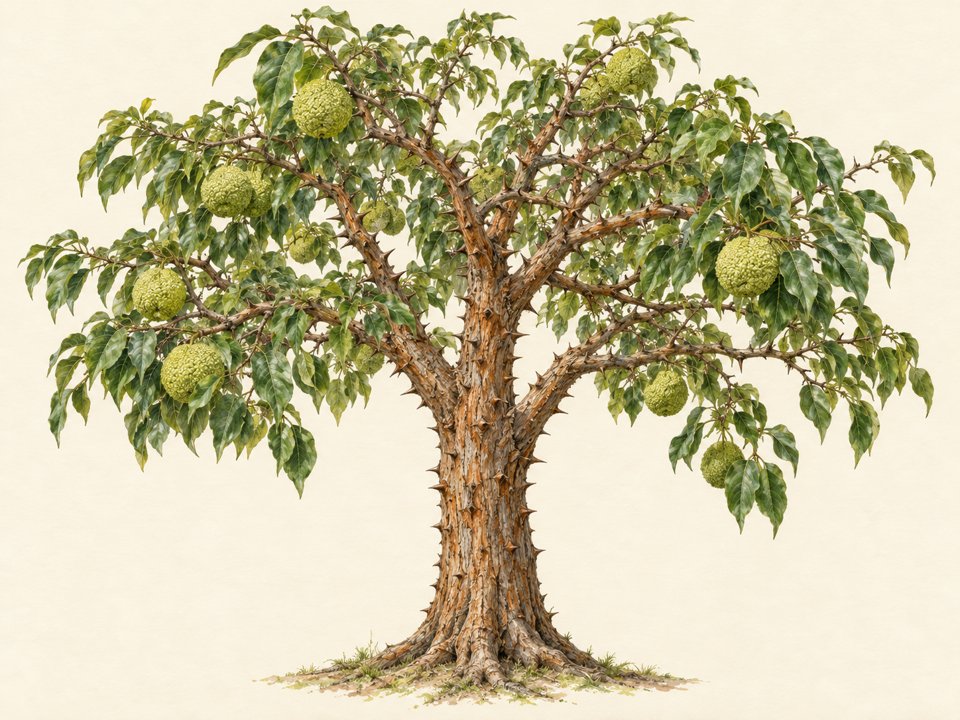
Osage Orange is a fast-growing deciduous tree with thorny branches and large, wrinkled green fruit. It grows in full sun. It tolerates a wide range of soils, including dry and poor sites.[1]
Light
Full sun.[2]
Soil and drainage
Tolerates a wide range of soils, including poor and wet soils; drought tolerant once established.[2]
Height
Typically 25 to 60 ft tall, occasionally to 70 ft.[2]
When to Plant Osage Orange
In Central Texas, the best time to plant Osage Orange is fall through late winter. That is roughly October through February. Cooler weather and fall rains let the roots establish before summer heat arrives.[3]
Container-grown trees can also go in the ground in spring. They can even go in during summer if you can commit to deep, regular watering through the first growing season. Spring and summer planting demand more from you and the tree.
If you would like a hand, the Texas Allied Landscape team can plant your Osage Orange and keep it thriving.
Planting
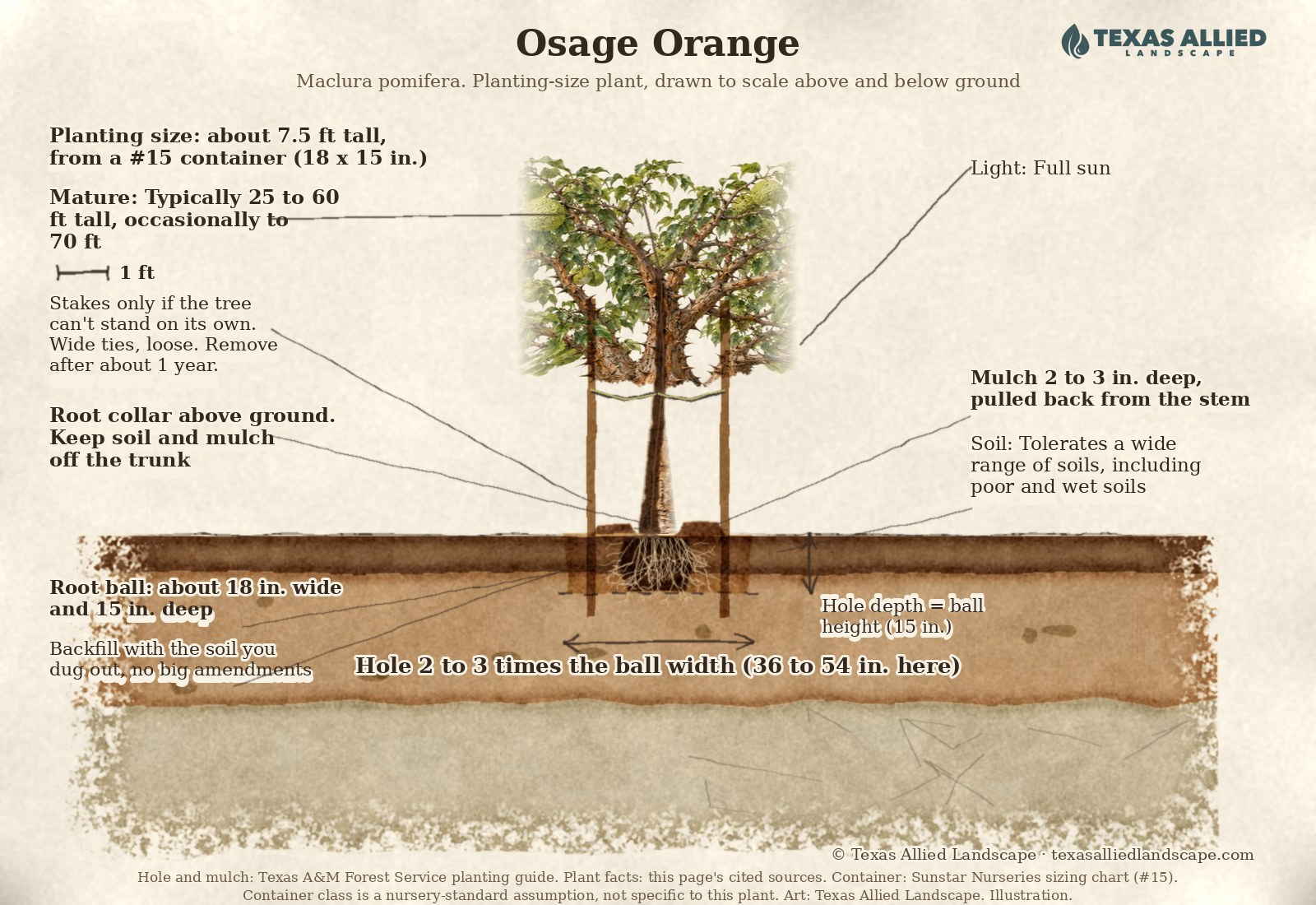
- Dig a hole at least twice as wide as the root ball and no deeper. A square hole keeps the roots from settling too deep. It also lets them grow out into the surrounding soil.[4]
- Fill the empty hole with water and check the drainage. If it takes longer than 24 hours to drain, choose another spot. Roots sitting under water will kill the tree.[4]
- Set the tree with the root collar (the flare just above the roots) level with or slightly above the ground. Carry it by the container or root ball, never the trunk. Take off all wire, twine, containers and bags before backfilling.[4]
- Backfill with the same soil that came out of the hole, without amendments. Settle it with water rather than packing it down.[4]
- For the site, its botanical name is Maclura pomifera and it belongs to the shade trees group. Osage Orange is a fast-growing deciduous tree with thorny branches and large, wrinkled green fruit. It grows in full sun. It tolerates a wide range of soils, including dry and poor sites.[1]
- For timing, the best time to plant Osage Orange is fall through late winter, roughly October through February. Cooler weather and fall rains let the roots establish before summer heat arrives.[3]
- Water for at least the first two years, without overwatering. A thorough soaking beats light, frequent watering.[4]
- Mulch 2 to 3 inches deep, out to the drip line and up to but not touching the trunk. Stake only if the tree cannot stand on its own. Take stakes off within a year. Most trees need no support. Do not fertilize during the first growing season.[4]
Care Instructions for Your Osage Orange
How to Water an Osage Orange
Growing in Central Texas
Yes. Its original range centers on the Red River country of northeast Texas, long before it was planted nationwide as hedge rows.[5]
Pests, disease, and problems
It is one of the hardest, most rot-resistant woods in North America. It is the classic bow wood of Native archers, which is why it is called bois d'arc, or "bow wood." It also makes fence posts that outlive the fence.[6]
Fruit and flowers
The old claim is folklore. Studies found no real repellent effect. The fruits are mostly a heavy, messy drop that nothing much eats.[7]
Osage orange questions
Is osage orange native to Texas?
Yes. Its original range centers on the Red River country of northeast Texas, long before it was planted nationwide as hedge rows.[5]
What is bois d'arc wood used for?
It is one of the hardest, most rot-resistant woods in North America. It is the classic bow wood of Native archers, which is why it is called bois d'arc, or "bow wood." It also makes fence posts that outlive the fence.[6]
Do the green "hedge apples" repel bugs?
The old claim is folklore. Studies found no real repellent effect. The fruits are mostly a heavy, messy drop that nothing much eats.[7]
Does osage orange have thorns?
Yes. It has fierce thorns in the branch axils, which is why it made living fences before barbed wire. Modern thornless, fruitless male cultivars exist for landscapes.[8]
Next step: Our horticulturalists can help you decide whether an old bois d'arc is a keeper or a hazard.
Let Texas Allied Landscape care for your Osage Orange
Osage Orange does best with steady, knowledgeable care. That means the right water, pruning at the right time, and a trained eye for stress. The horticulturists at Texas Allied Landscape care for plants like yours across the San Antonio area. They bring over 40 years of landscape experience.
In these community guides
Sources
- Lady Bird Johnson Wildflower Center, "Maclura pomifera"https://www.wildflower.org/plants/result.php?id_plant=MAPOab
- Maclura pomifera (Osage Orange), North Carolina Extension Gardener Plant Toolbox.https://plants.ces.ncsu.edu/plants/maclura-pomifera/abc
- October Gardening Checklist, Travis County AgriLife Extension.https://travis-tx.tamu.edu/about-2/horticulture/monthly-gardening-calendar-for-austin-area/october-gardening-checklist-for-austin-and-central-texas/ab
- Planting, Texas A&M Forest Service.https://tfsweb.tamu.edu/trees/tree-care/planting/abcdef
- Lady Bird Johnson Wildflower Center, Mr. Smarty Plants, "Native range of Osage orange."https://www.wildflower.org/expert/show.php?id=8427ab
- Texas A&M Forest Service, Trees of Texas, "Osage-Orange."https://texastreeid.tfs.tamu.edu/content/TreeDetails/?id=61ab
- Texas A&M Plants of Texas Rangelands, "Bois d'arc, Osage orange."https://rangeplants.tamu.edu/plant/bois-darc-osage-orange/ab
- Texas A&M Forest Service, Trees of Texas, "Osage-Orange."https://texastreeid.tfs.tamu.edu/content/TreeDetails/?id=61↑