
Property owners
Pineapple Guava
- Plant
- Pineapple Guava
- Botanical name
- Acca sellowiana
- Group
- Large shrubs
Pineapple Guava (Acca sellowiana): light, water, soil, size and care for San Antonio area landscapes.
On this page
Its botanical name is Acca sellowiana.
Light
It benefits from protection from late-day sun in Central Texas summers.[1]
Foliage
It is an evergreen shrub, native to subtropical higher-elevation South America.
Water
It is well-adapted but can struggle in extreme Texas summer heat. Water it regularly during the hottest months. If watering ever feels like a guessing game, our horticulturists can care for your Pineapple Guava on a schedule that fits your yard.
Seasonal behavior
It is evergreen. It may struggle in extreme summer heat, so plan water and afternoon protection accordingly.
Soil and drainage
Consistent soil moisture matters for quality fruit; water deeply.[2]
Height
10 to 15 ft tall and wide in warm climates; often 5 to 6 ft where winters are cool.[2]
When to Plant Pineapple Guava
Fall, October through November, and late winter into early spring are the best times to plant Pineapple Guava in Central Texas. Cooler months give the roots time to establish before summer heat.[3]
Container-grown shrubs can go in at other times if you keep up with watering. Avoid planting in the peak of summer.
If you would like a hand, the Texas Allied Landscape team can plant your Pineapple Guava and keep it thriving.
Planting
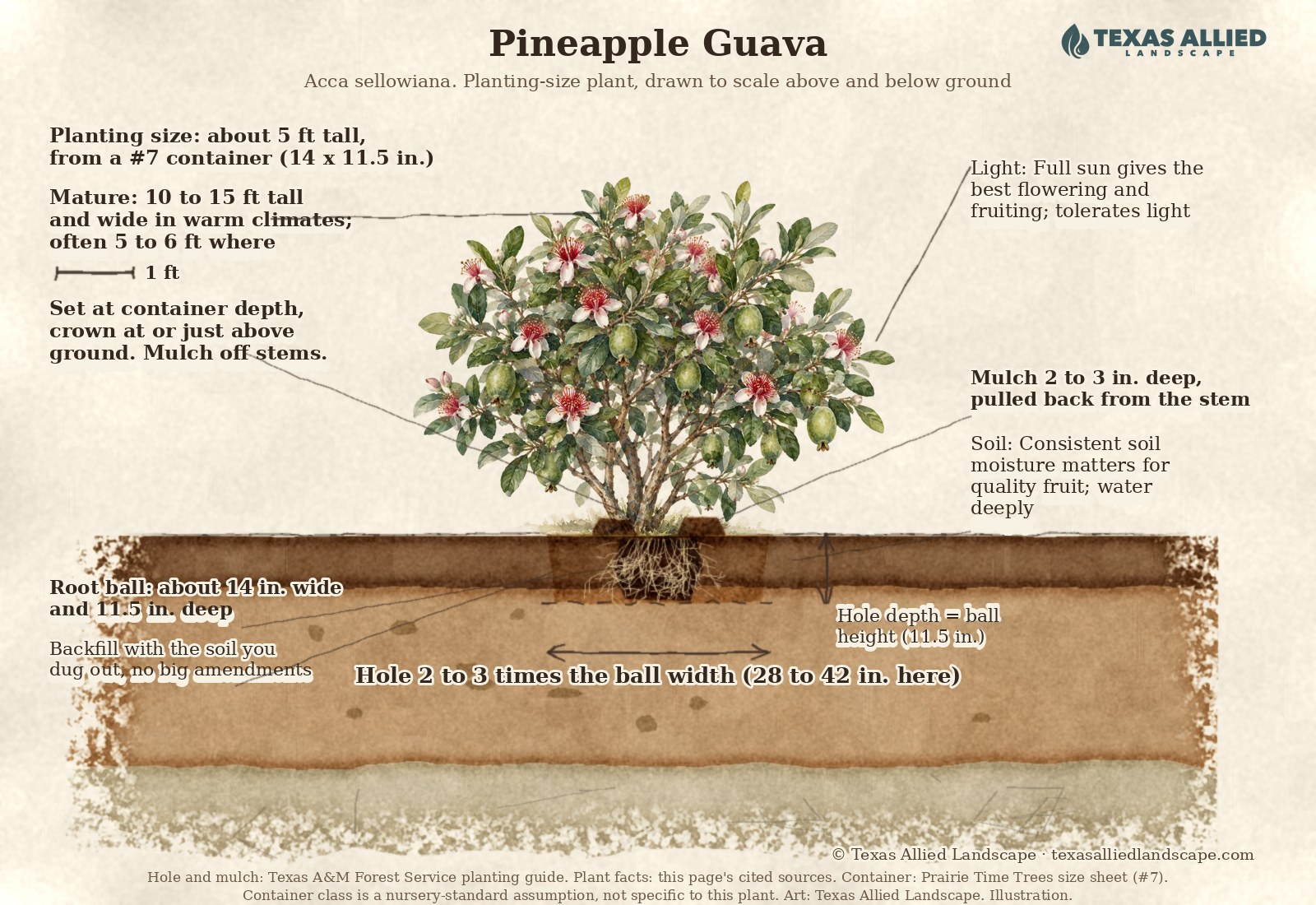
- Dig a hole at least twice as wide as the root ball and no deeper. This lets the roots grow out into the surrounding soil.[4]
- Fill the empty hole with water and check the drainage. If it takes longer than 24 hours to drain, choose another spot. Roots sitting under water will kill the plant.[4]
- Set it with the root collar (where the stems meet the roots) level with the ground. Take off the container and any twine or bags before backfilling.[4]
- Backfill with the same soil that came out of the hole, without amendments. Settle it with water rather than packing it down.[4]
- For timing, fall, October through November, and late winter into early spring are the best times to plant Pineapple Guava in Central Texas.
- Water regularly through the first growing season while the roots establish, without overwatering. A thorough soaking beats light, frequent watering.[4]
- Mulch 2 to 3 inches deep, up to but not touching the stems. It needs no staking or other support. Do not fertilize during the first growing season.[4]
Why does my pineapple guava look stressed in August?
It can struggle in extreme Texas summer heat. Regular water in the hottest months and protection from late-day sun help.
Care Instructions for Your Pineapple Guava
How to Water a Pineapple Guava
It is well-adapted but can struggle in extreme Texas summer heat. Water it regularly during the hottest months.
Sunlight
It benefits from protection from late-day sun in Central Texas summers.[1]
Normal seasonal behavior
It is evergreen. It may struggle in extreme summer heat, so plan water and afternoon protection accordingly.
Pineapple guava questions
Does pineapple guava fruit in Central Texas?
Yes. It is one of the most reliable fruiting plants here. It ripens green oval fruit in fall.[5]
Is pineapple guava cold hardy?
Very. It handles our winters without protection, which is rare for a fruiting plant.[6]
Can I use pineapple guava as a landscape shrub?
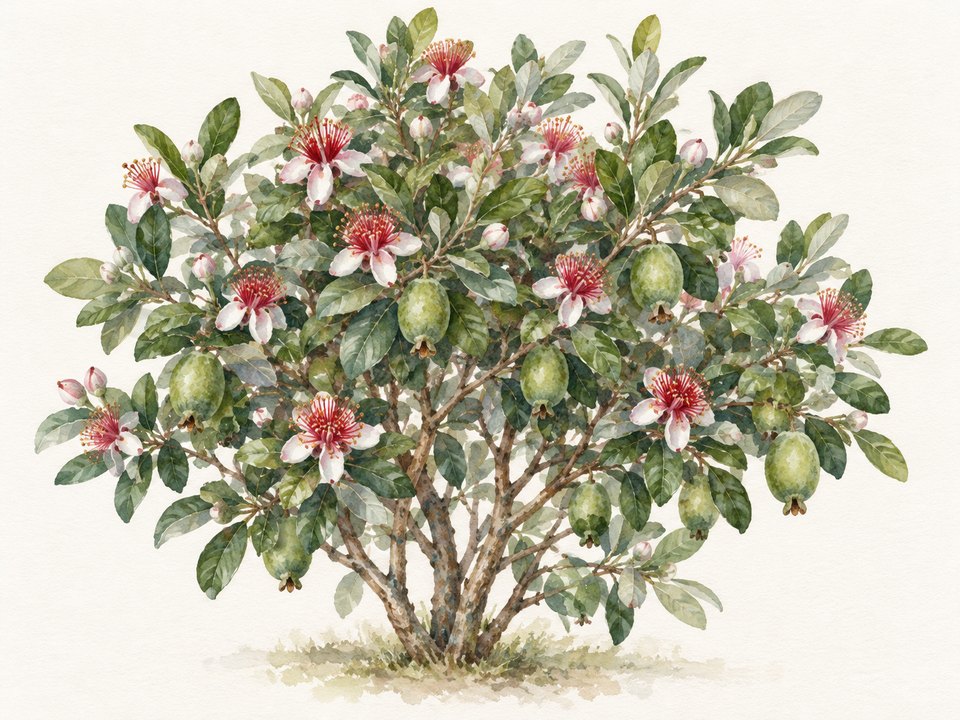
Absolutely. It has gray-green evergreen foliage and showy edible flowers. It shears into a hedge that happens to fruit.[7]
How big does pineapple guava get?
It reaches 10-15 feet unpruned and is easily kept smaller. It takes shearing well.[8]
Next step: Our horticulturalists can shape it as a fruiting screen.
Let Texas Allied Landscape care for your Pineapple Guava
Pineapple Guava does best with steady, knowledgeable care. That means the right water, pruning at the right time, and a trained eye for stress. The horticulturists at Texas Allied Landscape care for plants like yours across the San Antonio area. They bring over 40 years of landscape experience.
In these community guides

Illustration. Illustration based on reference photos of Johnson Ranch. Not a single literal view. Johnson Ranch Landscaping
Share your Johnson Ranch address, survey and yard ideas. Texas Allied Landscape can help plan planting, irrigation and…
Sources
- Pineapple Guava (Acca sellowiana), Central Texas Gardener.https://centraltexasgardener.org/resource/pineapple-guava/ab
- Acca sellowiana (Pineapple Guava), North Carolina Extension Gardener Plant Toolbox.https://plants.ces.ncsu.edu/plants/acca-sellowiana/ab
- October Gardening Checklist, Travis County AgriLife Extension.https://travis-tx.tamu.edu/about-2/horticulture/monthly-gardening-calendar-for-austin-area/october-gardening-checklist-for-austin-and-central-texas/↑
- Tree Care: Planting, Texas A&M Forest Service.https://tfsweb.tamu.edu/trees/tree-care/planting/abcdef
- Central Texas Gardener, "Pineapple Guava."https://centraltexasgardener.org/resource/pineapple-guava/↑
- University of Florida IFAS, "Pineapple Guava."https://gardeningsolutions.ifas.ufl.edu/plants/edibles/fruits/pineapple-guava/↑
- Phil McBride Landscaping, "Acca sellowiana."https://philmcbridelandscaping.com/plants/acca-sellowiana-syn-feijoa-sellowiana.html↑
- University of Florida IFAS, "Pineapple Guava."https://gardeningsolutions.ifas.ufl.edu/plants/edibles/fruits/pineapple-guava/↑