
Property owners
Plumbago (Blue)
- Plant
- Plumbago (Blue)
- Botanical name
- Plumbago auriculata
- Group
- Low shrubs and perennials
Plumbago (Blue) (Plumbago auriculata): light, water, soil, size and care for San Antonio area landscapes.
On this page
Botanical name: Plumbago auriculata.
Light
Soil and drainage
Adaptable with good drainage (another source describes it as disease, pest and deer resistant and unfussy).
Height
3 to 4 ft.
Spread
Up to 5 ft; another source lists 4-6 ft.
Foliage
Semi-evergreen in warm winters; drops leaves in extreme freezes; often freezes back to the ground.
Water
Sources differ: Low water; another source lists Medium - preserved as source disagreement. If watering ever feels like a guessing game, our horticulturists can care for your Plumbago (Blue) on a schedule that fits your yard.
Pruning
Prune spent flowers to encourage re-blooming and maintain shape; cut back freely or hedge - it often freezes back anyway.
Seasonal behavior
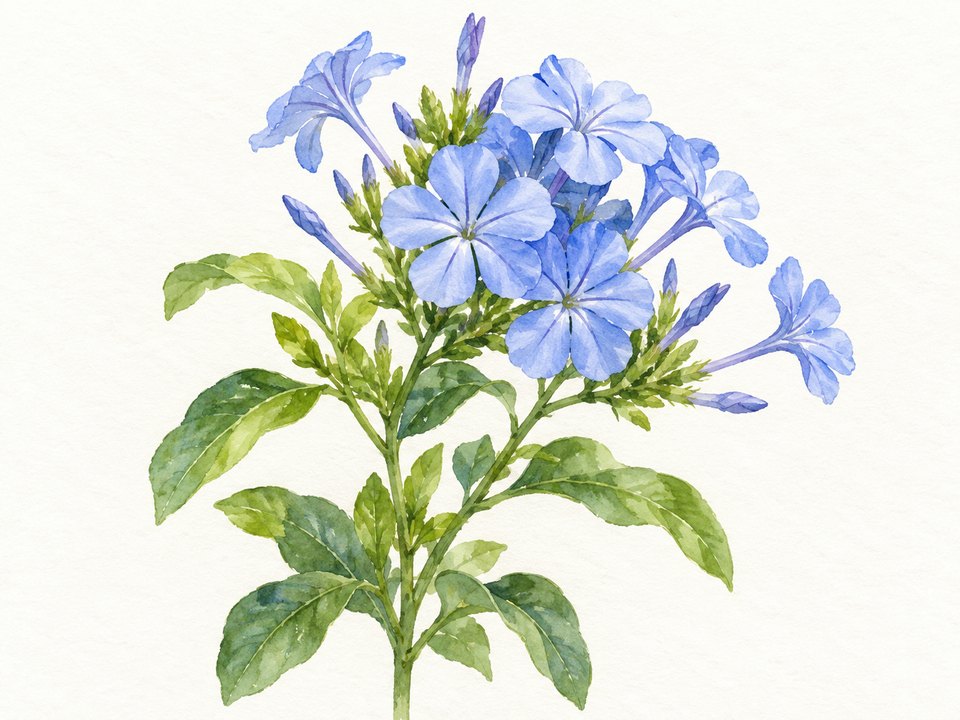
Blue (or white) flower clusters May until frost; butterfly plant.
When to Plant Plumbago (Blue)
Plumbago (Blue) is frost-tender in San Antonio, so plant it in spring after the last frost, usually around mid-March. Spring planting gives it a full growing season to establish before its first winter.
Even established plants can be damaged by hard freezes.
If you would like a hand, the Texas Allied Landscape team can plant your Plumbago (Blue) and keep it thriving.
Planting
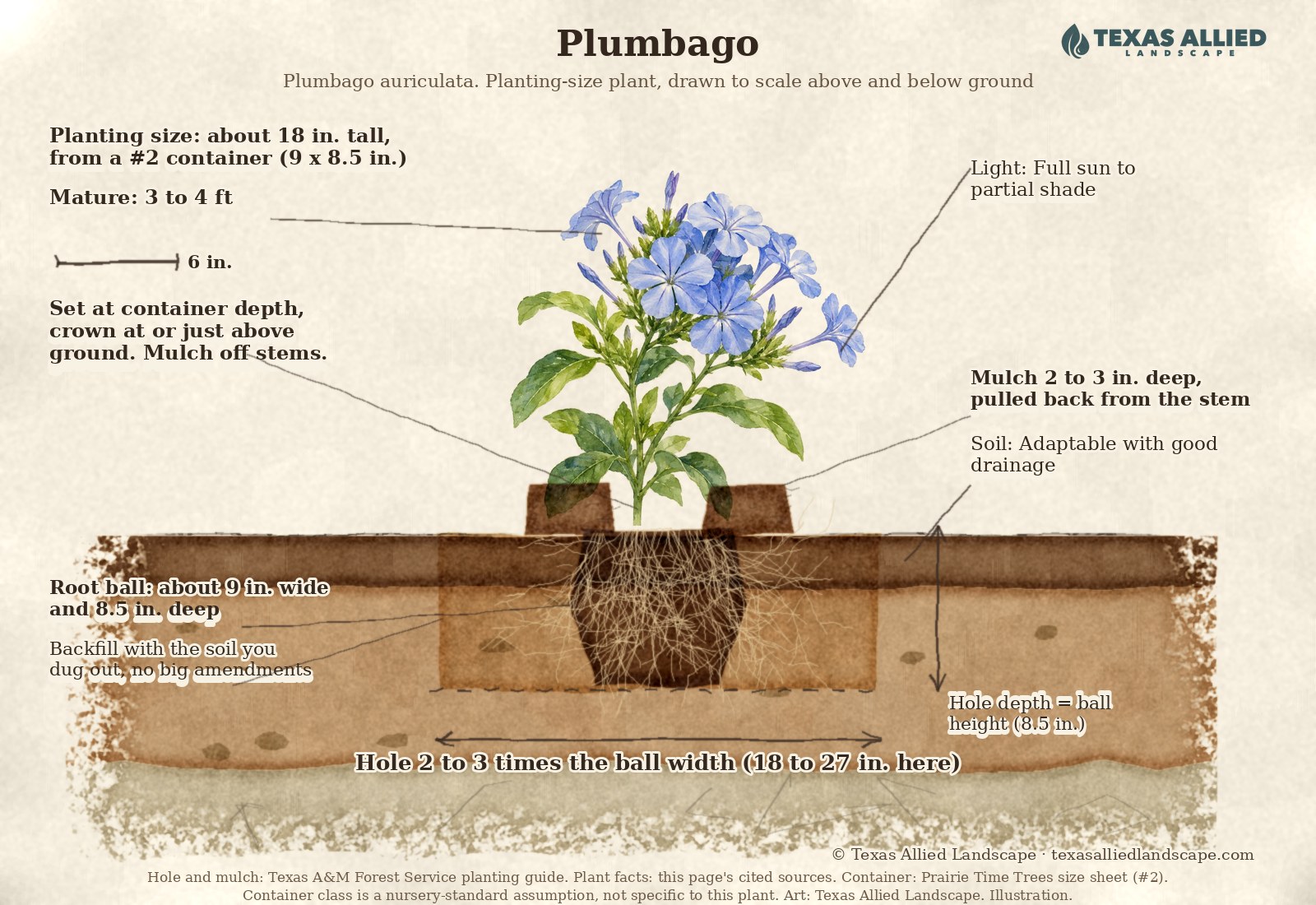
- Dig a hole twice as wide as the pot and no deeper, with sloping sides, and set the plant at the same depth it grew in its pot. Loosen any circling roots before backfilling.[4]
- For a new bed, clear grass and weeds first, roots and all.[4]
- Site: Full sun to partial shade.[1][2][3]
- Timing: Plumbago (Blue) is frost-tender in San Antonio, so plant it in spring after the last frost, usually around mid-March.
- Soak it well at planting and keep watering while the roots establish.[4]
- Mulch 2 to 4 inches, kept a few inches away from the stems to prevent crown rot. It needs no staking or other support.[4]
Did my plumbago die in the freeze?
Plumbago often freezes back to the ground but is root-hardy - cut it back freely and it returns in spring. Dieback alone does not mean it is dead.
Care Instructions for Your Plumbago (Blue)
How to Water a Plumbago (Blue)
Sources differ: Low water; another source lists Medium - preserved as source disagreement.
Sunlight
Full sun to partial shade.[1][2][3]
Soil and drainage
Adaptable with good drainage (another source describes it as disease, pest and deer resistant and unfussy).
Mature height and spread
3 to 4 ft. Up to 5 ft; another source lists 4-6 ft.
Pruning
Prune spent flowers to encourage re-blooming and maintain shape; cut back freely or hedge - it often freezes back anyway.
Normal seasonal behavior
Blue (or white) flower clusters May until frost; butterfly plant.
Plumbago questions
Will plumbago come back after a freeze?
In most of Central Texas, yes: tops freeze back in a cold winter but roots survive and resprout in spring. South of San Antonio it may stay evergreen. Mulch the crown in late fall for insurance.[5]
When do I cut back plumbago?
Cut frozen stems to the ground in late winter once hard freezes are past. Through the growing season, a light trim keeps it mounded; left alone it sprawls and climbs into neighbors.[6]
Next step: Our horticulturalists can keep plumbago shaped on a regular maintenance visit so it never takes over the bed.
Why are my plumbago's leaves turning yellow?
Usually cold damage or overwatering - plumbago wants good drainage and sulks in soggy soil. Check that sprinklers are not hitting it daily; it needs less water than the shrubs around it.[7]
Does plumbago grow in shade?
Part shade is fine and it still blooms, though heaviest flowering is in sun to bright shade. It is one of the better bloomers for the east and north sides of a house.[8]
Let Texas Allied Landscape care for your Plumbago (Blue)
Plumbago (Blue) does best with steady, knowledgeable care: the right water, pruning at the right time, and a trained eye for stress. The horticulturists at Texas Allied Landscape care for plants like yours across the San Antonio area, backed by over 40 years of landscape experience.
In these community guides
Illustration. Illustration based on reference photos of Shavano Rogers Ranch - Crosstimber. Not a single literal view. Crosstimber Landscaping
Plan your Crosstimber plants, shade and irrigation. Get help matching your lot rules, preparing the review package and…
Sources
- Cape Plumbago (Plumbago auriculata), Texas Superstar® Plants - Texas A&M AgriLife.https://texassuperstar.com/cape-plumbago/abc
- Plumbago, San Antonio Water System - Garden Style San Antonio.https://www.gardenstylesanantonio.com/plants/plumbago/abc
- Plumbago, City of Austin Watershed Protection - Grow Green.https://www.austintexas.gov/watershed-protection/plant-guide/plumbagoabc
- Back to basics: Planting perennials, SAWS Garden Style San Antonio.https://www.gardenstylesanantonio.com/garden-articles/back-to-basics-planting-perennials/abcd
- Central Texas Gardener, "Plumbago."https://centraltexasgardener.org/resource/plumbago/↑
- Randy Lemmon, "Plumbago (Blue Plumbago)."https://randylemmon.com/plant-profiles/plumbago-blue-plumbago/↑
- West Texas Gardening, "Growing Plumbago."https://www.westtexasgardening.org/post/growing-plumbago↑
- Central Texas Gardener, "Plumbago."https://centraltexasgardener.org/resource/plumbago/↑