
Property owners
Post Oak
- Plant
- Post Oak
- Botanical name
- Quercus stellata
- Group
- Shade trees
Post Oak: Full sun.[^po-npsot]
On this page
Botanical name: Quercus stellata.
Plant group: Shade trees.
Light
Full sun.[1]
Soil and drainage
Dry, rocky, sandy or thin upland soil - it is the tough oak of our poorest ground and hates soggy roots.[2]
Height
30-50 feet, slow growing.[3]
Spread
30-40 feet with a broad, rounded crown.[3]
Foliage
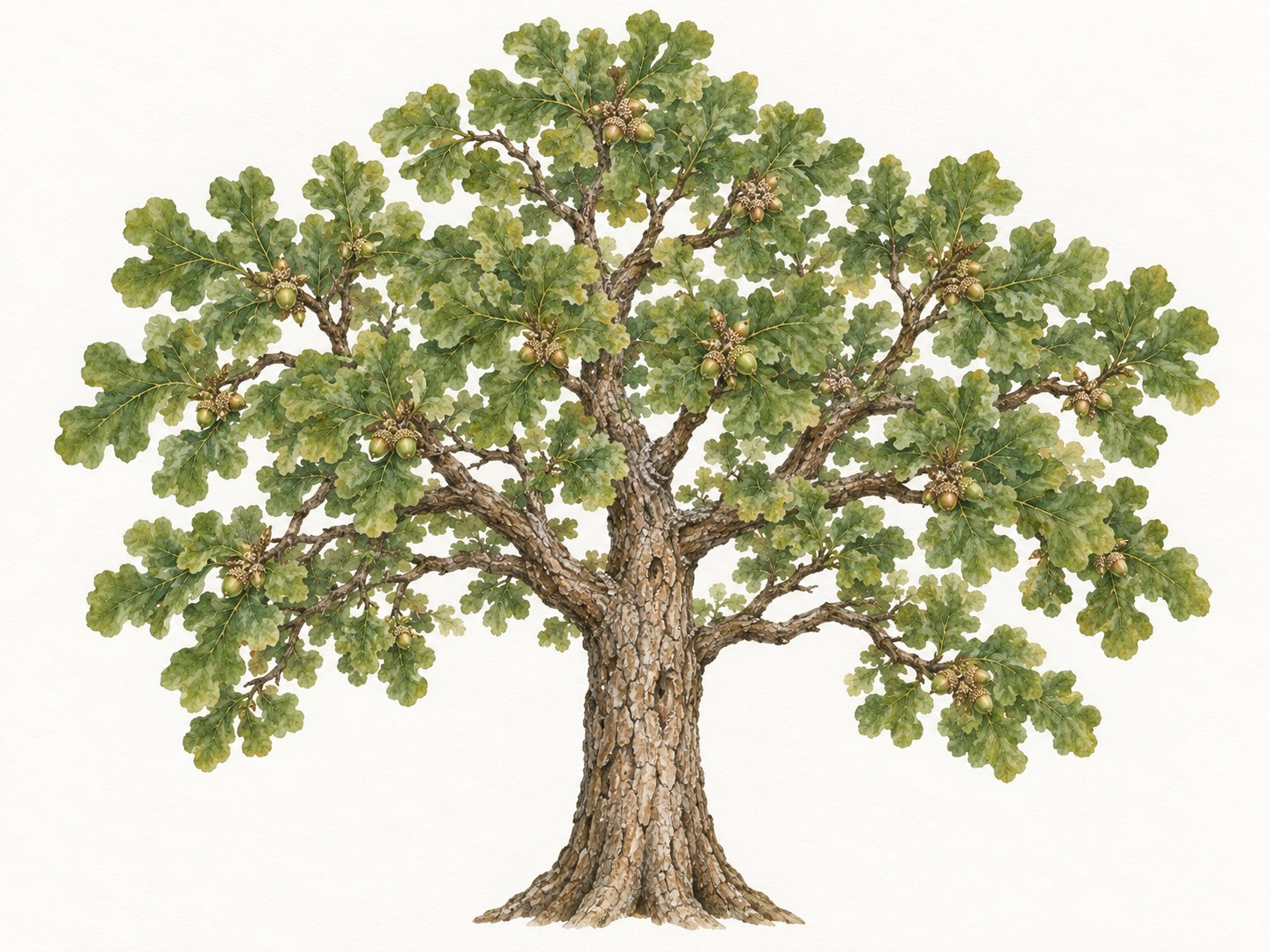
Thick, leathery, cross-shaped lobed leaves - the classic post oak silhouette; deciduous.[2]
Water
Very low once established - it is among the most drought tolerant oaks we have.[1]
Pruning
Low - it resents heavy pruning; remove deadwood in the coldest months and avoid oak-wilt-season cuts (February through June) or seal every wound.[2]
Seasonal behavior
A long-lived native that feeds wildlife with acorns and holds the uplands together; slow but nearly indestructible.[1]
When to Plant Post Oak
Plant Post Oak in fall or early spring in Central Texas.[1]
If you would like a hand, the Texas Allied Landscape team can plant your Post Oak and keep it thriving.
Planting
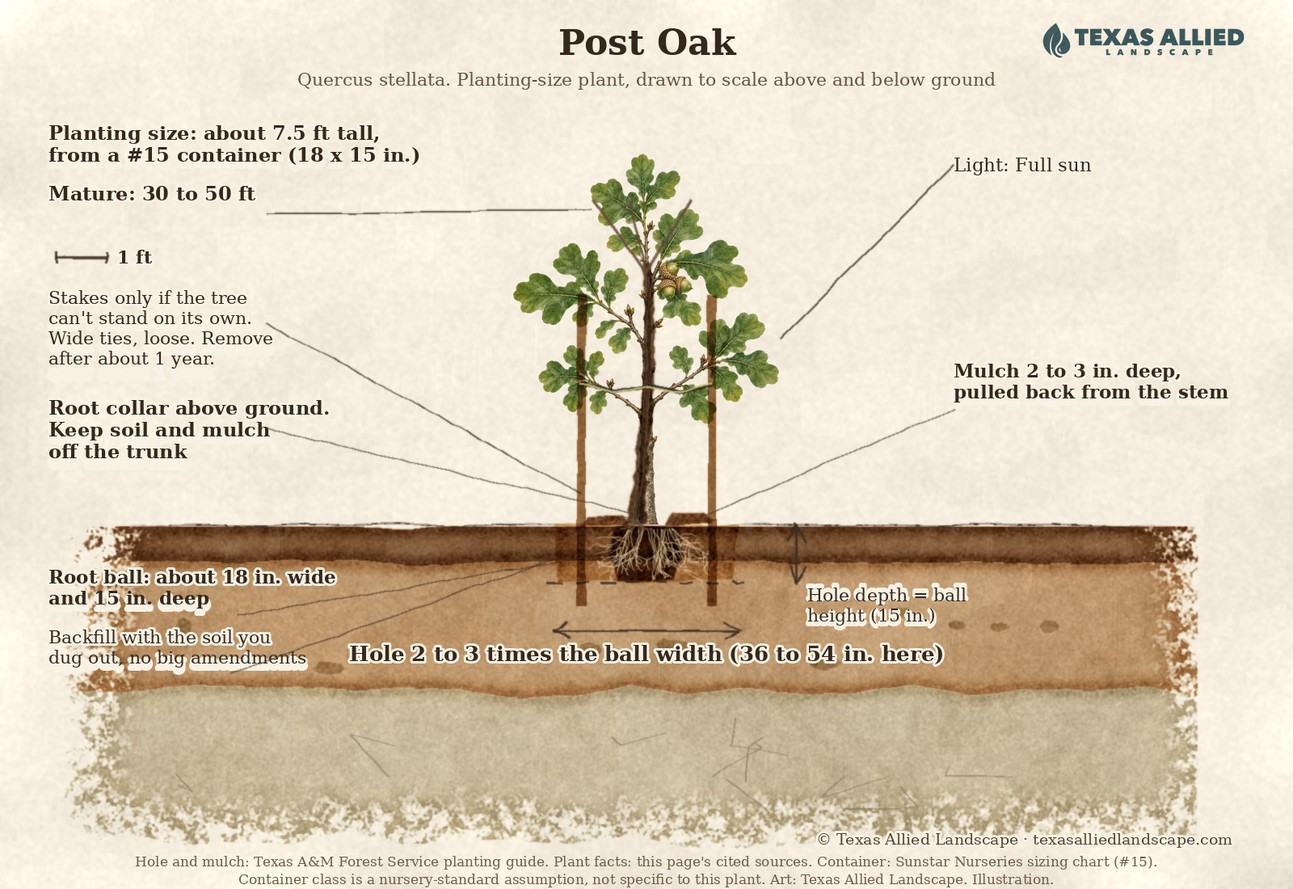
- Dig a hole at least twice as wide as the root ball and no deeper - a square hole keeps the roots from settling too deep while letting them grow out into the surrounding soil.[4]
- Fill the empty hole with water and check the drainage. If it takes longer than 24 hours to drain, choose another spot: roots sitting under water will kill the tree.[4]
- Set it with the root collar (the flare just above the roots) level with or slightly above the ground, and take off all wire, twine, containers and bags before backfilling.[4]
- Backfill with the same soil that came out of the hole, without amendments, and settle it with water rather than packing it down.[4]
- Site and soil: Plant group: Shade trees. Full sun.[1] Dry, rocky, sandy or thin upland soil - it is the tough oak of our poorest ground and hates soggy roots.[2]
- Timing: Plant Post Oak in fall or early spring in Central Texas.[1]
- Water for at least the first two years, without overwatering: a thorough soaking beats light, frequent watering.[4]
- Mulch 2 to 3 inches deep, out to the drip line and up to but not touching the trunk. Stake only if it cannot stand on its own and take stakes off within a year - most need no support. Do not fertilize during the first growing season.[4]
Care Instructions for Your Post Oak
Sunlight
Full sun.[1]
Soil and drainage
Dry, rocky, sandy or thin upland soil - it is the tough oak of our poorest ground and hates soggy roots.[2]
Mature height and spread
30-50 feet, slow growing.[3] 30-40 feet with a broad, rounded crown.[3]
Pruning
Low - it resents heavy pruning; remove deadwood in the coldest months and avoid oak-wilt-season cuts (February through June) or seal every wound.[2]
Normal seasonal behavior
A long-lived native that feeds wildlife with acorns and holds the uplands together; slow but nearly indestructible.[1]
Post oak questions
Is post oak a Texas native?
Yes - Quercus stellata is native across Texas and is one of the toughest oaks on dry upland ground.[5]
How fast does post oak grow?
Slowly - that is the trade for extreme drought tolerance and a lifespan measured in centuries.[6]
Can I prune post oak anytime?
No - like all oaks here, prune in the coldest months and seal cuts to avoid spreading oak wilt; avoid pruning February through June.[7]
Next step: Our horticulturalists prune oaks on the safe-season schedule and seal every cut.
Why is my post oak struggling in a watered lawn?
Too much water - post oaks evolved on dry, thin soils and often decline in irrigated, fertilized turf.[8]
Let Texas Allied Landscape care for your Post Oak
Post Oak does best with steady, knowledgeable care: the right water, pruning at the right time, and a trained eye for stress. The horticulturists at Texas Allied Landscape care for plants like yours across the San Antonio area, backed by over 40 years of landscape experience.
In these community guides
Sources
- Native Plant Society of Texas, "Quercus stellata."https://www.npsot.org/posts/native-plant/quercus-stellata/abcdefghi
- Texas A&M Forest Service, Texas Tree ID, "Post Oak."https://texastreeid.tfs.tamu.edu/content/pdf/Post_Oak.pdfabcdef
- Hermann Park Conservancy, "Post Oak."https://hermannpark.org/place/post-oak-quercus-stellata/abcd
- Planting, Texas A&M Forest Service.https://tfsweb.tamu.edu/trees/tree-care/planting/abcdef
- Native Plant Society of Texas, "Quercus stellata."https://www.npsot.org/posts/native-plant/quercus-stellata/↑
- Hermann Park Conservancy, "Post Oak."https://hermannpark.org/place/post-oak-quercus-stellata/↑
- Texas A&M Forest Service, Texas Tree ID, "Post Oak."https://texastreeid.tfs.tamu.edu/content/pdf/Post_Oak.pdf↑
- Texas A&M Forest Service, Texas Tree ID, "Post Oak."https://texastreeid.tfs.tamu.edu/content/pdf/Post_Oak.pdf↑